




Silver Vendor
- Messages
- 3,668
- Reactions
- 10,959
I'm passing along some information about possible rounds not going off in certain new S&W revolvers. I was unaware of such a problem, but an article over on revolverguy.com about the UC Ti revolvers brought it out.
Read here https://revolverguy.com/sw-432-ultimate-carry-ti-review/
The problem stems from short firing pins not reliably activating primers, as well as tolerance stacking from excessive headspace from the cylinder to the recoil shield area...I'll quote here;
Possible Ignition Reliability Causes
I am equipped with a theory regarding ignition reliability. First, the trigger on this revolver is very light. I tend to believe this gun is operating at the lower end of the reliability envelope, for the sake of a better trigger. While it will ignite American-made ammunition, the harder primers in South American (Magtech) and European (S&B) ammo challenge the light springs. Personally, I'd rather contend with an extra pound of trigger pull in exchange for reliable ignition. [Editor's Note: Noted Gunsmith Nelson Ford has described how the UC springs have a reduced diameter to reduce their energy]
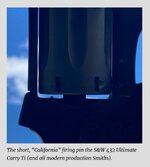
Second, the shortened firing pins on S&W revolvers probably have something to do with it, as well. These are informally known as "California firing pins," and have been put in S&W guns for decades to improve drop-safety. Now, so-called, "extended" firing pins from the likes of Apex and Cylinder & Slide are actually the original length. Replacing the OEM firing pin in the UC (or really any J-, K-, or L-Frame) revolver may result in an improvement in ignition reliability.
Finally, Smith & Wesson appears to have some headspacing issues with some revolvers. When coupled with the short firing pins, a multiplicative effect occurs that negatively impacts reliability.
I recommend extensively testing with ANY ammunition before depending on it. It would take far more ammunition than would be cost- or time-effective to restore my confidence in either of these specimen, or frankly, in this model generally." End quote.
I kinda have a dog in the fight, as I own High Desert Cartridge Company, and some have told me that some rounds are not going off, mainly the rounds loaded with CCI primers. The above might be the cause. I myself have not experienced such an event with my or any other ammo, but it is one thing to check before blaming the ammo...it just might be the gun.
Read here https://revolverguy.com/sw-432-ultimate-carry-ti-review/
The problem stems from short firing pins not reliably activating primers, as well as tolerance stacking from excessive headspace from the cylinder to the recoil shield area...I'll quote here;
Possible Ignition Reliability Causes
I am equipped with a theory regarding ignition reliability. First, the trigger on this revolver is very light. I tend to believe this gun is operating at the lower end of the reliability envelope, for the sake of a better trigger. While it will ignite American-made ammunition, the harder primers in South American (Magtech) and European (S&B) ammo challenge the light springs. Personally, I'd rather contend with an extra pound of trigger pull in exchange for reliable ignition. [Editor's Note: Noted Gunsmith Nelson Ford has described how the UC springs have a reduced diameter to reduce their energy]
Second, the shortened firing pins on S&W revolvers probably have something to do with it, as well. These are informally known as "California firing pins," and have been put in S&W guns for decades to improve drop-safety. Now, so-called, "extended" firing pins from the likes of Apex and Cylinder & Slide are actually the original length. Replacing the OEM firing pin in the UC (or really any J-, K-, or L-Frame) revolver may result in an improvement in ignition reliability.
Finally, Smith & Wesson appears to have some headspacing issues with some revolvers. When coupled with the short firing pins, a multiplicative effect occurs that negatively impacts reliability.
I recommend extensively testing with ANY ammunition before depending on it. It would take far more ammunition than would be cost- or time-effective to restore my confidence in either of these specimen, or frankly, in this model generally." End quote.
I kinda have a dog in the fight, as I own High Desert Cartridge Company, and some have told me that some rounds are not going off, mainly the rounds loaded with CCI primers. The above might be the cause. I myself have not experienced such an event with my or any other ammo, but it is one thing to check before blaming the ammo...it just might be the gun.