


JavaScript is disabled
Our website requires JavaScript to function properly. For a better experience, please enable JavaScript in your browser settings before proceeding.
Messages
19,601
Reactions
35,712
What is the cause of a stovepipe or failure to extract?

Generally speaking can stovepipes be caused by too strong recoil springs? Would a slightly lighter recoil spring fix the issue? Could it be a worn or weak extractor?
Specifically this...
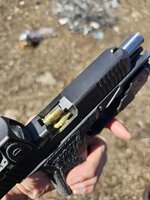
1720303293724.jpeg

details:
P80 PFC9, 115gn FMJ 9mm, 18lb recoil spring.
 
Looks to me it extracted, but didn't eject. One thought should all else seem right;
Don't know that particular gun but that can happen on a 1911 with a badly worn, chipped or broken ejector, (if extractor being OK)
in your case maybe a spring plunger type ejector, maybe broken / stuck? with patients, not a difficult replacement on a 1911 but again don't know yours.
 
Looks to me it extracted, but didn't eject. One thought should all else seem right;
Don't know that particular gun but that can happen on a 1911 with a badly worn, chipped or broken ejector, (if extractor being OK)
in your case maybe a spring plunger type ejector, maybe broken / stuck? with patients, not a difficult replacement on a 1911 but again don't know yours.
Its random occurrance, maybe once every 75-100rds. Otherwise runs fine. So I dont suspect the ejector... which is brand new on this build.
 
So it is possible that the slide is not recoiling enough to clear the spent case, but more likely it is your extractor is worn. That looks like a fairly modern pistol (a bit glocky, but I never keep track of all the clones that are out there), which means it likely has a blade style ejector. Unless that is worn down to a nub or missing entirely that is likely not the problem either. A worn extractor means that the ejector does not flip the cartridge out to the side, but knocks it more forwards into the action. Check to see if your extractor can hold onto a cartridge with no help. If it cannot it is probably too lose, thus leading to the ejection failures.

Of course this is all a guess. If you want a for-sure answer I would have to look at it and fiddle a little bit.
 
Try holding the pistol so that all the energy goes to moving the slide if the gun is bucking you're not holding on tight enough. Most likely if it's that random it's you not the gun or ammo.
 
Try holding the pistol so that all the energy goes to moving the slide if the gun is bucking you're not holding on tight enough. Most likely if it's that random it's you not the gun or ammo.
Ive thought about this and have made sure I grip the gun right and proper arm extension but maybe since its so random I occasionally neglect to pay attention to my grip? No idea how to test that, another virtually identical gun build runs fine but that doesn't mean another gun isnt more forgiving.
 
Ive thought about this and have made sure I grip the gun right and proper arm extension but maybe since its so random I occasionally neglect to pay attention to my grip? No idea how to test that, another virtually identical gun build runs fine but that doesn't mean another gun isnt more forgiving.
It's very common to relax a bit in a string of fire, one thing I watch for is if their elbows drop. Some people hold their breath as well and when they finally take a breath their body will relax. Generally guns work or they don't same with ammo. I see you are running an optic so that takes more energy to move over a stock slide. That's why most optic readys have slide cuts to lighten the slide to stock weight accounting for the optic.
 
It's very common to relax a bit in a string of fire, one thing I watch for is if their elbows drop. Some people hold their breath as well and when they finally take a breath their body will relax. Generally guns work or they don't same with ammo. I see you are running an optic so that takes more energy to move over a stock slide. That's why most optic readys have slide cuts to lighten the slide to stock weight accounting for the optic.
I will have to pay attention if I'm relaxing during strings of fire, especially after several magazines.
I always thought slide cutouts were for cosmetic "tacticool" looks only... I have wondered about the optic weight affecting this, but that supports my theory I need to move to a lighter recoil spring... ?
 
Its random occurrance, maybe once every 75-100rds. Otherwise runs fine. So I dont suspect the ejector... which is brand new on this build.
A most common cause of occasional FTE/stove pipes I have seen is limp wristing.

Probably not what you want to hear.
 
Last Edited:
If those are not reloads (if they were, need hotter charge… brass did not fully seal chamber… see soot on side), it is probably a combo of additional mass of RMR plus a spring weight that works well for 45acp, but is a little heavy for 115's. I would buy a 15 and 13lb spring and try those. You are not getting full lockback. Limp wristing a Glock will do the same thing.
 
If those are not reloads (if they were, need hotter charge… brass did not fully seal chamber… see soot on side), it is probably a combo of additional mass of RMR plus a spring weight that works well for 45acp, but is a little heavy for 115's. I would buy a 15 and 13lb spring and try those. You are not getting full lockback. Limp wristing a Glock will do the same thing.
These are factory new Remington UMC 115gn 9mm FMJ.
The current recoil spring is the recommended 18lb for this size gun but I have a Wolff spring kit and will try a 17 and 16lb reduced power recoil spring to account for the RMR weight.

I also wonder if using heavier bullets would eliminate the issue, would 124 or 147gn 9mm produce more consistent recoil?
 
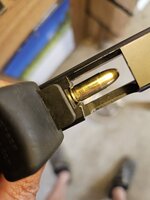
It holds. At least against gravity alone.
View attachment 1911645
Does it pass a shake test? What if you change orientation? The cartridge should be held decently tight in that position. If it just barely holds until you move it that is no good.

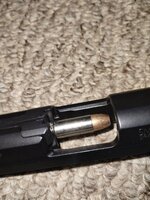
IMG_20240706_172925031.jpg

This one has a tight hold. I can toss it around and the cartridge will not fall out. It takes a decent smack to dislodge it.
 
Does it pass a shake test? What if you change orientation? The cartridge should be held decently tight in that position. If it just barely holds until you move it that is no good.

View attachment 1911690

This one has a tight hold. I can toss it around and the cartridge will not fall out. It takes a decent smack to dislodge it.
Orientation?
When I put it in position of full battery it holds tight. When I put it in position where it goes once the slide unlocks just before extraction it holds, but will eventually work itself out with enough shaking.
I think my extractor is good?

I think the issue is either me limp wristing occasionally or too heavy recoil spring rate.
 
Orientation?
When I put it in position of full battery it holds tight. When I put it in position where it goes once the slide unlocks just before extraction it holds, but will eventually work itself out with enough shaking.
I think my extractor is good?

I think the issue is either me limp wristing occasionally or too heavy recoil spring rate.
I can toss mine around like a baton and it will hold onto the cartridge. Only a good smack will dislodge it. It does not have to be that tight to work right, but it does need to be tight enough to hold onto the shell until the ejector peels it off. From the rest of the comments I think I agree that it is limp wristing, if it works well for the first half dozen mags in a string and only fails on the later ones it probably is not anything mechanical with the gun. If you got a random failure occasionally at the start of the string (and you are sure you were not being lazy/fatigued) then maybe look at the spring. But really it is almost never the spring, as most guns will run totally fine even with an overly heavy spring so long as the bolt travels far enough back to pick up a new round and the ejector is long enough. Your image showed a stove pipe with a new round picked up. It should have cleared that case, unless a limp wrist let the gun keep up with the fling and eat it again (assuming all the other mechanicals are working right, which seems to be true).

This does bring me to the last possibility I can think of for a mechanical issue. If you have a strong spring/short ejector combo that is juuuust right it may cause reliability issues on a weakish grip that might not be a true "limp wrist." Figuring out if your slide just barely grabs a new cartridge is hard to do without a decent camera, but checking where your ejector is assuming you gun does that is much easier. A blade type ejector really should come out over the back of a new cartridge by an eighth of an inch or so, or the entire length of the rebated rim up to the start of the case wall. If you do not have that much ejector you may be getting weak ejection, which would make the gun's tolerance for limp wristing much worse.

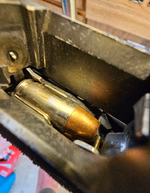
IMG_20240706_192247887.jpg

You can see how far my ejector sticks out over the back of the next cartridge. If you have less than that you may have a more finicky gun when it comes to grip strength.
 
I can toss mine around like a baton and it will hold onto the cartridge. Only a good smack will dislodge it.
The position most people put the sample round in for this test is much different than the position the round is in when its being contacted by the ejector. This makes a difference in the test.
This does bring me to the last possibility I can think of for a mechanical issue. If you have a strong spring/short ejector combo that is juuuust right it may cause reliability issues on a weakish grip that might not be a true "limp wrist."
My ejector is new, Im intentionally running a gen5 ejector in my gen3 architecture (yes this works and not the issue), not only does it protrude well over the case but the Gen5 tip is bigger to engage the round.
But your reply makes me wonder if the issue is actually a slight combination of fatigue (ie, limpwristing) -and- a slightly heavy recoil spring, which is why the issue is so intermittently random.
I have a Wolff spring kit where I can test in 1lb increments. The standard is 18lbs for this size 9mm. I should try a 17 or 16lb next range session?


Gen5 ejector
1720320219947.png
 
The position most people put the sample round in for this test is much different than the position the round is in when its being contacted by the ejector. This makes a difference in the test.

My ejector is new, Im intentionally running a gen5 ejector in my gen3 architecture (yes this works and not the issue), not only does it protrude well over the case but the Gen5 tip is bigger to engage the round.
But your reply makes me wonder if the issue is actually a slight combination of fatigue (ie, limpwristing) -and- a slightly heavy recoil spring, which is why the issue is so intermittently random.
I have a Wolff spring kit where I can test in 1lb increments. The standard is 18lbs for this size 9mm. I should try a 17 or 16lb next range session?


Gen5 ejector
View attachment 1911729
Yep that does look like a good long ejector. I am not sure the weaker spring is going to help you as by the time the bolt face gets back far enough to pick up the new round the old case should be long gone. Pretty sure your problem is getting little girl wrists after popping a few too many down range. At this point I am going to need a good high speed camera if you want to convince me otherwise :s0140:
 

Upcoming Events

New Classified Ads

Back Top