


JavaScript is disabled
Our website requires JavaScript to function properly. For a better experience, please enable JavaScript in your browser settings before proceeding.
So I've been researching for the last month,and boy is a lot of this confusing.im hoping once I start doing it it will all make more since.but I was wondering if a hornaday lock and load app would be to much for a beginner.i was also looking at a turret press as well.ill mostly be reloading 223,9mm,380 and 45 acp with once fired brass.so if anyone can give me a good recommendation or advice,maybe tools that I'll need that might not be mentioned right away.thanks for the help guys.

In 1980 I was asking the same thing as you. I knew no one that reloaded rifle or pistol ammo and only a few that did shotgun ammo. I bought a book called "The ABCs of Reloading" and read it cover to cover. It's still in print in newer versions but with the same title. I still use it as a reference. It's a good place to start.
 
I'm a pretty cautious guy,and my dad really drove safety is number one into me.when I told him I was going to be reloading his first words were safety glasses.but I actually read the post about 3 times and am kinda nervous about losing a finger
Eye would be my biggest concern. Closest I came to losing a finger was putting the case in with the left hand and running the ram home with the right. Finger got stuck, and I got a nice, round hole punched into my finger tip. It was nasty, took 3 weeks to heal.

Also I'm probably
Going to buy some good brand name bullets to start with,just plinking stuff.but would keeping one and using it as comparison for the same type of bullet but different manufacturer be a good way to compare to keep from putting the bullet in the brass to far
For SAAMI spec chambers (which all guns should have), if you build a round with the same bullet and powder, to manufacturer's load specs, you'll be all right. Once you have experience behind you, and more equipment to measure & test, you can deviate and experiment.
Just what from I under stand for the oal is if I had the same type of bullet but different manufactures I could put one in to far but still have the same oal correct?
There are many different bullet designs. For example, on a 308 Winchester, you can buy bullets that are PSP (pointed soft point), Spitzer, Spire Point, Round Nose, Hollow Point, etc. Each of these have a very different bullet shape and curvature extending from the nose to the base.
Typical COAL (Case Over All Length) specified on a 308 round is 2.800". I have Round Nose and PSP bullets bullets, that if I load to 2.800 OAL, will not fit in my chamber.
A bullet stuck too far in the brass, seated against the powder, is not as problematic as a bullet that is loaded out, pressing all the way to the lands and the case is too full of powder. Why? It doesn't take that much pressure to push a bullet in or out of a case. It's when the bullet is forced into the rifling that the pressure really builds. That's also when powder burn rates have a significant effect. Load a rifle case (much slower powder) with pistol powder (very fast), and you are just as likely to have a detonation as you fire the bullet.
When you get into experimenting with different bullets and offset from the lands, you will need to have B2O (base to ogive) measurement tools, and it's always good to have a modified case gauge to measure the minimum setback for your specific bullets.

DOH..
I was thinking something different. Checking primer seating yes. 100%.. For some dumbass reason I was thinking overall size for fitting in chamber NOT the primer seating.

Edited post above to reflect my misunderstanding. My assumption was in the reading that a chamber in a pistol will have the case flush/below the flat surface. The post was to show that cases don't do that.. BUT... primers are flush.
Ughhh.. Crow anyone? I'm hungry.
You can have flush primers but they are not seated all the way in. I recently had some Fail to Fires, where the firing pin struck the primer but only pushed the primer in all the way. They had been flush.
 
So I've been researching for the last month,and boy is a lot of this confusing.im hoping once I start doing it it will all make more since.but I was wondering if a hornaday lock and load app would be to much for a beginner.i was also looking at a turret press as well.ill mostly be reloading 223,9mm,380 and 45 acp with once fired brass.so if anyone can give me a good recommendation or advice,maybe tools that I'll need that might not be mentioned right away.thanks for the help guys.
Hornady Lock-N-Load AP looks like a nice piece of kit.
Not the full-blown Ammo Plant, just the basic progressive.
In the videos, it looks like it runs smooth with that 1/2 and 1/2 index feature.
 
This thread is filled with great advice, thanks to all who contributed and shared their knowledge and experience. I've got to set aside some time to get through the entire thread, but getting into reloading has been a goal of mine that this thread is helping push me to make happen.
 
This thread is filled with great advice, thanks to all who contributed and shared their knowledge and experience. I've got to set aside some time to get through the entire thread, but getting into reloading has been a goal of mine that this thread is helping push me to make happen.

Reloading is something I think everyone who is serious about owning and shooting guns should do, it gives you a new appreciation for what you're doing.
 
Well I have everything I need to start making some .45acp.i think I have a good enough understanding to hopefully make some safe ammo.goong to work on setting up my shop tomorrow and getting some brass all cleaned and ready and hopefully kick out a few test rounds.will report back tomorrow evening with results.
 
Well I have everything I need to start making some .45acp.i think I have a good enough understanding to hopefully make some safe ammo.goong to work on setting up my shop tomorrow and getting some brass all cleaned and ready and hopefully kick out a few test rounds.will report back tomorrow evening with results.

Awesome :D
 
Here is the very best advice!!
Personally, if you have never reloaded before, I would look around for a decent single stage press and start there to get the basics and "feel" for reloading. There is a lot going on with a progressive, and I think having the basics down pat before moving to a progressive lowered the learning curve, and like I said, the single stage I still use.. I think most guys probably own both from what I have observed
 
Besides double charging any other big things to watch out for that could end really bad,those thoughts are in the back of my head
Your double charge and a squib during testing that sticks in the barrel are the most common things that end bad. Just be double sure of your recepie and your charge and that you don't seat your projectile ridiculously deep. When you get to testing fire a few factory loads first as a baseline so you can compare accuracy and felt recoil/function.

Also...if you're the nervous type take a towel to pat your forehead. Pulling the trigger the first time on your own loads can be a rush.
 
Besides double charging any other big things to watch out for that could end really bad,those thoughts are in the back of my head

Your data for TG is pretty conservative which is good. I've used 5gn behind a 230 gn RN before, pretty stout load but a lot of people shoot it. I like 4.5gn w/230, 5.0 gn w/a 200 LSWC or coated. I mostly shoot 200 gn out of a 45 anymore. My OAL is 1.25" usually, you're load data shows 1.20". I like to run them as long as will fit in the magazine and chamber, gives you a little more cushion with pressure. Since you're doing 45 auto take the barrel out of your gun and use it as a chamber gauge, do the 'plunk' test. Drop them in, if they fully chamber it'll make a 'plunk' sound (maybe not really but that's what it's called). If they're sticky, back off the length a bit. You don't need to crimp them much, .471" or so, just enough to get a good grip on the bullet. Too much crimp will also raise pressure, especially w/a low pressure round like the 45 auto. Go slow until you get a good rhythm down, it's easy to get addled when you're new at it. Don't overthink things too much, it ain't rocket science, but can kill you so do be careful. Make sure you're bench is clean and organized and you have a place for everything. When you're rolling along you don't want to have to clean up a mess or look for things before you can get going again. Just me but I wouldn't drink while loading, alcohol or anything for that matter. I always put my coffee cup away from the bench, you definitely don't want a spill around your gear and supplies. It's a good idea to have primers and powder away from the bench also, preferably in a cabinet. Clearly mark everything. Take notes. Have good, no, make that excellent lighting.

Let us know how they shoot!!
 
Last Edited:
And when you test fire, just load 1-2 in the mag. If the rounds are too weak, the slide won't be held back on the last shot.
Also, note where that brass went.. you want to inspect the fired case, paying particular attention to the primer..
your reloading manual should tell you what all to look for.
And jack a few cases out of the chamber and measure oal to see if there's any setback.
 
So I realized I haven't read much about crimping,I've looked thru the books and I feel like I'm missing something or not reading it right.it just says how to get a light or heavy crimp,I don't see any info on the loading data either.so how do I figure out what kind of crimp I need,where to put it and if I did it right?
 
So I realized I haven't read much about crimping,I've looked thru the books and I feel like I'm missing something or not reading it right.it just says how to get a light or heavy crimp,I don't see any info on the loading data either.so how do I figure out what kind of crimp I need,where to put it and if I did it right?

For .45 or 9mm a moderate crimp is all that's needed. take a caliper to the range, load two rounds, fire one, then measure the other, if it changes you need a heavier crimp. Basically the more powerful the round is the more crimp you need. For a semi auto just crimp wherever the bullet ends up for the OAL you want. Some bullets have actual crimp grooves, but it's rare for a semi auto bullet too. Mostly this is because semi auto rounds are taper crimped rather than roll crimped.

Forgot to add, if a round is under a lot of stress it should be heavily crimped as well, like for a lever action.
 
Last Edited:
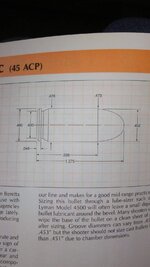
On the cartridge drawing there is a measurement at the mouth of the case. In this case it is .473 for 45 auto. After you crimp measure the case mouth with calipers. .45 auto usually crimps between .473 to .470. That is about where you want to be so the case mouth headspaces in the chamber properly.
20170214_201947.jpg
 
Thanks guys,I feel a lot more confident about that now.i feel like a lot of it will come once I have things set up and I front of me.

It's a lot to deal with at first, but it will all come together and get easier as you get some practice. You're going about it the right way though, and being extra cautious.
 
It's a lot to deal with at first, but it will all come together and get easier as you get some practice. You're going about it the right way though, and being extra cautious.

Yea somewhere someone mention bringing towel to wipe my head of if I'm the nervous type,well I'm gonna bring 2.
 

Upcoming Events

New Classified Ads

Back Top