


JavaScript is disabled
Our website requires JavaScript to function properly. For a better experience, please enable JavaScript in your browser settings before proceeding.
Yea, squibs are not good.
When you get your reloading manuals, read and understand the steps and procedures and why you are doing them.
It's not complicated though.
Make sure that your loads are as specified in the manuals.
You do this by visual inspection/verification and a micrometer, scales, etc..
Also, make sure your primers are seated below flush by standing them up on a flat surface.. they should sit flat and not wobble.
A "proud" primer could result in a slamfire or tie up a revolver, or both. not good
Also, make sure your loads are physically strong enough to be safe. Try to push the bullet into the case with your thumbs and then leaning into it, pushing it against the bench or whatever.. it shouldn't move. If a bullet gets jammed back into the case while feeding it will increase pressure such that the gun could well fail catastrophically.
For revolvers, they will try to walk out and tie up the gun.. there should be sufficient crimp to prevent this.
There is a reason for every step in the loading process, just make sure you understand them and why you are doing them.
 
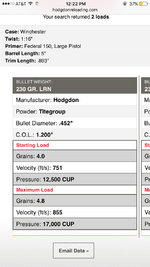
I noticed the hp-38 would work for all the rounds as well,and it has a slower burning rate according to that chart,would that mean it would have less of a snappy recoil?
You are finding out that re-loading is more of a science than just a hobby :).
HP-38 is a powder I use a lot for pistol and started when I couldn't find some other go to powders.
W-231 is the same as HP-38, made by Hodgdon, under the Winchester name.
Set your sights on pistol reloading data | Hodgdon Reloading
Recently started using it for 45ACP in a resolver and it seems sooty in that application.
Powder is like motor oil/tumbling media, everyone has a different favorite, and will defend their choice...forever :confused:.
:D
 
Last Edited:
When you put your reloads thru the case gauge, you can check primer seating visually and by running your finger across the bottom of the shell. If you are using a barrel as a case gauge, it works the same. :)
 
Edit:
In my reading I was confusing a post with another. The below information while accurate was taken out of context by me.
...

Referring to primer seating: yes
I was thinking of sizing for proper fitment into a chamber, hence the confusion.
When you put your reloads thru the case gauge, you can check primer seating visually and by running your finger across the bottom of the shell. If you are using a barrel as a case gauge, it works the same. :)
Not always on the barrel but always in case gauge block.

Some may be fully supported but they "look different" than others.

Key to me on barrel fitting check is that if you tap it with your thumb it will still fall right out. Any loaded case pressed into a chamber should fall out on its own when tipped upside down.

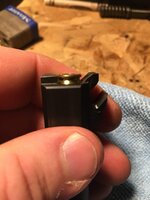
XD 9mm below
IMG_2179.JPG

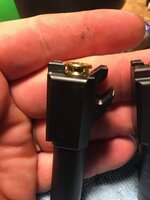
.40 XD:
image.jpg
 
Last Edited:
Anyone around grants pass/Medford area know a good shop for reloading supplies that usually keeps a full stock,stopped at sportsmans warehouse and everything was pretty picked thru already
 
Before you go out and spend a lot of money on a press, I'd try to find a friend that reloads and give their press a try. After trying several, I settled on a Dillon 650 as my first press. Many people say to start on a single stage (my second press for other reasons), but the quantity of rounds I needed to do monthly pushed me towards the Dillon. Secondly, 90% of the people I shoot with monthly have Dillons and a vast majority of USPSA shooters use Dillons.

I shoot about 1000 to 1200 pistol rounds per month and load about 2000 5.56 rounds per year, so a progressive press made sense. My rifle rounds are for 3Gun and plinking, so I need quantity not super quality. The 5.56 rounds can still hit a 12 gong at 250 yards...good enough. Dillon has a very good warranty and I'm yet to pay for any spare parts. If something breaks, I call them and they send out a replacement.
 
One other thing. Bimart never really seems to have what I need. I'm always checking Midway and Powder Valley for powder and primers. Just this week Midway had a no hazmat fee sale on CCI primers. Powder Valley used to waive hazmat or had really good sales, if you want to buy 20lbs of powder. I went in with other people at work and had 45lbs of powder and 20,000 primers shipped to work. The cost came out cheaper than we could get anywhere else.

On thing to keep in mind the press in only the down payment in this hobby. Next, you'll need an automatic case feeder, a bunch more primer filler tubes, a 100 hole case gauge for each caliber, a powder trickler to make up test loads, a good beam scale, a good electronic scale for speed, check weights, a chrono to test loads and storage for 20,000 bullets when you find them on sale at 30% off. I then needed to build a workbench to mount the press and store all of my supplies. With 20,000 bullets holding the workbench down, it doesn't move.
 
Finding small pistol primers is tough in Southern Oregon. Some powders like Win231 or Win296 are both hard too find. I used to make a tour- Blackbird, Sportsman, etc until I visited GunsRUs in South Medford. All the " tough-to-find" powders they have had.
 
Not always on the barrel but always in case gauge block.

Some may be fully supported but they "look different" than others.

Key to me on barrel fitting check is that if you tap it with your thumb it will still fall right out. Any loaded case pressed into a chamber should fall out on its own when tipped upside down.

XD 9mm below
View attachment 342739

.40 XD:
View attachment 342740


???? You can still check primer seating in either setting as long as the barrel is not in the firearm at the time. (We didn't mention it should be removed first?) The bottom of the shell is always visible and available to feel.

But IMO your point about the shell falling out is excellent. This is best. But I have had some lead RN loaded shells with wax on them that wouldn't fall out, yet function fine in the weapon.
 
???? You can still check primer seating in either setting as long as the barrel is not in the firearm at the time. (We didn't mention it should be removed first?) The bottom of the shell is always visible and available to feel.......
DOH..
I was thinking something different. Checking primer seating yes. 100%.. For some dumbass reason I was thinking overall size for fitting in chamber NOT the primer seating.

Edited post above to reflect my misunderstanding. My assumption was in the reading that a chamber in a pistol will have the case flush/below the flat surface. The post was to show that cases don't do that.. BUT... primers are flush.

Ughhh.. Crow anyone? I'm hungry.
 
DOH..
I was thinking something different. Checking primer seating yes. 100%.. For some dumbass reason I was thinking overall size for fitting in chamber NOT the primer seating.

Edited post above to reflect my misunderstanding. My assumption was in the reading that a chamber in a pistol will have the case flush/below the flat surface. The post was to show that cases don't do that.. BUT... primers are flush.

Ughhh.. Crow anyone? I'm hungry.

No prob!! You make a good point. :)
 

Upcoming Events

New Classified Ads

Back Top