


JavaScript is disabled
Our website requires JavaScript to function properly. For a better experience, please enable JavaScript in your browser settings before proceeding.
I have a copy of a written opinion by Asst Atty General Christine Gregoire stating that a loaded handgun does not have to be on the body while in a motor vehicle, provided that you possess a valid Washington CPL. This has been discussed many times and has been upheld when challenged. The wording in the statute is really quite simple and clear English.
 
Post the opinion, please. Also, the statute is nothing but confusing. Normal people don't use language like this.
Its really not going to be useful. What a Governor said decades ago is going to mean nothing if some LEO wants to cite you. Showing this to them would mean nothing. The one post here was cut directly from the WA site that tells you how to get a CPL and how they work here. In RARE instances someone runs into an LEO who does not like the common folk to have a gun and or the LEO has little clue how the law works. If one decides to cite you the way to handle it is stay calm, take the citation, go to court. What too many do is get loud, try to hold court on the side of the road and this NEVER makes things better.
 
Is it legal to drive with a loaded handgun in the vehicle if the handgun is not directly on my person.
My car has racing seats and I like to slip the gun/holster in between the console and seat while I'm driving since it would be incredibly uncomfortable to sit in the seats while still wearing it.
This is in Washington and I have a current CPL
Just carry the gun how you want. Don't tell anyone, and no one will be the wiser. If a cop pulls you over, how would he know you have a gun unless you tell him or he sees it?
 
Last Edited:
Just carry the gun. Don't tell anyone, and no one will be the wiser. If a cop pulls you over, how would he know you have a gun unless you tell him or he sees it?
This is one of the problems with taking advice off the net for things like this. In this state if any LEO runs your name they can see you have a CPL. If they run your tags and you are the owner they can see it. Only interactions I have had in decades were a couple break downs waiting for AAA. Both time I had my CPL in hand with my ID and it was waved off. Suspect they already knew who I was. So if stopped and carrying I do not recommend leading the conversation with "I have a gun". If they ask? Tell them and see what they want you to do and of course do NOT put your hands anywhere near it as many seem to want to do for some reason I have never understood.
 
Unable to post the AGs opinion letter as I do not have an electronic copy. I obtained the written opinion from Dave Workman many years ago. The language in the statute regarding handguns in vehicles has not changed since then.
 
When interacting with law enforcement...
It is best to keep it to the Three C's.
Clearly...
Completely...
Concisely....

Keep your answers / statements short and too the point.

Also worth considering :
What you said :
"Officer , I have a CPL and a gun"
What the officer might have heard :
" I have a gun"
Two similar , but different statements , that depending on inflection , emphasis , or the bias of the listener....
Can mean many different things to those hearing them.
Often the mind will see and hear what it expects to be there...and not what is actually there.

Andy
 
When interacting with law enforcement...
It is best to keep it to the Three C's.
Clearly...
Completely...
Concisely....

Keep your answers / statements short and too the point.

Also worth considering :
What you said :
"Officer , I have a CPL and a gun"
What the officer might have heard :
" I have a gun"
Two similar , but different statements , that depending on inflection , emphasis , or the bias of the listener....
Can mean many different things to those hearing them.
Often the mind will see and hear what it expects to be there...and not what is actually there.

Andy
Make sure to reach for your Wallet swiftly and with purpose, to let the officer know you're extra ready to comply with his request to see credentials.
 
Post the opinion, please. Also, the statute is nothing but confusing. Normal people don't use language like this.

Does it cite any cases?
No cases cited. It was a clarification of the statute's language per the AGs office. It comes down to this: A, B or C. All 3 stand alone. It's pretty clear language. Maybe Dave Workman could respond to this, if someone can reach him. I've seen a post or two from him on this forum.
 
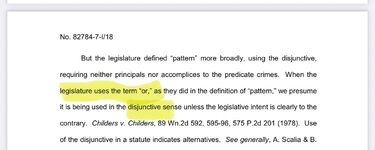
If the words of a late U.S. Supreme Court justice aren't good enough, see State v. Gordon, No. 82784-7-1 (February 13, 2023)(unpublished) at pages 21-22.
The book you cite is a good resource for law students, I'll give you that. In the Gordon case you cite I can't find anything that will help us interpret the RCW the OP is asking about. An opinion by the State's top legal officer, albeit from 20+ years ago, could be more helpful. Not a complete "get out of jail free" card but something potentially more relevant and tangible. I will ask the AG's office to dig it up via a FOIA request.
 
The book you cite is a good resource for law students, I'll give you that. In the Gordon case you cite I can't find anything that will help us interpret the RCW the OP is asking about. An opinion by the State's top legal officer, albeit from 20+ years ago, could be more helpful. Not a complete "get out of jail free" card but something potentially more relevant and tangible. I will ask the AG's office to dig it up via a FOIA request.
Let me make this easy. When the Legislature lists a series of options, or menu choices, separated by commas, and there is an "or" before the last menu option, then the statute is disjunctive. (Unless the obvious intention is otherwise). That means that any one of menu items by itself is acceptable.

In the loaded-pistol-in-vehicle statute there is a list of situations, separated by commas, and an "or" before the last menu item. That means that any of the menu items by itself is acceptable.


IMG_2397.jpeg
 
Let me make this easy. When the Legislature lists a series of options, or menu choices, separated by commas, and there is an "or" before the last menu option, then the statute is disjunctive. (Unless the obvious intention is otherwise). That means that any one of menu items by itself is acceptable.

In the loaded-pistol-in-vehicle statute there is a list of situations, separated by commas, and an "or" before the last menu item. That means that any of the menu items by itself is acceptable.


View attachment 2121566
Ok, thank you for the upload. You can see that it takes the Washington State Supreme Court to intepret the statute construction. So again, prime evidence that this is difficult for lay people, police and lower lever courts, certainly for Gordon's lawyers to make sense of.
I will wager you that most police officers are not trained on such intricacies of the law and language and if they are quickly glancing through their law book on the side of the road deciding whether to jam you up, it could be helpful to have the AG's memo. Not a sure thing if someone is determined to violate your rights, but it will make it harder for them to claim ignorance of the law later.
 

Upcoming Events

New Classified Ads

Back Top