Join the #1 community for gun owners of the Northwest
We believe the 2nd Amendment is best defended through grass-roots organization, education, and advocacy centered around individual gun owners. It is our mission to encourage, organize, and support these efforts throughout Oregon, Washington, Idaho, Montana, and Wyoming.
Waist/Hip height has been ideal for me. The kids are a little older now- they like to help from time to time. An anti-fatigue mat does wonders for extended sessions.
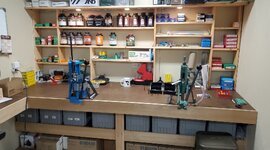
After several setups over many years I have (for my stature to stand up) a 42" height for my loading presses ( Both single stage) 4" thick X 30" X 12" solid wood slab on a stand with shelves for dies and trays etc. and bolted to the wall.
A 31" high Formica topped bench for all else (while sitting in a captains chair on wheels) the bench is 6 foot x 24" and open in the center for my feet & legs with drawers on each end like a large office desk (with the addition of a portable table top stand 13" high for my scale to be at eyes height with out bending over) The top is 1 1/2" thick so I have easy access to clamp some things, as needed, like shell trimmer, Powder measure, little arbor press or even my rifle and gun stand when cleaning. Things I don't want sliding around while using but can easily unclamp and store away when not needed.
To the left is my computer So I can access zip drives for Jack first, Numrich, Brownells and others drawings and parts list, plus internet access, not to mention my own documents for loading and repair info. To the right are book shelves with reference and loading materials which is why I find the chair on wheels handy for both the former and the latter.
I am lucky to have a dedicated space available. A good portion of my life I did not, sometimes wrestling with my wife for kitchen table time and space. . most important is a solid, preferably bolted to the wall press location, But even lack of that shouldn't stop anyone and why I spent many early years using a Lee hand loader till space and life picked up, the rest can be as simple or complex as money, time and life can provide.
A long time ago, when I was taught the basics of reloading, it was done from the standing position. Since then, I've tried a sitting set-up, it didn't work for me. I found that sitting limited my range of motion too much. There was more trunk-twisting involved, rather than total body movement. It was just too limiting for me. I quickly reverted to doing everything standing. So this factor right here is what determines my bench working height.
I have two benches. I call them, "the clean bench and the dirty bench." The clean bench is where reloading tasks are undertaken, along with watch repair and what seems like an unlimited number of other jobs that want cleanliness. The dirty bench I built in the 1970's out of pretty substantial timber and that's where I do rougher work. Back when I repaired vehicle starter motors, generators, alternators, front suspension parts, etc., it was all done there. Anything that needs hand sawing or filing gets done there. Anything that wants power sawing gets done outside. My table saw is on wheels and miter saws can be moved around easily.
Stability is a key concept to keep in mind for a reloading set-up.
The anti-fatigue mats for standing work have been mentioned above; good advice. I've got them for the bench where I do reloading. My other bench has carpeting in front. Which is worth mentioning for old people. There has been a trend for many years now toward hard flooring in homes. As an old person, I appreciate carpet in the rooms I spend most of my time in. Carpet is easier on the feet and if you have a fall, there is a bit of cushioning effect. It also adds a bit of insulation on upper floors or those with air space under them.
Carpet is not advised for areas where you are doing reloading. This is due to potential loose powder accumulation and corresponding fire hazard. For this same reason, cleanliness in reloading work areas is a good idea.
My current, and longest set up, worked well for my 6'2" height.
My reloading bench is 41" high but I dont recall how I got that number. I think I did a 40" high frame and then the tops are ~1" thick. I dont do a lot in a true standing position, I have a couple of stools that are 30" high and I am usually sitting on/against one and puts the top about 2" below my elbow. This is where all of my presses, prep center, trimmer and swagger are set up.
With that said, my main work bench 48" high and is 48" wide and 96" long. It is build around full sheets of 3/4" HD particle board. There are 3 levels with a bottom shelf and middle shelf for storage and top for work bench. This works well for things I want to where it is close to eye level. My other "work" area for general stuff is regular kitchen base cabinets that are set on a 2x4 frame to give it an extra 3.5" of height. While is a general bench, it is where my vibratory tumbler is a where I do a lot of brass sorting.
The main point is that depending on exactly what you are doing, you may need/want different heights. What works well for your press(s) may not work well for other operations.
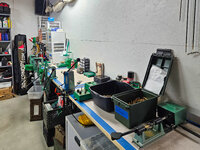
Here is what my main reloading bench looks like today as I am trimming some brass.
It's true what others have said, your height is a key factor, also the height of your elbows, (even at the same height some people have more "leg length", some have more "torso length".
If the bench is too high, you're forced to lift your shoulders/upper arms, and that's fatiguing.
If it's too short you're always bending at the waist.
I find a bench top that's a few inches below my elbows works, but that's pretty high for an RCBS, pushing down on the lever is no big deal, it's the lifting up that gets tiring.
A Dillon press and an RCBS single stage want different mounting heights.
You can always cut-down or add-to the legs on a bar stool.
A beam scale wants to be somewhere around eye level, an electronic one can be lower.
Standing is more useful for "moving around" work, where you're using multiple tools.
Sitting is more useful for repetitive motion, like cranking a case trimmer endlessly.
The old "furniture" standards of counter heights at ~36" were designed for a 5'4" to 5'9" person to be able to wash dishes in a sink, (that's not like reloading).
Mine are kitchen counter height and my 550 with the stand is just right. My RCBS single stage is a couple inches higher than the counter top and would be better higher, same for the Square Deal. Higher is better for me.
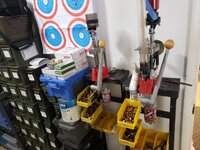
I welded up a receiver hitch that bolts to the front, center leg of my table. I slide in whichever press, trimmer, vice whatever I want. Each attachement is on a sq. tube riser, 1/4" wall and threaded 1/2" - 20 tpi. I run a bolt in one side and snug it up real quick and there's no wobble. I found that I like most press operations much higher than table height. Under the table I bolted short, thin wall mini receivers that I can slide each press in when I'm not using them.
BTW, I'm standing on an anti fatigue mat doing my all my press stuff.
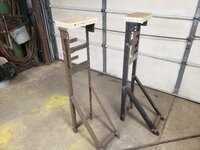
I reload standing. These are easy to move. I built five. You must use two hands. I run a three hole turret, and four progressives. I do most priming on the press. I simply don't have a place for a solid mounted bench.
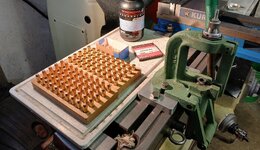
I only load maybe a couple times a year. Set up for a week or so. Doesn't justify a dedicated bench, so I mount the press on the mill table. Rock solid, and adjustable for height. Bench opposite of mill (not shown), for the measure, trimmer etc. Otherwise, stored out of the way in a lockable cabinet.
I only load maybe a couple times a year. Set up for a week or so. Doesn't justify a dedicated bench, so I mount the press on the mill table. Rock solid, and adjustable for height. Bench opposite of mill (not shown), for the measure, trimmer etc. Otherwise, stored out of the way in a lockable cabinet.
A general rule regarding work bench height is that ideally one has different work bench heights available for different tasks. That is to say for example, for fine coordination demanding tasks such as assembly of small parts an ideal bench height would be on the higher side. Conversely if you have a need where you are going to be needing to apply a lot of force then a lower work surface would be more advantageous. I am blessed with a good sized garage and the fellow that built the place left a hella stout work bench where I have my drill press and vise. It's on the lower side and is just right for when I need to whack on something. I have an 8 foot long 42 " high reloading bench as I mentioned above which is just right. I have a foldable table and an adjustable office chair for desk work tasks. I have all heights covered.
If a person does not have the space for multiple height options and perhaps can only make one choice, then choose a taller work height when it comes to reloading. That gives you the sit & stand flexibility. At my last house I had only one choice so I made due in a very confined space. I made it work.
If our Supporting Vendors don't have what you're looking for, use these links before making a purchase and we will receive a small percentage of the sale