


JavaScript is disabled
Our website requires JavaScript to function properly. For a better experience, please enable JavaScript in your browser settings before proceeding.
Messages
289
Reactions
645
Recently did a ladder-style test and may have found a node at the last rung. The range being tested did not go to the max safe load, so there are 2-3 more rungs which could be tested. My reason for stopping the test short was to save components. Usually if I find two or more nodes I pick the lower one anyways.

If you've experienced this, then did you accept the node or load a few more rungs to retest?

I have a love-hate relationship with load testing. Love finding what shoots best. Hate the time consumption and component usage.
 
I have.
I accepted the node but also loaded 3 more rounds above incrementally to measure velocity and look for pressure.
I didnt want to accept the node if it was just like .1gn from pressure.


I also have a love-hate relationship with load dev. Its not like its boring but it is work and id rather be doing other things. Its worth it once you find your recipe.
 
Stop where you want to. It's up to you. For me when I find "good enough" that's what I make from there on out. But then again I'm loading for hunting rifles and a 1" group at 100 yds is good enough.
 
"Nodes" (a relatively recently erupting term) have come to mean different things to different shooters. Evidenced in every discussion of such.

The term usually refers to velocity consistency measured on a chronograph, when a certain charge of powder/bullet combination stands out from the rest.

Another "node" may be an accuracy improvement when compared to other loads. A lucky shooter will stumble on velocity consistency AND accuracy early and at the same time.

VERY often the most accurate load, however, is NOT the most velocity-consistent. Saddling one's self exclusively to velocity consistency is the handloader's version of tunnel vision.

Definitions of "Node" that refer to barrel harmonics and vibration are not helpful to most shooters, since they are without equipment to measure such. Their instrument for doing so is accuracy/consistency on the paper.

"Fashion Speak" is creeping into the shooting world. Say the right words and you'll sound knowledgeable. Some shooters have even established themselves as "word police" to buttress their insecurities. Others have glommed on to an established definition of a technique (i.e.: "Full Length Resizing"), and "revolutionized" the view of it, when in reality what they are actually doing (by their own account) has no bearing or relationship to the common, age-tested definition of the term.

Shock value is a great image-boosting technique. Transparent though when utilized by a self-promoter. :cool:
 
Last Edited:
"Nodes" (a relatively recently erupting term) have come to mean different things to different shooters. Evidenced in every discussion of such.

The term usually refers to velocity consistency measured on a chronograph, when a certain charge of powder/bullet combination stands out from the rest.

Another "node" may be an accuracy improvement when compared to other loads. A lucky shooter will stumble on velocity consistency AND accuracy early and at the same time.

VERY often the most accurate load, however, is NOT the most velocity-consistent. Saddling one's self exclusively to velocity consistency is the handloader's version of tunnel vision.

Definitions of "Node" that refer to barrel harmonics and vibration are not helpful to most shooters, since they are without equipment to measure such. Their instrument for doing so is accuracy/consistency on the paper.

"Fashion Speak" is creeping into the shooting world. Say the right words and you'll sound knowledgeable. Some shooters have even established themselves as "word police" to buttress their insecurities. Others have glommed on to an established definition of a technique (i.e.: "Full Length Resizing"), and "revolutionized" the view of it, when in reality what they are actually doing (by their own account) has no bearing or relationship to the common, age-tested definition of the term.

Shock value is a great image-boosting technique. Transparent though when utilized by a self-promoter. :cool:
Wow. Had no idea simply by asking a question I was a self-promoter trying to use shock value.
 
Good on ya, Mate.

Your question was well-thought and gave me an opportunity to spout about the "Ladder" and "Node" jargon (method of which is entirely a valid one...if employed as conceived, which most do not). If there is a better condensed version of my view on it, it is this from another website and to no credit of mine:

"Someone might have put together a theoretical model of what barrel vibration might look like.

But this is a very complicated problem with way too many variables to reduce to a calculus equation.

Shooting that barrel and letting your target tell you what it likes will solve the problem."

...and don't get lost in the "Fashion-speak".

Competition rifle shooters will know the personal reference I finished with. :cool:
 
Being a fairly new convert to handloading, i remember it took me a while to figure out what "node" meant.
Now i take it to mean either an accuracy node (smallest group size) or a velocity node (smallest spread between charge weights).
 
Being a fairly new convert to handloading, i remember it took me a while to figure out what "node" meant.
Now i take it to mean either an accuracy node (smallest group size) or a velocity node (smallest spread between charge weights).
I was horrified by Calculus long enough to know precisely what it means there.

Great to see we've arrived at the identical destination in a struggle to apply it to handloading. Responses on other forums are quite telling regarding overall confusion when participants are asked for a definition.

But "Node" is so much more scientificky-sounding than what I've been noting for 56 years in my bench books as "anomalies". (Points of Interest in data and results). Ya wanna be cool, don't ya? :cool:
 
Ive embraced the term as it makes sense to me, but one of the things ive learned from older handloaders was the final answer will always be barrel harmonics, ie, group size.
Ive chased velocity but it only wastes components if you're accuracy "node" has already presented itself.
At least, i haven't found a faster accuracy node yet, befor finding pressure signs. I suppose its possible but im not going to beat myself up looking for it as long as my accuracy node velocity is respectably hunt worthy.
 
I have.
I accepted the node but also loaded 3 more rounds above incrementally to measure velocity and look for pressure.
I didnt want to accept the node if it was just like .1gn from pressure.


I also have a love-hate relationship with load dev. Its not like its boring but it is work and id rather be doing other things. Its worth it once you find your recipe.
My plan is to do a mini-powder test after a seating depth test. Retest the selected node with 2 additional steps on either side for a total of 5. As a confirmation.
 
Now, after all this testing and loading, how much does it change with the weather? I've. Had loads that are quite accurate on a day in the 50's seem pretty "spicy" on a hot day. Accuracy degraded as well. I find a load that is good enough for target work and call it a day.
 
My plan is to do a mini-powder test after a seating depth test. Retest the selected node with 2 additional steps on either side for a total of 5. As a confirmation.
Components and loading techniques affect accuracy (of course). Some affect accuracy more often and to a greater degree than others (with some overlap on occasion).

Bullets are the greatest influence.

Powder is second. (Type and amount.)

Seating depth and primer choice are nearly equivalent in their influence normally (speaking toward a percentage of the total of what makes a great load). They can be VERY significant to final refinement. Once the bullet is located (and correct for the purpose), all else follows.

Changing components/techniques in this order (ONE COMPONENT/TECHNIQUE AT A TIME) is most often the best strategy toward discovering the best load for a rifle. An agreeable bullet will almost always display itself apart from others when any appropriate (but perhaps not yet ideal) powder is used.

Too many reloaders and handloaders go at this as if they are the first person to ever load for their cartridge, overlooking the books and cross-referencing other reliable sources to narrow down what might work. With a new cartridge (to the loader), significant time and effort should be made to research any and all available data and techniques that have worked before for other shooters with similar guns. This needs to be done well in advance of sitting at the loading bench.

Those that find drudgery in complicated "Ladder" and "Node" procedures can save themselves a helluva lot of time and effort by studying the efforts of those who have loaded for the cartridge (and sometimes even the gun!) before.

Perhaps the greatest resource I have ever used is Ken Waters' Pet Loads. Very often he makes load development for a new gun/cartridge an EASY "chore".

...and I can't remember him ever saying a darn thing about any nodes. :cool:
 
All I know is at my age, I would rather find a node than a nodule. :confused:
On another note, I always look for happy combustion first which results in low es and sd. Sometimes you get lucky and barrel harmonics also line up with the happy combustion. Other times seating depth changes are needed to get the barrel harmonics consistently spitting out bullets that land close together. On rare occasions it does not work and a component change is in order.
 
Recently did a ladder-style test and may have found a node at the last rung. The range being tested did not go to the max safe load, so there are 2-3 more rungs which could be tested. My reason for stopping the test short was to save components. Usually if I find two or more nodes I pick the lower one anyways.

If you've experienced this, then did you accept the node or load a few more rungs to retest?

I have a love-hate relationship with load testing. Love finding what shoots best. Hate the time consumption and component usage.
To answer your question, I usually go above the last accuracy node by a few increments to make sure it doesn't get better with increased powder charge. The only time I don't go up more is if I'm seeing or experiencing pressure signs.

I usually go with the accuracy node that gives me the most velocity. And like you mentioned, I usually see two accuracy nodes.
 
If one relies primarily on conventional tangible "pressure signs" (flattened primers, cratered primers, head expansion) as a "cut-off point" toward adding more powder, the clock is ticking toward a disaster.

While these are "possible indicators" and not to be ignored, each of them can appear for entirely different reasons APART from pressure. Conversely each of them can fail to appear at all, even when pressure is far too great.

Accuracy also can frequently "get better" by adding powder above an accuracy point displayed by the gun absent of any "pressure signs" as mentioned above, and the lure of it is genuine, as is the increased chance for catastrophe.

When operating at the high end of the load books, tangible "pressure signs" need to be measured and coordinated with chronograph readings (anomalies, fluctuations, etc.) as the ONLY indicators of pressure available to the handloader. Velocity is indeed pressure. Consistent velocity is NOT always the most accurate load, and gun-destroying pressures may well be happening with that hotter, "more accurate load" than where the gun found its first sweet spot.

Without a chronograph, visible "pressure signs" are a poor safety indicator. A chronograph gives the handloader a dim flashlight on pressure when the choice is made to "dance with the devil on the head of a pin".
 
I'd never heard it called a "ladder test" until a few years ago. I always referred to it as "working up a load".
Up til then I'd always looked for a factory duplication load looking at FPS, primarily. If the group was decent, then off we go.
A couple(few?) years ago I sat down and loaded up rounds for an accuracy based ladder test in my 30-06AI Ackley Improved.
I already knew that I would be able to stretch the velocity to 2900+ fps, I decided it was time to see how well this gun would shoot.
I hit one loading that had minimal ES and also grouped better than this gun had ever done before. I increased the charge .5 grain and there was no real increase in velocity. (-20fps) The group size opened up a little, too.
I may be leaving 100fps on the table, but I am already at higher than standard 30-06 velocities, and the 30-06 is already more powerful than needed for my hunting.
If I were to continue this quest, the next ladder test would involve bullet seating depth, but I am quite happy with this hunting load.

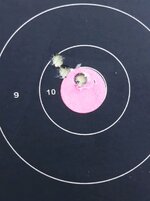
ladder test 9.14.21.jpg
 

Upcoming Events

New Classified Ads

Back Top