


JavaScript is disabled
Our website requires JavaScript to function properly. For a better experience, please enable JavaScript in your browser settings before proceeding.
Something I will consider when it comes to group sizes is the intended round count expected for firearm being tested.

If you are hunting big game and only expect one, two or maybe three rounds max to be fired during normal use case, then a three or five round group might be acceptable for testing.

If you are hunting zombies or sage rats, where 10, 20 or more rounds will be fired during normal use case, then a much larger group size might be better.

A barrel that gives sub MOA 5 round groups, will likely not hold that with 20rnd groups.
 
A barrel that gives SOME sub MOA 5 shot groups and SOME over MOA 5 shot groups is not a sub MOA barrel.

My 6 ARC ARs get tested at 200 yards, and tend to do 3-4 shots in a half MOA or so, and 1 or 2 "flyers" that bump it to .8 to 1.2 MOA. I will sometimes get a few beautiful .6 MOA groups (hell yeah!) and a few ugly 1.3 MOA groups (boo-hoo!).

What MOA is my rifle-ammo combo?

I'd say 1.3. I usually say, "It's about MOA. Sometimes a little under, sometimes a little over." And that really is good enough for the steel shooting games.
 
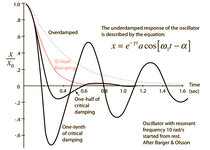
Okay, I tried to resist but here it is. This is your barrel as an insufficiently damped oscillating waveform.
frame_0_delay-0.01s.jpg

The details of the waveform aren't important at the moment but the general theory and graphic representation are.

~snip/ If a bullet flies at 3000 fps, it will pass through a 24″ (two-foot) barrel in 1/1500th of a second. If you have a useful barrel life of 3000 rounds, that would translate to just two seconds of actual bullet-in-barrel operating time.


Ah, but it's not that simple. Your bullet starts at zero velocity and then accelerates as it passes through the bore, so the projectile's average velocity is not the same as the 3000 fps muzzle velocity. So how long does a centerfire bullet (with 3000 fps MV) typically stay in the bore? The answer is about .002 seconds. ~snip *

So now we've established time in bore and know that muzzle position/angle at bullet departure needs to be established. If you didn't come to the same conclusion quit reading and continue shooting. I guarantee you'll be much happier.

Extreme spread and standard deviation. If you don't know these terms it's okay and your OCD will thank you. If you do know these terms it won't help much but it's okay if you're an egghead.

At some data point in mythical time and place a bullet will be leaving the barrel at such an exacting moment that the barrel has just began an upswing of the muzzle. This bullet regardless of it's velocity will eventually impact a target. A chronograph is a plus here but not entirely necessary. A second bullet, identifiably . slower by 10,15,20 maybe 25 ft/sec, or a tenth or three grains less charge weight is fired and goes through the same hole?1 This bullet was in the barrel longer and was subjected to more vertical influence by the rising muzzle. Do not confuse this with recoil although it does have something to do with the over all physics of the thing.

Okay if you got this far you have my sympathies because although I try to dumb this crap down somewhat I do try to make people think. I'm as capable of "hold my beer , watch this..." as I am of writing a completely researched thesis.


So with the basic (very basic physics) physics of motion stated lets move on to statistical data sampling.

I shoot three shot groups at/as/for ladder testing. Instead of recording group size or location I record radial distance from point of aim. I get a data point from each round fired as well as group size which comes in handy later.

My efforts are centered around random dispersion analysis. In english, get a bunch of data and try to make sense of it .
View: https://www.youtube.com/watch?v=cq3q78zUZv0

A much better job of explaining it than I can in a short forum post. Please keep in mind I've been doing this, however poorly for nearly 50 years. If I tell you it's worth watching it possibly is.

So yes, getting barrel harmonics/oscillation to dampen velocity variability is a thing. I have a .308 at 165/168gr near 2700 ft/sec with an ES of nearly 30 across viable temperature and humidity, that will sub .5 MOA . Again, one half MOA with shots recording nearly 30 ft/sec different velocity.

This is where the extra data comes in handy. It's now time to mess with seating depth. Once the waterfall is established I'll move on to seating depth testing with five round groups. I not only enjoy shooting but I love data points. Seating depth is widely covered else/anywhere so you get a break. Just don't jam and don't get sloppy. It will sort itself out.

Finally I'll tease with the fact that I have several fast digital storage oscilloscopes I'm in the early stages of mounting a piezoelectric microphone/transducer to the breech area and will be attempting to record the wave function in real time. The ignition spike shouldn't be an issue and depending on the dynamic range of the mic and scope the barrel exit ping shouldn't be an issue either. If barrel exit is an issue a fine wire broken on bullet exit can be used for timing.

I guess I stayed out of this so long because it seemed so obvious that waterline was a thing, a real thing.


Lastly, after all this please don't ask me how I sight in a rifle. I don't have that written down yet and I have to walk the dog.


tnx for putting up with me .


*I know I lifted it from somewhere but I don't remember where.
 
Last Edited:
So now we've established time in bore and know that muzzle position/angle at bullet departure needs to be established. If you didn't come to the same conclusion quit reading and continue shooting. I guarantee you'll be much happier.
So basically you just described the importance of seating depth nodes?
 
Okay, I tried to resist but here it is. This is your barrel as an insufficiently damped oscillating waveform.
View attachment 2103694

The details of the waveform aren't important at the moment but the general theory and graphic representation are.

~snip/ If a bullet flies at 3000 fps, it will pass through a 24″ (two-foot) barrel in 1/1500th of a second. If you have a useful barrel life of 3000 rounds, that would translate to just two seconds of actual bullet-in-barrel operating time.


Ah, but it's not that simple. Your bullet starts at zero velocity and then accelerates as it passes through the bore, so the projectile's average velocity is not the same as the 3000 fps muzzle velocity. So how long does a centerfire bullet (with 3000 fps MV) typically stay in the bore? The answer is about .002 seconds. ~snip *

So now we've established time in bore and know that muzzle position/angle at bullet departure needs to be established. If you didn't come to the same conclusion quit reading and continue shooting. I guarantee you'll be much happier.

Extreme spread and standard deviation. If you don't know these terms it's okay and your OCD will thank you. If you do know these terms it won't help much but it's okay if you're an egghead.

At some data point in mythical time and place a bullet will be leaving the barrel at such an exacting moment that the barrel has just began an upswing of the muzzle. This bullet regardless of it's velocity will eventually impact a target. A chronograph is a plus here but not entirely necessary. A second bullet, identifiably . slower by 10,15,20 maybe 25 ft/sec, or a tenth or three grains less charge weight is fired and goes through the same hole?1 This bullet was in the barrel longer and was subjected to more vertical influence by the rising muzzle. Do not confuse this with recoil although it does have something to do with the over all physics of the thing.

Okay if you got this far you have my sympathies because although I try to dumb this crap down somewhat I do try to make people think. I'm as capable of "hold my beer , watch this..." as I am of writing a completely researched thesis.


So with the basic (very basic physics) physics of motion stated lets move on to statistical data sampling.

I shoot three shot groups at/as/for ladder testing. Instead of recording group size or location I record radial distance from point of aim. I get a data point from each round fired as well as group size which comes in handy later.

My efforts are centered around random dispersion analysis. In english, get a bunch of data and try to make sense of it .
View: https://www.youtube.com/watch?v=cq3q78zUZv0

A much better job of explaining it than I can in a short forum post. Please keep in mind I've been doing this, however poorly for nearly 50 years. If I tell you it's worth watching it possibly is.

So yes, getting barrel harmonics/oscillation to dampen velocity variability is a thing. I have a .308 at 165/168gr near 2700 ft/sec with an ES of nearly 30 across viable temperature and humidity, that will sub .5 MOA . Again, one half MOA with shots recording nearly 30 ft/sec different velocity.

This is where the extra data comes in handy. It's now time to mess with seating depth. Once the waterfall is established I'll move on to seating depth testing with five round groups. I not only enjoy shooting but I love data points. Seating depth is widely covered else/anywhere so you get a break. Just don't jam and don't get sloppy. It will sort itself out.

Finally I'll tease with the fact that I have several fast digital storage oscilloscopes I'm in the early stages of mounting a piezoelectric microphone/transducer to the breech area and will be attempting to record the wave function in real time. The ignition spike shouldn't be an issue and depending on the dynamic range of the mic and scope the barrel exit ping shouldn't be an issue either. If barrel exit is an issue a fine wire broken on bullet exit can be used for timing.

I guess I stayed out of this so long because it seemed so obvious that waterline was a thing, a real thing.


Lastly, after all this please don't ask me how I sight in a rifle. I don't have that written down yet and I have to walk the dog.


tnx for putting up with me .


*I know I lifted it from somewhere but I don't remember where.
So how do you feel about the Hornady duo and their idea of using 20+ rnd group sizes?
 
Whats a waterline?
...a "group" that without regard to size that maintains consistent impact elevation at 200 (arbitrary) yards within a variation of charge weight and velocity. In my case I have a .308 that will hit the same elevation on target over a charge weight variation of .6 grains (actually .8gr but I throw out the high and the low) and nearly 30 ft/sec difference.

Only then is any investigation into seating depth worth while.

The whole point is if any variation in the vertical can be possibly, identifiably, controlled or eliminated then the only two remaining variables are group size and windage.The rest is on the shooter. The more you can control any variable other than the shooter the more consistent the result.

In my case the mechanics of the shot are still there even as my visual acuity diminishes. At some point it won't matter what I do with or to the rifle, the limiting factor will be me. Until that point I will attempt to eliminate the variables within my control and continue to shoot.
 
I have this theory that large sample size load development is intended for ammo manufacturers selling a round to fit any rifle.
 
About 15 years ago, I was taught the ladder test, where you are looking for the "water line" as @kopcicle wrote. A workup of load charges of three to five rounds each, shot at a target (in my case, 200 yards), where you were looking for the most consistent vertical group, highest on the target, meaning the group all hit at the same POI above the POA. This was inferred to mean that the bullet time in the barrel was the most consistent and leaving the barrel when it was on the upswing.
Then I read you're looking for the group that has the most consistent horizontal level. Same thing, a different way to describe it.
Then I read you don't need to do all that gyration - just load up 10 rounds or more and chrono the MV. Where there is a flat spot in your MV, that's a node.
Funny, I found that last method to be surprisingly useful at picking "the right load".
However, the nerd in me has always suspected, unless you are getting the most consistent (identical) brass, The exact same primers and seating depth, most consistent neck tension and a zero variation shooting support (think "rail gun"), the numbers and testing is just voodoo. Still, I'm happy when i hit something that consistently gives me an acceptable accuracy.


To clarify this large sample group method: If I load up & shoot 30 rounds with a given powder at a 50gr charge weight, then another group with a 55gr charge weight, they will each have the same group size?
Lets say you have three different loads of 30 rounds each for the same rifle, and they all shoot the "same" group size diameter. Some groups will have a tighter average cluster, i.e. a ragged hole and a few flyers. Some will be scatter shot, but both will have the same MOA measurement. Which is more accurate?

So yes, getting barrel harmonics/oscillation to dampen velocity variability is a thing.
I've also read an article that say barrel oscillation attenuators have no effect on accuracy.
Finally I'll tease with the fact that I have several fast digital storage oscilloscopes I'm in the early stages of mounting a piezoelectric microphone/transducer to the breech area and will be attempting to record the wave function in real time.
Me, I'd affix a series of strain gauges in line at the bottom, along the length of the barrel, to look at the harmonics.
 
… the numbers and testing is just voodoo.
That has been my concern. My shooting buddy and I have found "good loads" using strict OCW, a charge ladder, a casual OCW, or maybe even both of those approaches. So some load looks better or even good on Day 1 with 5-shot groups. So we load up some more with and around that charge and go out again. Day 2 that same load tested in 5-shots maybe doesn't look so good. Sometimes we might take a starting load on Day 2, and that load looks better on Day 2 than the selected loads did on Day 1.

"Just because it shot well one day doesn't mean it will another" is what we say.

So several different test days to hopefully prove that load, usually multiple 5-shot or 10-shot groups before I pick something to crank out 500 or 1,000 rounds.

Lets say you have three different loads of 30 rounds each for the same rifle, and they all shoot the "same" group size diameter. Some groups will have a tighter average cluster, i.e. a ragged hole and a few flyers. Some will be scatter shot, but both will have the same MOA measurement. Which is more accurate?
I would suggest that mean radius from center yields the best measure of dispersion because it is calculated based on each shot, while the group size is based on 1 or 2 outliers.

I need to man up and try the full Hornady method. I'll try it with something cheap, like .223.
 
...a "group" that without regard to size that maintains consistent impact elevation at 200 (arbitrary) yards within a variation of charge weight and velocity. In my case I have a .308 that will hit the same elevation on target over a charge weight variation of .6 grains (actually .8gr but I throw out the high and the low) and nearly 30 ft/sec difference.

Only then is any investigation into seating depth worth while.

The whole point is if any variation in the vertical can be possibly, identifiably, controlled or eliminated then the only two remaining variables are group size and windage.The rest is on the shooter. The more you can control any variable other than the shooter the more consistent the result.

In my case the mechanics of the shot are still there even as my visual acuity diminishes. At some point it won't matter what I do with or to the rifle, the limiting factor will be me. Until that point I will attempt to eliminate the variables within my control and continue to shoot.
What Kop describes here is basically theory behind the Satterlee method that I have been using since the component shortages started. It is a time and component saver and yields as good of results as my former ocw method. In less than 50 rounds I can have a fully developed load with this method. I also play with GRT to help pick relevant powders to start with.
 
I have decided to use the 223 cartridge instead of 308 in my first attempt at using this single charge weight group testing method. I just received an order of primed 223 brass with a majority of it being Norma 223 cases. There are easily more than 200 Norma cases in the batch I received. That will allow me to use the same type of brass for all the loads I do.

I will use my Savage Axis (gen 1) for testing. It has a sporter barrel. That may make it more influenced by barrel whip than a heavier barrel.

I will still attempt to try 10 different powders, 20rnds each and will use a 55gr FMJ Berry's bullet for all loads.

I am may get started loading this weekend, if I can get my bench mess cleaned up during the week. Or I might try using this press at the dinner table when the wife is still sleeping.


Upcoming Events

Back Top