


JavaScript is disabled
Our website requires JavaScript to function properly. For a better experience, please enable JavaScript in your browser settings before proceeding.
Messages
316
Reactions
1,073
This ended up turning into quite the project. I did a halfway decent job of documenting it, so I figured it would make another good post.

Customer wanted 5/8-24 threads on their Browning BAR MK3. Barrel measured around .68" in diameter, so it was going to need a collar added for the shoulder. In addition, disassembly and removal of the barrel on these is a time consuming and risky affair (correction: @Velzey reports it is an easy takedown, unlike the older BARs) This, combined with the fact that the barrel has a welded/brazed gas block (making it so it would not fit my barrel fixture) I decided it would best be machined as a barrelled action.

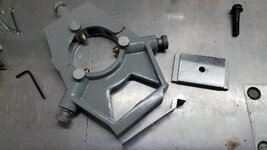
I tried to fit the action on my big Leblond that has a nice steady rest with rollers. Unfortunately, the barrel was too skinny and the fingers would not adjust small enough. So, after taking some measurements on my Prototrak TRL 1440, I perused Ebay for a steady rest that I hoped would fit. I pulled the trigger on one, and a week later it was here. And.... it did not fit. Of course. So I spent the day making an adapter plate, a new clamp, and modifying the base of the steady rest to fit the adapter plate.

Next step was to make a collar for the barrel. I did not get any pics of thise, but you can use your imagination. It is just a .800" diameter x .250" long "ring" of 4140 steel with 5/8x24 internal threads thru.

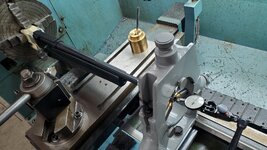
I could now get the action chucked up. I started with the muzzle supported by the tailstock (using a crown saver to protect the bore) and the action in the 4 jaw. I did a rough dialing of the chuck by indicating off the OD of the barrel. We will revisit the indicator in a bit.

20241006_013804.jpg 20241005_155319.jpg
 
Last Edited:
Now that the barrel was roughly dialed in, I took a skim cut where the threads would end up going. This was to establish a diameter that would, in theory, be true to the live center, which should be true to the crown saver, which should be true to the bore.

It was now time to set up the new steady rest. I got the fingers adjusted so they were resting on the freshly cut journal, and then removed the tailstock. This would now give me access to the bore. I got my long needle indicator and put it in as far as it would go. I could now finish dialing in the 4 jaw.

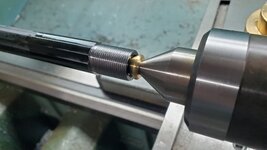
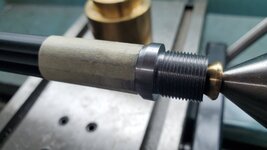
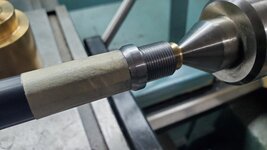
Once I was satisfied with the indicator, I then put the live center back into the muzzle (with a fresh crown saver), and removed the steady rest. The threads were then cut. Instead of the usual .600" long, these were .830" long to allow for the collar.

20241005_160308.jpg 20241005_164748.jpg 20241005_183335.jpg
 
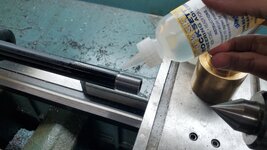
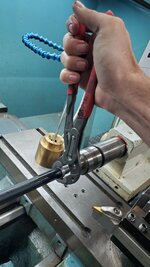
Now that we had threads, it was time to add our collar. Everything was cleaned with acetone before applying Rocksett. The collar was then (brutally) torqued into place.

We now have a shoulder that will support a suppressor properly. But... the face is not true to the bore. And, it is quite ugly. Especially with the teeth marks from the channel locks. So, it gets re-machined. The face and OD get cut, a new thread relief is added, and I put a taper on the back side to blend with the barrel.

20241005_183510.jpg 20241005_183647.jpg 20241005_185813.jpg 20241005_185807.jpg
 
Here it is with my personal can mounted. Bore alignment was checked and found to be concentric.

It is certainly an interesting rifle. A bit different from what I usually work on.

20241005_191823.jpg
 
Awesome work. Not everyone will do a barreled action, and one of the shops known nationally for that service just closed in the last few weeks due to the unexpected death of the owner. A lot of people are looking for quality barrel work, such as yours, right now.
 
Awesome work. Not everyone will do a barreled action, and one of the shops known nationally for that service just closed in the last few weeks due to the unexpected death of the owner. A lot of people are looking for quality barrel work, such as yours, right now.
You're referring to Class 3 Machining?

I appreciate the kind words.
 
I have threaded dozens of these new Browning BAR mk3's the last few years. The barrels are held in place by 2 1/4-28 pinch bolts that are hidden under rear of the forearm. Slide the forearm forward and inch, loosen the bolts the barrel slides right off the receiver.
Not like the older BAR's at all. Those require a special fixture to support the barrel.
Was this barrel attached somehow differently ?
 
That's very good to know. I believe this one was how you described. I saw the bolts.

How do you fixture the barrel after it has been removed? To me, it looked like even if I pulled it, the gas block would interfere with the spindle bore.
 
Browning uses a barrel extension similar to the AR family.

I chuck up on the extension ( I have a true zero chuck )
I use a sleeve that slips over the barrel to run my steady rest on. That way I have access
to the bore to check for run out. I modified my steady rest to have 4 contact points instead
Of three. Removed the bronze bushings and run three precision roller bearings. Adjust to run true if needed.
 
I did not make any adjustments to the gas system. This was discussed with the customer prior to threading, and it was decided to see how the rifle functioned first without making any modifications. I have not heard from him, so I assume no news is good news.
 
Do you adjust the gas block to ensure proper firing?

Sent seperate email. Definitely in the market for this improvement to my BAR MKIII DBM.
I've cut a few Browning BAR barrels down to 18" and have not had any cycling problems. The gas system seems to be pretty efficient. Even with a supressor it still cycles fine:,
 
Very nice write up! All the CNC machines available and I still enjoy a little turning/threading/reaming on the old manual lathes. Just so handy and my ancestors would be proud :s0064: . Very satisfying.
 

Upcoming Events

New Classified Ads

Back Top