


JavaScript is disabled
Our website requires JavaScript to function properly. For a better experience, please enable JavaScript in your browser settings before proceeding.
Physics being what they, you will NEVER repeal the laws of the conservation of energy, not matter now many padded cushions you use between the stock and shoulder.

As long as you are slinging a 150gr bullet out of one end at 3250 fps, that 8 pound gun is going to move, unless it is literally bolted down.

Is THAT ever going to happen in the real world?

Cor 'snot.

Your ambition of shooting a hundred rounds of .300 WM in a session proves nothing at all to me except that you have way too much money and are probably built like the late and much-missed Mr Bunyan.

Those of us who used that calibre professionally will advise you that a range session would usually involve not more than around thirty carefully aimed shots, and we weren't paying for them either. Remember, too, that we were wearing full combat gear as well, which served to lessen the recoil effect somewhat.

Any suggestions on budget (sub $100) stocks that will remedy the issues, I have to keep in mind that they're mostly $200 rifles and I have a good number of them to outfit.

As for buying a sub-hundred dollar stock - I'll be honest and say that such a thing is usually to be found on a $50 rifle.

What about modifying the tupperware stocks?
Based on expertise that you've already agreed that you don't have?

What about adding some weights to the rifle?
Where?

Any budget break ideas for non threaded sporter profile barrels?

Call Bartlein and ask them - be prepared to get roasted.

There's a good reason why a GOOD stock costs good money.

R&D, colossal amounts of it, by professional shooters and ergonomicists, and literally thousands of shot rounds by a variety people of all builds - all that costs money that you don't seem to want to pay.

This rifle looks no different to many others, but has been extensively for use by somebody who would be lying behind it for extended periods. The stock has been filled with lead rods - 3.5kg-worth of 'em. The result is a rifle that STILL moves under recoil - shooting 168gr .308 bullets at 2880 fps does that - but nowhere near as much as it would without all that dead-weight ballast.

1753111368194.png
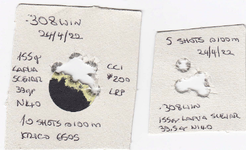
Here's a couple of groups I shot back in 2022 - just after my 77th birthday -
1753111653867.png

My stock is the one that I'm convinced was used by those clever Norwegian furniture makers who brought GRS stocks to the shooting world - best to get to where you can actually get your hands on a GRS stock - laminated or composite - and get a feel for what THE definitive all-rounder stock looks and feel like.
 
Lowrider stocks have long been considered upscale for bench rest even prone shooting similar to this:View attachment 2131390
When using a rest, the best recoil suppression comes from the weight of the rifle, not the rest.
I think I should figure out a cheap way to add weight to my tupperware stocks. 20lbs worth should make for some easy shooting.
 
My brother had a 300win mag he hated to shoot, it was about 8lbs. I've shot some platforms that people say kick a bit, 50 Beowolf and others, that to me, didn't feel like much of anything...

His 300win mag, it had a little bite, I'd shoot it, but it was not the most enjoyable.

Years later, I ended up grabbing a 300win mag of my own, I went with a platform that was about 3lbs heavier just out of the box, adding optics and more, even more weight. My 300win mag is actually pleasant to shoot, if it wasn't for the ammo being more expensive, I'd be shooting it more often than I do...

Given a 12ga, the heavier the platform. The more likely ill shoot it, I have some pump actions average weight, fun to shoot. I have a folding single shot light weight shotgun, that can hurt you after a couple shells of cheap birdshot...
 
I've found three things that eliminate heavy recoil: consignment, classified, and gun shows.

:)

Bruce
 
Fixing a lead sled to bench would certainly damage optic or stock. Don't even consider it. I occasionally use a lead sled with no extra weight in tray and have not experienced any damage to optics or stocks. One of the better ideas I have come across for dealing with heavier recoil is a happy bench. Basically it is a standing height bench. You get the benefits of a steady position and also your body is in a better position to naturally give with the recoil. Of course there are always muzzle brakes and suppressors for recoil reduction.
 
Lead sleds have suffered a loss of popularity since it was discovered (repeatedly) that it is relatively easy to damage a rifle with one.

NO rifle of any significant recoil is designed to withstand being held absolutely stationary against the recoil force, and MOST are not designed to survive anything approaching fierce resistance.

Lead Sleds also cannot duplicate how a gun will shoot if held independently by a human for a host of reasons: contact points on the gun itself, position of the triggering person, etc.

If firing one's rifle becomes uncomfortable enough that accuracy begins to suffer, one might explore ceasing to shoot that rifle (and perhaps consider opting for a gun of less recoil).
 
Sounds like you need a retirement project!

 
I don't know a solution for your price point. I'd say get the barrels threaded (if there is enough material to safely do so) and throw on a quality brake or even better a suppressor. It's amazing how much recoil a suppressor eliminates. But that's not happening for $100.
 
I am interested in other less conventional methods that people have used to lessen felt recoil in heavy recoiling rifles. I want to be comfortable shooting a 100 rounds in a bench session with all my rifles including the 300 Win Mag and 7mm Rem Mag.
Take a bunch of paper crumple it up and place in a zip loc quart sized bag, tape this to the end of the buttstock, All of the firearm related receipts you have received for the last two years should be sufficient; you may just be able to create one for each rifle. Start eating your Wheaties the crust on your sandwiches and only drink black coffee that auttaa do the trick.
 
If firing one's rifle becomes uncomfortable enough that accuracy begins to suffer, one might explore ceasing to shoot that rifle (and perhaps consider opting for a gun of less recoil).
Good point however if you PLAN to keep the rifle (and you reload) consider toned down reloads with lighter bullets.

I have done this with the few heavy recoiling rifles I HAVE owned and while NOT particularly 'heavy recoiling' as they are I load reduced rounds for my .30-30s.

I shoot for sport and recreation and want 'all day shooters' that are accurate and pleasant to shoot on or off a bench and not something heavy recoiling and stressful.
 
Last Edited:
I have a bunch. Rem 700s, Savage axis 1 and 2s, Savage 110, 111, Model 12, Mossberg ATR 100, T/C Compass 1 & 2. I think I have one Ruger American as well.

I will suffer through the mil surps.
I had one of those. My opinion is they are intended to be lighter weight, budget hunting rifles. The barrel of my Savage would heat up after a few quick follow up shots enough to effect the point of impact. It became difficult to justify the cost of ammo to shoot paper. The recoil of the 30-06 felt similar to a 12ga.

I have muzzle brakes on 3 of 4 of my 30 cal rifles . Two came from the factory with them. I mostly shoot alone so no noise complaints, but recoil is minimal.
 
Back in the late '60s I bought a M70 in .300WM, it was brutal off the bench.
At only ~7-1/2 lbs., it just didn't have the weight to accommodate that cartridge, but it was fine to carry in the steep mountains all day.
When I got a M70 in .375H&H, Win. had the brains to produce a 9lb rifle, add a scope/mounts/sling, and it pushed the weight up to a bit over 10lbs.
While it had more recoil than the .300 it was actually easier to shoot.
The recoil was more like a shotgun, a big thump instead of a sharp kick.
At the bench I used a P.A.S.T. recoil pad and a small bag of shot against my shoulder.
Once it sheared the cross bolt in one of the QD scope mounts, Leupold replaced it for free.
I now stay away from any of the 7mm > .300 mags, the recoil is just to sharp and fast, (plus the ear-splitting blast).
I'd rather shoot a .375 with less velocity than a .30 that's going at light speed.
 
Personally, I really only see the need for rifles that kill at both ends for 2 purposes.

1. Hunting big critters that can stomp, claw and bite you to death
2. Extreme long range target shooting/sniping.

If engaged in #2, I would have much recoil mitigation on said rifle in the form of weight, brakes and suppressors.
 
If firing one's rifle becomes uncomfortable enough that accuracy begins to suffer, one might explore ceasing to shoot that rifle (and perhaps consider opting for a gun of less recoil).


this is why my .338 win mag is currently for sale in the classifieds. after a total reverse shoulder replacement the .338 needs to find a new home.
 
Good point however if you PLAN to keep the rifle (and you reload) consider toned down reloads with lighter bullets.

I have done this with the few heavy recoiling rifles I HAVE owned and while NOT particularly 'heavy recoiling' as they are I load reduced rounds for my .30-30s.

I shoot for sport and recreation and want 'all day shooters' that are accurate and pleasant to shoot on or off a bench and not something heavy recoiling and stressful.
I will definitely experiment with reduced loads. But I have fallen into such good deals on magnum powders lately, that I am going to have to put together near full house loads. Maybe I can do the stout loads first and finish off the session with the reduced loads. Reduced loads should help extend barrel life too.
 
My Savage 111 30-06 has a carved and beat up stock. I am going to experiment with adding some weight to it along with a new butt pad. If that helps tame that rifle, I can try it with some of the others.

I will keep an eye out for deals on nicer stocks, maybe used.
 

Upcoming Events

Back Top