Join the #1 community for gun owners of the Northwest
We believe the 2nd Amendment is best defended through grass-roots organization, education, and advocacy centered around individual gun owners. It is our mission to encourage, organize, and support these efforts throughout Oregon, Washington, Idaho, Montana, and Wyoming.
Ever have the lens behind the cover fog? I used several types of no fog, cat crap, whatever. I couldn't get the lens to stay clear. I'd rather fight the raindrops.
Well, actually I'd rather sit in my treestand on a dry day and have a monster blacktail saunter on by at 25 yards.
Anyone have a good recommendation for a "no fog" treatment?
Zeiss makes anti fogging kits. You do need to reapply it every couple days of use and start with a clean lens. I keep my rifle in the cold when I hunt and after I get back to minimize the chance of condensation/fog. I open my caps every so often as well and I rarely have fog issues since I hike and hunt for 12 or more hours in a day and the temps can vary by 30 degrees during that time. If I know there is no chance of precip, I will stow my caps in my pack.
Ever have the lens behind the cover fog? I used several types of no fog, cat crap, whatever. I couldn't get the lens to stay clear. I'd rather fight the raindrops.
Well, actually I'd rather sit in my treestand on a dry day and have a monster blacktail saunter on by at 25 yards.
Anyone have a good recommendation for a "no fog" treatment?
I have had fogged lens's, even with quality optics. But Ive learned its not an issue if you keep the rifle the same temp as the air and check your scope covers occasionally if the rifle was slung close to the body or carried close to the body.
Years ago I tried a no-fog product and found it did help some, but also found that it needed constant reapplication. One thing to note is the more you wipe, clean lenses the more you will wear off any optical coatings applied at the factory. I found once I learned to normalize the optics temperature to the air temp I no longer need to worry about fogging and havent used a no fog product in years.
I have had fogged lens's, even with quality optics. But Ive learned its not an issue if you keep the rifle the same temp as the air and check your scope covers occasionally if the rifle was slung close to the body or carried close to the body.
Years ago I tried a no-fog product and found it did help some, but also found that it needed constant reapplication. One thing to note is the more you wipe, clean lenses the more you will wear off any optical coatings applied at the factory. I found once I learned to normalize the optics temperature to the air temp I no longer need to worry about fogging and havent used a no fog product in years.
Even on a clear warm day, dust and pollen can coat the lens. Though not usually compromising a shot but it can get so bad it warrants daily cleaning. I try to avoid cleaning or even touching the lens, especially on a quality optic, and especially in the field hunting where I might not have a proper lens cloth and proper lens cleaner.
Here in the coast range hiking thru sword ferns in early deer season the pollen is so thick it coats the lens's badly, so even on a nice day I want to have scope covers on the scope, but be able to quickly deploy them if needed, then remove them if still hunting is less dusty, polleny situations. I do love the freedom of hunting with no scope covers but I keep them handy.
I was reading in a marksmanship book somewhere and the subject of gear care the author stated that unless your actually aiming he recommends your scope lens should be covered to protect the lens. Of course he wasn't writing from a hunting perspective but the point was not lost. I had some older scopes for many years that were all scratched out from inexperience, but now I have some nicer scopes and if I have my way I dont want to need to clean them. Keep them from getting dirty, keep them normalized to the cold air and they wont fog.
The Leupold Aluma covers work well, but do occasionally flip open on their own.
The cheap rubber bikini covers always work well and never fail. The rubber band trick I learned makes them flip to the off side by just pulling back on the ocular cover tab and letting go. the force removes the objective cover and the rubber bands tied to the side opposite the ejection port keep the cover with the gun.
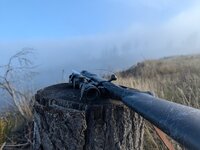
I often use the blue rubber bands I get from bundles of asparagus albeit slightly unsightly. note, two rubber bands work best, not certain why this pic only shows one the other might have broke yet I notice I had a spare on my barrel... odd. I might have been fidgeting with things that day.
If there is a cover on your scope in the Cascade range, you had better be sitting overlooking a clearcut were you have time to prepare for a shot. I might have the opportunity in my treestand, but I'd prefer to keep movement to a minimum cuz at that point the deer are close. If you're bustin the brush you'll be lucky to get a shot off, let alone be fussin with covers and such.
Even on a clear warm day, dust and pollen can coat the lens. Though not usually compromising a shot but it can get so bad it warrants daily cleaning. I try to avoid cleaning or even touching the lens, especially on a quality optic, and especially in the field hunting where I might not have a proper lens cloth and proper lens cleaner.
Here in the coast range hiking thru sword ferns in early deer season the pollen is so thick it coats the lens's badly, so even on a nice day I want to have scope covers on the scope, but be able to quickly deploy them if needed, then remove them if still hunting is less dusty, polleny situations. I do love the freedom of hunting with no scope covers but I keep them handy.
I was reading in a marksmanship book somewhere and the subject of gear care the author stated that unless your actually aiming he recommends your scope lens should be covered to protect the lens. Of course he wasn't writing from a hunting perspective but the point was not lost. I had some older scopes for many years that were all scratched out from inexperience, but now I have some nicer scopes and if I have my way I dont want to need to clean them. Keep them from getting dirty, keep them normalized to the cold air and they wont fog.
The Leupold Aluma covers work well, but do occasionally flip open on their own.
The cheap rubber bikini covers always work well and never fail. The rubber band trick I learned makes them flip to the off side by just pulling back on the ocular cover tab and letting go. the force removes the objective cover and the rubber bands tied to the side opposite the ejection port keep the cover with the gun.
I often use the blue rubber bands I get from bundles of asparagus albeit slightly unsightly. note, two rubber bands work best, not certain why this pic only shows one the other might have broke yet I notice I had a spare on my barrel... odd. I might have been fidgeting with things that day. View attachment 2008351
Ever have the lens behind the cover fog? I used several types of no fog, cat crap, whatever. I couldn't get the lens to stay clear. I'd rather fight the raindrops.
Well, actually I'd rather sit in my treestand on a dry day and have a monster blacktail saunter on by at 25 yards.
Anyone have a good recommendation for a "no fog" treatment?
It has, its about 35 years old now and been thru the wringer but I don't hunt as much with it anymore. Occasionally I take it out now and then for the fun of it especially in heavy timber hunts.
It has, its about 35 years old now and been thru the wringer but I don't hunt as much with it anymore. Occasionally I take it out now and then for the fun of it especially in heavy timber hunts.
If our Supporting Vendors don't have what you're looking for, use these links before making a purchase and we will receive a small percentage of the sale