


JavaScript is disabled
Our website requires JavaScript to function properly. For a better experience, please enable JavaScript in your browser settings before proceeding.
Pull one of the bullets and see if that reloaded case will fit. That will tell you if it is a bullet length issue or the case is being pushed out of spec when seating.

Long ago I moved to separate dies for seating and for crimping if needed. Too frequently I ended up with a small shoulder bulge that would make it hard or impossible to close the bolt. Now that I crimp as a separate station I have never had that problem.
 
Last Edited:
Thanks. I'll look into it. My cases chamber just fine. Are you saying this could still be the issue ?
I think the issue is somewhere in either your case measurement, sizing, or seating operation. I think Nwcid has a good point about crimping, are you crimping with the seating die in the same step? or are you backing off the seating die one full turn to avoid crimping?
 
Thanks. I'll look into it. My cases chamber just fine. Are you saying this could still be the issue ?
I understand that your freshly resized cases chamber fine. When you seat, and crimp if you are, is it deforming the case somehow?

Of course you can measure and see, but another way is to pull the bullet and see if that case still chambers. If it does chamber, then you have a bullet length issue, if it does not chamber, the brass has been deformed out of spec while you are reloading.
 
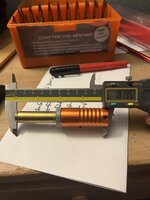
I still dont know how the SAC comparator works or why you would be measuring a reference dimension but try taking a seated round and measuring your shoulder the way youve been doing it and if the shoulder has moved or changed then your might be inadvertently crimping as you seat the bullet.
 
I'm using a redding type s match set. The FL sizer uses a bushing for the neck . I'm using a sac bushing .312 . Loaded the necks .318 . New reloader so forgive me. I hope this awnsers the question.
 
I'm using a redding type s match set. The FL sizer uses a bushing for the neck . I'm using a sac bushing .312 . Loaded the necks .318 . New reloader so forgive me. I hope this awnsers the question.

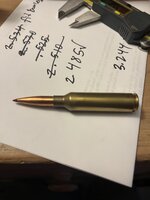
IMG_2529.jpeg
 
Color the bullet with a marker. Chamber it. If the bullet isn't marked by the throat or lands, it is a case problem.

Then you can start coloring the case to see where it is too tight.

Bruce
 
I'm using a redding type s match set. The FL sizer uses a bushing for the neck . I'm using a sac bushing .312 . Loaded the necks .318 . New reloader so forgive me. I hope this awnsers the question.

View attachment 2071471
I dont recommend a bushing die for new reloaders, not needed for what your doing (presumably hunting round?). Maybe someone experienced can coach on the bushing die setup but assuming its set up correctly and your full length sizing correctly you should be sizing to saami spec, the neck OD dimension should be .317 -.008". What are your objectives with this handload? Because for a beginner and a factory rifle you dont need to worry about custom neck tensions, get a standard Redding sizing die IMO.

I don't know how or why a SAC comparator would be different than the Hornady OAL comparator, but more than once you've suggested your measuring the wrong shoulder dimension and the correct bushing should be .420 dia for the 7prc shoulder.
 
I think after resizing compression, on the updraw, the neck expander ball may be pulling the neck and shoulders up, making the shoulder chambering angle too obtuse.
The solution is extremely simple. Dip your neck in imperial sizing wax before resizing so the ball is not grabbing carboned brass.

And for the love of all that is holy, please tell me you are annealing first, FULL length resizing to cam-over second, and neck trimming last in case prep.

If you get a bore scope, look for a carbon ring in the neck chamber.

Sharpie marking a loaded round would show a fine ring around shoulder/neck angle if my suspicion is accurate on the ball issue.
 
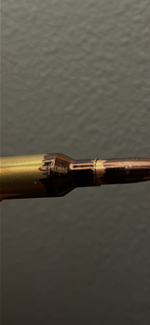
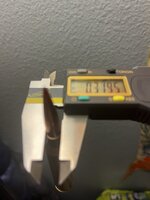
I may have found the issue. I just got a 3.382 Oal round to chamber. The very top of the neck edge has an burr/edge to it and measure's bigger than the main neck body . I sanded it down the burr until it was .317 and boom. Chambered. I don't see the issue happening on the sized brass. only on the loaded rounds. So it must happening while pressing the bullets.

IMG_2534.jpeg IMG_2535.jpeg
 
The should be no burr if you are chamfering inner and outer neck edges after trimming.

ADG brass is thicker than commercial brass from Hornady or Winchester… very unforgiving on burs and such, and should be loaded conservatively watching for pressure signs in a ladder since case has a slightly lower volume than most other brass.
 
A round as high pressure (ADG brass)and powerful as a 300PRC would be expected to grow to unchamberable neck length in one firing… the bur is likely from neck expanding to maximum neck length then burring on the chamber's neck end.
Pull bullets, pour out powder to reuse, punch primer (carefully), resize with lube inside neck and on case, then trim and chamfer. Reload. Problem solved.
 

Upcoming Events

New Classified Ads

Back Top