


JavaScript is disabled
Our website requires JavaScript to function properly. For a better experience, please enable JavaScript in your browser settings before proceeding.
A good full length sizing die can produce concentric cases but some do not. The issue is almost always the expander ball. If you have a die that is making your case runout more than .002 - .003". Try taking guts out and sizing. If runout is minimized you have your smoking gun. Of course your neck is now too tight and will need to be expanded. A lee collet die can be used for this. I like working my brass as little as possible so boring out the neck of the fl sizing die in a lathe or getting a body die is the answer. This all works along with no case cleaning well. If you are having success with your methodology that is great. I am just providing some different perspective after many rabbit hole dives.
 
A good full length sizing die can produce concentric cases but some do not. The issue is almost always the expander ball. If you have a die that is making your case runout more than .002 - .003". Try taking guts out and sizing. If runout is minimized you have your smoking gun. Of course your neck is now too tight and will need to be expanded. A lee collet die can be used for this. I like working my brass as little as possible so boring out the neck of the fl sizing die in a lathe or getting a body die is the answer. This all works along with no case cleaning well. If you are having success with your methodology that is great. I am just providing some different perspective after many rabbit hole dives.
I appreciate hearing about how these work, it helps me understand the reasons better. Ive only been handloading for a few years now but the different ways are still overwhelming. Perhaps concentricity is the reason my extreme spread isnt so great?
I could get a concentricity gauge but dont see the space or money to get a lathe.
 
A good full length sizing die can produce concentric cases but some do not. The issue is almost always the expander ball. If you have a die that is making your case runout more than .002 - .003". Try taking guts out and sizing. If runout is minimized you have your smoking gun. Of course your neck is now too tight and will need to be expanded. A lee collet die can be used for this. I like working my brass as little as possible so boring out the neck of the fl sizing die in a lathe or getting a body die is the answer. This all works along with no case cleaning well. If you are having success with your methodology that is great. I am just providing some different perspective after many rabbit hole dives.
The way I deal with this is by running the expander ball up into the die to the point that on the down stroke it only just clears the neck. and on the upstroke the ball is started in the neck while the neck is still fully supported by the die. this does not allow the case to move around and makes the ball start straight in line with the neck. This has cut my runout to near nothing. The only issue with doing it this way is I have to deprime on a separate die. But I deprime before cleaning anyway. DR
 
Low ES is mostly a function of good combustion which is powder choice and charge weight. Primer choice and inconsistent neck tension can also affect ES. High runout (over .006" or so) will affect group size but not ES.
 
Low ES is mostly a function of good combustion which is powder choice and charge weight. Primer choice and inconsistent neck tension can also affect ES. High runout (over .006" or so) will affect group size but not ES.
I will make a note of this thank you but man am I tired of spending money and time trying different powders and components.
 
The way I deal with this is by running the expander ball up into the die to the point that on the down stroke it only just clears the neck. and on the upstroke the ball is started in the neck while the neck is still fully supported by the die. this does not allow the case to move around and makes the ball start straight in line with the neck. This has cut my runout to near nothing. The only issue with doing it this way is I have to deprime on a separate die. But I deprime before cleaning anyway. DR
I did try this with some success on some dies but on others it did not help. When I tried a body die and the collet die combo in eliminated having to lube inside of case neck which was a good thing for me!
 
I will make a note of this thank you but man am I tired of spending money and time trying different powders and components.
From scratch I start with 2-3 powders with 10 loads per powder increasing charge in increments of .2 of a grain but all other parameters the same. . In 20-30 shots all over a chrono I usually have a clear winner for a powder. Then it is just a matter of seating depth and final charge weight.
 
From scratch I start with 2-3 powders with 10 loads per powder increasing charge in increments of .2 of a grain but all other parameters the same. . In 20-30 shots all over a chrono I usually have a clear winner for a powder. Then it is just a matter of seating depth and final charge weight.
I started handloading in the middle of the covid supply chain crunch. I once had to wait about 6 months just to find a component to start learning. I also had to buy powder and primers in bulk to assure I would have some after learning.
 
Iron, zinc and acid makes a natural battery and iron, in contact with copper (with trace nickel), makes a Type J thermocouple, creating a miniscule charge by what is known as the Seebeck Effect.
It must have been an electrifying bath for your brass.
 
If you really want another way to clean your brass, I have a spare vibratory cleaner you can have. Also have a HF rock tumbler that is collecting dust, and plenty of spare pins.
One thing I love about this forum is how people step up to help others. Im super grateful for the offer, though I feel my mistake here was entirely on me but otherwise I get good clean results from sonic cleaning. Note, I do have a tumbler I use before seating bullets to give it a shine.
 
I started handloading in the middle of the covid supply chain crunch. I once had to wait about 6 months just to find a component to start learning. I also had to buy powder and primers in bulk to assure I would have some after learning.
Yep I get it, tough timing to get into reloading. It sounds like you have mostly prevailed regardless!
 
The solution has been used even just last week no issues. RCBS sonic cleaning solution.

But I think I know what happened... I dont even know how to type this quickly so bear with me. But the one and only thing that changed is I added a few strings of some kind of bailing wire to the cleaning basket to prevent brass from slipping thru. The basket is a cheaply made stamped hardware cloth and the squares are too big, so I weaved a piece of random bailing wire thru some to close the squares up. The basket is made of metal so what gives?

The bailing wires turned all black.
Bailing wire is also likely galvanized or treated to prevent corrosion. It sounds like combined with the other ingredients, something made a galvanic cell and/or an oxidation/reduction reaction occurred. The bailing wire turning black sounds like it was on the receiving end.
 
Bailing wire is also likely galvanized or treated to prevent corrosion. It sounds like combined with the other ingredients, something made a galvanic cell and/or an oxidation/reduction reaction occurred. The bailing wire turning black sounds like it was on the receiving end.
I dont know the science of that but agree it looks like the yellow zinc got sucked out of the brass.

I did not stop to think I shouldnt mix metals in the cleaner, especially since the cleaner came with a metal basket. It does look plated so maybe that plating type is neutral. I dont know. I cant seem to find much info on mixing metals with cartridge brass in sonic cleaners. I wont do it again but just curious to learn what happened.
 
I can only speculate, but perhaps the wires pulled the zinc from the brass. I cant think of a way to polish the cases, not set up for that.
The zip tie idea i think is a winner to the original problem.

So I cleaned the tank, new cleaning solution, removed the bailing wire hack, tested 2 pcs of scrap brass no issues. Ran a second batch of newly fireformed cases came out clean and perfect.

Looking at the ruined cases I can see what looks like burn marks my guess is the cases with the discolored black spots were the ones touching the bailing wire.

View attachment 2142875
Drill or dremal with a polishing brush or if you don't have the brush, you can make one from either a sponge, cloth rag, paper towel or TP depending how fast you want to spin it. Plus a polishing compound or other polishing solution.
 
Drill or dremal with a polishing brush or if you don't have the brush, you can make one from either a sponge, cloth rag, paper towel or TP depending how fast you want to spin it. Plus a polishing compound or other polishing solution.
I forgot I have an old dremel tool. It even has a tiny polishing wheel..... hold on.
....(queue Jeopardy theme music)....


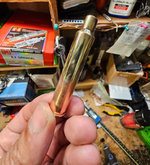
So is the idea its only surface discoloration if the red surface buffs out to the yellow brass? Does this mean my brass is still good?

1754872867513.png
 
My first wife used net bags or Lingerie bags. I learned that they work well to keep cases sorted while being washed. this would work to keep the cases in that basket also.
So now I can think of one good idea I got from the ex! DR
 
I forgot I have an old dremel tool. It even has a tiny polishing wheel..... hold on.
....(queue Jeopardy theme music)....


So is the idea its only surface discoloration if the red surface buffs out to the yellow brass? Does this mean my brass is still good?

View attachment 2143321
It means you made it pretty. No idea of the brass is compromised. Probably not, but do you really want to find out the hard way?
 

Upcoming Events

New Classified Ads

Back Top