


JavaScript is disabled
Our website requires JavaScript to function properly. For a better experience, please enable JavaScript in your browser settings before proceeding.
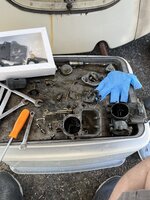
I had to do it. Sorry.

par.jpg
 
It's was la
I agree. Sounds like a stuck open injector or a cracked intake. If you have a temp gun shoot temps of each cylinder exhaust manifold before I
it goes into the collector. If you have a dead cylinder the temp difference will be obvious. When reinstalling the intake are you using the proper tightening sequence? If all that looks good I would check fuel pressure after the regulator on the manifold.

"NO water or super clean got on the distributor or batt."

I am a bit confused why you have a distributor as this should be a coil on plug?

View attachment 2064266
It was late and I was tired from screwing with it all day, I meant to day Alternator not distributor 🙄
 
Good call. Pretty easy to swap entire coil pack banks and see if the problem moves from bank 1 to bank 2 also. The multiple misfire and fuel smell leads me think its injector or regulator failure though. A bad ground or ground strap can make the coils behave funny also.
Possibly injector or regulator issue but lack of complete combustion or no combustion of fuel will cause fuel smell.

Plenty of others already mentioned lots of possibilities for diagnostics. This stuff can be a pain in the back of the lap when it's in front of you.

Sounds like there's some way more qualified then this backyard mechanic but I've yet to send any of my vehicles to a mechanic. However, I have nothing newer than 2006, it's a pain at times I couldn't imagine the new stuff.
 
Last Edited:
I paid less for my property than the price of a new vehicle!
Even considering the Monopoly Money situation, the cost of new vehicles is astonishing. I know people make more money now than I used to. But I'm still amazed. Yet people keep finding ways to buy new rigs. Favored method of finance closers, extend the term. I believe cars are better made these days, in general. Which may cause them to stay in service long enough to reach the payoff date. But when they go bad when the warranty runs out, Katie bar the door.

When I've read online articles about people having problems with Tesla vehicles, I get the impression that customer service after sales is one of the things that Elon has managed to do away with. Spend all that money and have lousy service. Yet the cult continues.
 

I brought my new born daughter home from the hospital in my 2003 Maxima. Now the same Maxima is her first car. Of course this means a fair amount renovation. We order all of our parts from RockAuto which saves a fortune in parts versus the local parts store. The first thing we did was replace all the plugs, coils (coil on plug configuration) and fuel injectors. All those for the 6 cylinder engine were just over $500 from RockAuto and in there somewhere the idle studder smoothed right out and no more misfire codes. (Same parts from Napa were over $1200)

Some times the spray and pray (and pay) parts replacement works. Being able to purchase reasonably priced parts and install them yourself makes this approach much more affordable than going to a mechanic... which is pretty much what most of them are doing anyway.
 
I'm gonna toss this out there, but you MAY have a bad injector seal, given the age and mileage, plus if anyone got in there and futzed around before you and rolled, pinched, or tore a seal, that would cause not only a lean condition, BUT would trip the knock codes and cause the fuel smell, let alone a rough running engine! I would also get a noid light tester and start testing the injectors themselves and have a real close look at the wiring!
Another thing to look at is the coils, again, given the age and milage, you could have a couple gone bad, or the lightning hoses could also have loose connections, or breaks in the cabling, a simple continuity test will tell the tail on the lightning hoses, the lightning boxes you can test old school, with a plug attached and crank her over and watch for the lightning!

Lastly, CHECK the DAMN GROUNDS, ALL OF THEM, with the wet coast states now using de-icer on the roads, it doesn't take hardly any to cause ground issues, you wouldn't believe how many issue I have found that simply traced to bad grounds!
 
Two misfires on cylinders that follow each other in the firing order are logged by the ECU from crankshaft speed from the crankshaft position sensor. It is unlikely, but not impossible that two coil packs/wires/plugs/injectors failed at the same time.
P0300 is logged generally anytime there is a variation is crankshaft speed that cannot be isolated to just one cylinder.
The firing order for the 2004 Yukon 6.0L engine is 1-8-7-2-6-5-4-3

A misfire that is followed with knock sensor faults and then oxygen sensor faults and a raw fuel smell would indicate that you may have a mechanical issue with the engine.

The oxygen sensor fault from a generic scan tool could be a sensor, rich condition, lean condition, Oxygen sensor heater circuit etc
A vacuum leak (cracked intake, hose, gasket) should not normally cause a Knock sensor fault

An intake valve issue can cause air to be pumped back into the intake from the cylinder. This air has already been measured/counted by the Mass air meter (if applicable) which can cause an air fuel ratio error without an external vacuum leak. I bring this up, because of the comment about a sucking noise.


My personal diagnostic order would be the following. (after quickly swapping coils 2&6, and spark plugs 2&6 all to other different cylinders and writing down where they went)
Ensure the PCV or crankcase ventilation system is working correctly. I don't normally work on American V8's. If it has a pvc valve, then make sure its clean and working, if this engine uses a PCV diaphragm then make sure its not torn. If it uses a diaphragm, and its torn, the oil cap will be under vacuum when running.

Find a scan tool that can monitor short and long term fuel trims. If your short term fuel trim is positive you may have a vacuum leak. Positive means the ECU is adding fuel. If you can't monitor fuel trims, move to a smoke test.
Smoke test the intake system. (requires a smoke machine)
Compression check all cylinders properly with fuel pump disabled and throttle wide open and a fully charged battery.
If any are found low on the first revolution or the final pressure reading, I would perform a leak down test and use a camera to look at the piston walls and valves.

There are some videos on YouTube how to make a smoke machine, Amazon also has cheap versions. type "automotive smoke machine' into Amazon, there is one for $58. Also look for a "automotive smoke machine bladder adapter" it inflates and will allow you to remove the air filter and actually pressurize the intake. This will be a very low pressure, but is more effective than just putting the smoke into an intake port.
 
Thanks for all the suggestions guys, although some are WAY over my expertise level. I don't know how to check ohms and voltages with a meter... I suck at that stuff, I don't think it's a compression issue, I'm pretty sure I somehow kinked/split/fractured the nylon hard line that goes to the purge valve on top of the intake. Iwas going to starting this morning and check it but when I went out to the shop I discovered I left my stupid code reader plugged on the the OBD port and absolutely killed the battery, soooooooooo here I am and my wife just got home with a new battery about 30 min ago.
So I will update this thread tomorrow after several cups of strong balck coffee and some swearing at the car gods! Thanks again for everybody's effort to chime in!
 
This is an excellent thread on diagnostics.
Changing the plugs & wires may not have been the solution to the problem.
Much of "debugging" nowadays has (sadly) become just swapping out parts.
Lastly, CHECK the DAMN GROUNDS, ALL OF THEM, with the wet coast states now using de-icer on the roads, it doesn't take hardly any to cause ground issues, you wouldn't believe how many issue I have found that simply traced to bad grounds!
So true. Grounds, grounds, grounds, grounds.
I got called in to work at the Shell Refinery in Anacortes because a safety system was shutting down the whole refinery. We isolated it to a system of sensors, and checking connections, it turned out to be a loose ground wire.
 
Just because there's a code does not mean that specific part is bad. You'll drive yourself insane chasing codes around, especially if every time you turn the sucker on you get a different one.

Unfortunately, throwing parts at a problem is an issue even with professionals. Some of the people I work with have made $50k misdiagnoses because of a loose wire. "But the code said"
 
Last Edited:
If you think you may have a cracked breather line and can't see the area, get a can of starting fluid and carefully spray a SMALL amount at the line in question with the engine running. If the idle increases, you have found your leak. Alternatively you can use propane from a torch. What you are doing is temporarily fixing the mixture problem with the added "fuel".
A fire extinguisher ready to go is mandatory for this test.

I'm don't commonly work on GM products, but have seen their lifters that allow cylinder cutout fail, not sure if your engine uses this or not. That is why I was thinking it could be a mechanical issue. The knock sensor fault after the misfires is what leads me this direction. Just a possibility.

I suspect this is not an electrical issue, however…
If you do want to improve your diagnostic game you can do so with even a cheap mutilimeter and an hour of your time learning.

YouTube "multimeter automotive voltage drop test"

In short, this is how resistance is professionally checked vs using the Ohms or resistance function of the meter. Knowing how to perform this one test will cover 90%+ of all automotive electrical issues. This is how you professionally check a ground, battery cable, switch, etc.

Using the ohm function of a meter can test continuity, but will not be able to determine if current can flow through the connection. A voltage drop test can prove any switch or connection near instantly.

If you go have trouble visualizing electricity, don't feel like you are alone. Pretend it's a fluid or hydraulic circuit.

I direct messaged you my email yesterday, feel free to reach out.

I'm an ASE Master tech with an ASE L3 advanced certification for Electric vehicles and took 1st place for Oregon in college in the automotive field. I normally fix German cars that the last 6 shops or the dealer can't figure out. Happy to just help you as I can. Not looking for any type of compensation.

Good luck.
 
I have worked on and swapped several of these LS based motors.
View: https://m.youtube.com/shorts/d5D-yKwMoBo


Video shows the all the grounds. The one on the top and back of the motor ties into and ground the coil harness. Check them all though.

If it still happens, swap coil banks and see if the problem moves from side to the other. Swaping coil banks is easy with 4 small bolts holding the coil rack to the valve cover and the big plug in the middle of the coils and it comes off.
 

Upcoming Events

New Classified Ads

Back Top