


JavaScript is disabled
Our website requires JavaScript to function properly. For a better experience, please enable JavaScript in your browser settings before proceeding.
Shoulder bumping doesnt straighten a bullet out.
I would measure your shoulder datum with a comparator. If you full lenght size, without shoulder bumping but truly FL size the case it should be slightly smaller than saami spec but the only way to know is if you measure the shoulder datum. If your not sizing the full length of the case then it might not fit other rifles. Annealing might help it form better too, its worth noting.
Must be called something else then what I'm thinking of in the resizing process.

But worth noting and looking into thankyou very much.
 
Measure and compare the neck, shoulder, above belt, and belt diameter on both the cases that chamber and those that don't.

Bruce
I don't have much brass from the M77 to compare to but with what I have.

On neck M700 gets about four thousandths bigger vs the M77.
0.311in vs 0.307in

Just about the belt M700 brass is once again bigger but not in any meaningful way that I can see 0.512in or 0.5115in compared to the M77 0.5105in or 0.509in

Belt diameter is the same all around 0.530in to 0.529in
 

The differences you see would mostly matter if there is a carbon ring. Also you need to figure out where those scratches are coming from.

If you don't have a bore scope, chock up a slotted brass jag on a short length of brass cleaning rod, and put a swatch of lead-away cloth in the slot. Insert just past shoulder into chamber neck and spin with low speed cordless drill. If you see black carbon, you have a cleaning to do.

You see those black lines on the brass right next to the neck rim? That's what builds up in the chamber neck. Bore paste will quicken the job.
 
Last Edited:
There must be some meaningful difference between cases that chamber and those that don't.

Maybe the 700 chamber was a bit oval. Measure the 700 brass twice at a 90 degree difference.

Measure the same distance halfway up the body on both cases and scribe a line with the calipers, then measure the diameter. Try it again just below the shoulders. Black marker on the cases before scribing will help you see it.

Bruce
 
Im guessing its the shoulder datum.
Without a comparator tool, it's all a guessing game. I used one to solve my similar issue with 308 that turn out to be really hard brass that would spring back from the shoulder bump. And it was a Ruger 77 it had a problem fitting. Extra annealing time solved the problem, as well as turning the shell holder and recompressing several times.
 
Last Edited:
Without a comparator tool, it's all a guessing game.
true, but if its been properly full length sized it should fit every rifle. His post #15 leaves me wondering if its being sized correctly...

Yes. I would hope so, considering I have two different manufacture die sets one of them is bound to be full length. And as per my OP at first my uncle and I thought I was getting deep enough to the shoulder so we screwed the die body further into the press making a top of the stroke press not possible because the case is in there. At that point we just became puzzled as all hell.
 
There must be some meaningful difference between cases that chamber and those that don't.
As I related in the What Did You Reload Today thread last month, I experienced .270 cases that fit into my bolt action rifle just fine, that would not chamber in my Remington 7600 pump action. I had screwed the sizing die down to touch the shell holder, then backed it off 1/2 of a turn. I was able to chamber cases in both rifles when I tried again later and didn't back off that 1/2 turn. In my mind it didn't seem like a meaningful difference, but that 1/2 turn made all the difference.
 
As I related in the What Did You Reload Today thread last month, I experienced .270 cases that fit into my bolt action rifle just fine, that would not chamber in my Remington 7600 pump action. I had screwed the sizing die down to touch the shell holder, then backed it off 1/2 of a turn. I was able to chamber cases in both rifles when I tried again later and didn't back off that 1/2 turn. In my mind it didn't seem like a meaningful difference, but that 1/2 turn made all the difference.
That would be the difference between shoulder bumping and true full length sizing. Which affects the case shoulder datum location. I shoulder bump all my rifle cases and 1/2 turn is a lot, I dont even think it would touch the shoulder if I turned it that much, thats about .036" of vertical movement (7/8-14 threads)
 
So I applied some dye chem on my brass and that showed scratching after attempting to cycle through the gun.
Rereading the thread.

Color the brass, carefully chamber it by hand to avoid scratches. Gently close the bolt but not to totally tight jamming. Work the bolt with case back and forth, maybe 1/2 inch, several times, touching the jam point. Extract and look at it.

You are looking for a ring around the case with the coloring removed. Try variations of this until you find that ring. That's where the case is too large in diameter.

If the case is too long in the body and not too large in diameter, there will disturbance to the coloring on the shoulder, but no distinct ring on the body.

Bruce
 
That would be the difference between shoulder bumping and true full length sizing. Which affects the case shoulder datum location. I shoulder bump all my rifle cases and 1/2 turn is a lot, I dont even think it would touch the shoulder if I turned it that much, thats about .036" of vertical movement (7/8-14 threads)
My intention was full-length sizing. It probably was only 1/4 turn not 1/2. I thought I followed the directions but upon further review I found - not quite. The directions say to lower the die to touch the shell holder then move the shell holder out of the way and lower the die another 1/8 to 1/4 turn. I moved the die up instead of down. I was thinking if the die was already touching the shell holder, you must raise it a little to avoid wear and tear. As Trump would say - "WRONG". The instructions actually say to "cam-over" which is what I was afraid would create wear and tear. (I've seen RCBS advice not to cam-over with carbide dies, and another unvetted source said not to cam-over on belted magnum cartridges.)
 
My intention was full-length sizing. It probably was only 1/4 turn not 1/2. I thought I followed the directions but upon further review I found - not quite. The directions say to lower the die to touch the shell holder then move the shell holder out of the way and lower the die another 1/8 to 1/4 turn. I moved the die up instead of down. I was thinking if the die was already touching the shell holder, you must raise it a little to avoid wear and tear. As Trump would say - "WRONG". The instructions actually say to "cam-over" which is what I was afraid would create wear and tear. (I've seen RCBS advice not to cam-over with carbide dies, and another unvetted source said not to cam-over on belted magnum cartridges.)
Interesting, none of my dies instruct to turn deeper than touching the shell holder. Redding says you will "feel" the shell holder bottom out. I bought a Forster Accu Ring for shoulder bumping, increments of .001" marked on the lock ring. I find I only need about .004"-.008" at most (guessing maybe a 1/16" turn) for all my rifle calibers to bump the shoulder only .002". Annealing helps greatly.
Anyways, if the OP has turned back his sizing die and it doesnt fully size the shoulder datum enough it probably wont fit other rifles.

1740985232986.png
 
true, but if its been properly full length sized it should fit every rifle. His post #15 leaves me wondering if its being sized correctly...
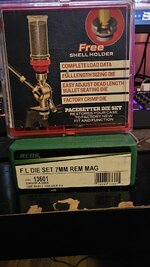
To put this concern to bed, yes. I have full length dies. I put the die body down to touch the shell holder, I run the ram to the top of the stroke. I do not have neck sizing dies of any kind nor have I neck sized this brass. It's all been full length resized. Here's my die sets plane as day Full Length.


1000005318.jpg
 
Thats interesting to learn, all my dies are Redding and Hornady, none are carbide dies. Ive never checked for play in my press linkages, I'll check next time.
 
To put this concern to bed, yes. I have full length dies. I put the die body down to touch the shell holder, I run the ram to the top of the stroke. I do not have neck sizing dies of any kind nor have I neck sized this brass. It's all been full length resized. Here's my die sets plane as day Full Length.
Thanks for putting up with me, :)
So then if the cases are FL sized they should fit... the only other thing is the trim length could be hitting the step in the chamber. Otherwise, my guess is the new rifles chamber has something wrong, maybe headspace is off.
 
@iron_road Do you have a loaded ammo checker? If not, maybe get one to see if problem brass checks OK in it. If so, then problem is in chamber. If not, then brass is a problem.
I don't but I'm almost positive it's the brass being so stiff the shoulder datum/ bump is out of spec. I was watching Ultimate Reloader and apparently what can happen is you can neck size or full length resize but the shoulder still bounces out of spec. So annealing might be the answer.
 
If the brass has been fired several times without any annealing i can see it resisting resizing.
I anneal after every firing, when i bump the shoulder i find consistency withing a few thou on the shoulder datum. Prior to adding the anneal step the datum dimension was all over the place...
I find annealing an essential step in the reloading process.
 

Upcoming Events

New Classified Ads

Back Top