Join the #1 community for gun owners of the Northwest
We believe the 2nd Amendment is best defended through grass-roots organization, education, and advocacy centered around individual gun owners. It is our mission to encourage, organize, and support these efforts throughout Oregon, Washington, Idaho, Montana, and Wyoming.
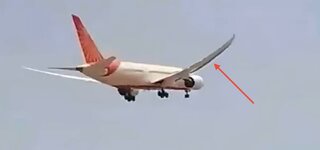
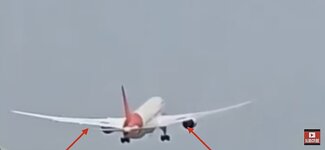
After reading your post I took some stills and enhanced onmy phone and I see front slats for sure and most likely rear flaps late in the video. So that supports this idea very accurately from what I can make out.
Second photo we don't see a smooth line on edge of wing, we see broken edges from flaps. I assume the shadows on that second photo are either the gaps from the flaps or perhaps some spoiler on/aeliron or whatever the bubblegum they are called that operate independently from the flaps. I don't know on that.
THE death-cheating Brit sole survivor of the Air India disaster has revealed a clue that something was wrong just moments before the crash. Vishwash Ramesh, 40, said the cabin lights began flickeri…
www.thesun.co.uk
A passenger from the day before said the air conditioning, lights, screens, and flight attendant call switches weren't working.
A PASSENGER who flew on the doomed Air India jet just two hours before it crashed said the plane was ridden with faults. Shocking footage showed the Boeing 787 Dreamliner’s interior with defe…
www.thesun.co.uk
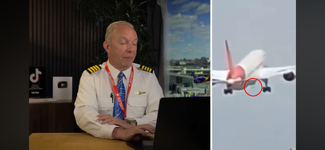
Blancolirio says the rat was deployed and that could mean loss of electrical or hydraulics. The plot thickens…
Dude says survivor heard load bang and lights flicker. He says thats what would happen when Rat deployed and supplied electrical. He shows a photo of rat deployed on the plane also. Indicates loss of power in both engines.
Old video of 787 factory workers saying they would not fly on one due to shotty work and workers on drugs. Also the whistleblower guy who reportedly killed himself worked at the 787 factory. Of course could be unrelated such as contaminated fuel also. Not enough info yet.
A frightening video shows ten Boeing engineers admit they would not fly on the 787 Dreamliner jets they were building like the Air India plane that crashed Thursday.
Lots of folks are speculating in the 787 if the engines had both quit, or were way behind the power on take off, that's an interesting question, and here is the kicker, the audio alone doesn't provide enough evidence of this, especially when you can hear the R.A.T. spinning!
Years ago, I had the chance to see the then new "Dream Liner" prototype Flying, of of the things that really struck me was just how quiet it was, even at take off, it didn't have that tell tail fan howl, or thunderous exhaust roar, it was really that quiet, so I have no idea from what we hear in the video if it was at max power or not, any other big airliner should have been at full ear splitting power, you shouldn't even be able to hear the R.A.T. if deployed, let alone hear yourself think!
Needless to say, any accident that involves loss of lives is a tragedy. I worked at Boeing for 46 years, mostly in commercial airplane sales and marketing. I have had friends calling me and asking me what I know. I don't know anything more than anyone else at this point. I don't like to speculate on the possible cause or causes of an accident. It doesn't matter if it's a Boeing or Airbus or Embraer aircraft, or which company made the engines. Social media is full of speculation and it's not fair, at this point of the investigation, to the pilots or the airline or the maintenance crew or the airframe/engine manufacturers. Let the investigators recover the flight data and audio recorders, and then analyze the data.
Let me just say that the available video is not of good enough quality to discern whether the flaps were deployed for takeoff. They could be at 5 degrees and you would not be able to tell from the video. However, there are four separate steps in the preflight sequence to ensure the flaps are at the proper setting. The software will not let you proceed if flaps are not set.
The Flight Data Recorder was recovered and is reported to be in useable condition. The Cockpit Voice Recorder received substantial damage but the recording may be recoverable. The FDR should tell the tale about engine power output and flap settings.
The two things that seem to be known is that the RAT emergency electrical/hydraulic power unit was operating soon after liftoff, and that the aircraft used almost all of the runway before lifting off. Both indicate something was wrong late in the takeoff roll.
We will need more information to determine what wasn't working right, much less why it wasn't working right.
The Flight Data Recorder was recovered and is reported to be in useable condition. The Cockpit Voice Recorder received substantial damage but the recording may be recoverable. The FDR should tell the tale about engine power output and flap settings.
The two things that seem to be known is that the RAT emergency electrical/hydraulic power unit was operating soon after liftoff, and that the aircraft used almost all of the runway before lifting off. Both indicate something was wrong late in the takeoff roll.
We will need more information to determine what wasn't working right, much less why it wasn't working right.
Yes, but I can't help but wonder if politics is already being played here. This is India's national carrier. There is reputation and government image at stake. This may be why the FDR and CVR have not already been sent abroad for data recovery. The AC was in serivce for 11 years without major issues it seems. It had to have gone through C checks, and maybe even a D check by the time of the incident. I highly doubt the cause will be a Boeing issue, ala 737 Max and MCAS, and more likey a crew/maitenance one.
Doesn't it seem like FDRs and CVRs are archaic?? Why don't they livestream that crap to the cloud?? That way it doesn't go down with the airplane. Soccer moms have better recording abilities for little Timmy's third grade piano recital than the airlines have for the most important information on the plane. Stupid!!
Doesn't it seem like FDRs and CVRs are archaic?? Why don't they livestream that crap to the cloud?? That way it doesn't go down with the airplane. Soccer moms have better recording abilities for little Timmy's third grade piano recital than the airlines have for the most important information on the plane. Stupid!!
The most important information on the plane is that which is presented to the pilots flying that plane, period. Everything else is secondary.
Also, as much as you are used to your instant access around your home, not all of the world has the coverage required to receive that amount of data, even via satelite uplink.
The most important information on the plane is that which is presented to the pilots flying that plane, period. Everything else is secondary.
Also, as much as you are used to your instant access around your home, not all of the world has the coverage required to receive that amount of data, even via satelite uplink.
Of course that's the most important info. It's also what they are recording.
They have radar and radio contact and can sell me internet on the phuquing plane anywhere in the world, they can sure as hell transmit the fate of a few hundred people to the cloud!!
Of course that's the most important info. It's also what they are recording.
They have radar and radio contact and can sell me internet on the phuquing plane anywhere in the world, they can sure as hell transmit the fate of a few hundred people to the cloud!!
They could also charge you $1000 to fly from Portland to Seattle so that said data could be uploaded to the cloud in near real-time. There's a very high cost for instant satellite communications, and the coverage isn't ubiquitous despite what Starlink and others will tell you. Selling a service versus providing said service are two very different things.
Yes, but I can't help but wonder if politics is already being played here. This is India's national carrier. There is reputation and government image at stake. This may be why the FDR and CVR have not already been sent abroad for data recovery. The AC was in serivce for 11 years without major issues it seems. It had to have gone through C checks, and maybe even a D check by the time of the incident. I highly doubt the cause will be a Boeing issue, ala 737 Max and MCAS, and more likey a crew/maitenance one.
I agree that the problem is unlikely to be a design flaw. I also am doubtful that the crew failed to follow proper procedures, and they appear to have done a very good job of flying a stricken aircraft as well as possible.
I think the most likely cause is lack of power. Where this happened, and to what extent is in doubt. If early enough in the takeoff roll, the takeoff should have been aborted. After a certain point, depending on conditions, the takeoff cannot be aborted without crashing while ground-bound. This is opposed to continuing the takeoff and returning to land.
One video shows the plane lifting off at the very end of the runway and climbing out at a shallow angle. It then stops climbing and starts a slow descent until it crashes. This might indicate a decrease in power after liftoff, and is my suspicion.
I think the crew encountered a power problem that kept getting worse. This lead them to follow procedures that should have kept them safe, but the continued decrease in power left them with no where to go but straight ahead and descending.
I agree that the problem is unlikely to be a design flaw. I also am doubtful that the crew failed to follow proper procedures, and they appear to have done a very good job of flying a stricken aircraft as well as possible.
I think the most likely cause is lack of power. Where this happened, and to what extent is in doubt. If early enough in the takeoff roll, the takeoff should have been aborted. After a certain point, depending on conditions, the takeoff cannot be aborted without crashing while ground-bound. This is opposed to continuing the takeoff and returning to land.
One video shows the plane lifting off at the very end of the runway and climbing out at a shallow angle. It then stops climbing and starts a slow descent until it crashes. This might indicate a decrease in power after liftoff, and is my suspicion.
I think the crew encountered a power problem that kept getting worse. This lead them to follow procedures that should have kept them safe, but the continued decrease in power left them with no where to go but straight ahead and descending.
IM seeing something else here, but I agree with part of your post. The take off roll at the weight being reported should have had a much more pronounced flap setting, something we should have seen in the footage, but we didn't! Couple thoughts on that, supposedly that Boeing needs the correct pilot inputs before it will even start a take off roll, so one would think that would also include the flap settings and we should have seen them at the take off settings, which would be a much more pronounced visually identifiable setting! I'm wondering if somehow the pilots could have overridden those settings, choosing to fly it out rather then rejecting at V-1! Or, maybe they reached V-1 and thought they had enough power/speed to complete the take off and climb out? Something is very wrong with this whole event, and the pilots should have had enough time, distance, and experience/training to identify that they are not going to make it once at V-1, no mater what they do, so we see them try to climb, instead of slamming in the brakes @v-1 and rejecting the take off! Maybe they retracted the flaps hoping to trade drag ( and lift) for speed? That doesn't explain the RAT deploying, and the obvious lack of thrust, or the flaps at or nearly cruise settings upon lift off!
If our Supporting Vendors don't have what you're looking for, use these links before making a purchase and we will receive a small percentage of the sale