


JavaScript is disabled
Our website requires JavaScript to function properly. For a better experience, please enable JavaScript in your browser settings before proceeding.
:eek:

Private jet causes Southwest to go around at Midway today. It crossed the runway while Southwest was landing.


Holy crap that jet pulled out right in front of the south west plane just as the wheels were about to touch down. Very close call and an alert southwest pilot. Very close to another big air disaster.

View: https://youtu.be/rG_lOc_Zh_w?si=U5l6v2An9oVM5mi6
 
blancolirio breaks it down. The business jet did not hold short of the runway as instructed by Ground Control.

View: https://www.youtube.com/watch?v=m6BLyJ2QiFY
Looks to me with this one and helicopter one everybody is using 1940's tech to coordinate complex operations with high volumes of aircraft. Both instances critical communications was cut off. Seems like as an industry they need to bite the $ bullet and upgrade to digital communications.

I think near the end Blancolirio briefly mentioned an onboard diagram to show where you are on the runway? Seems like there should be a more advanced system such as on onboard map which clearly gives them a green light/red light or something. That would be in addition to fixing the comms problems. That's what it seems like to me are the problems from a purely layman's perspective. Comms is #1 problem imo.

What other industries settle for 1940's tech for the sake of backwards compatibility of older/less advanced machines? Boating maybe? Less pressure on boating than juggling multiple airplanes on real time. Seems like most industries technology advances why can't they implement more advanced comms?
 
Last Edited:
Aviation Data Link has been around for a long time. The resistance of the FAA to incorporate it into Air Traffic Control has limited its use.

Using Data Link would be one way to improve communications and control at major airports. Small, private aircraft rarely, if ever, go there, so backward compatibility is not an issue.

There have long been advanced equipment requirements to operate in airspace near busy airports. Incorporating Data Link in that airspace will not be a large burden, because most aircraft that use that airspace already have some form of Data Link in regular use for non-regulatory purposes.

The big issue is the FAA resistance to change.

https://simpleflying.com/datalink-communications-aviation-guide/
 
At Ronald Reagan airport American Airlines plane was landing on the same runway as a plane taking off and had to do a go-round. Seems this wasn't a near miss like the other one though. They may just be reporting every little thing in this case.
 
Click bait. Sensationalism sells.

In other news, over 10 million cars almost collided head-on today, with closure rates (60 mph each direction) of 120 miles per hour. They had no barrier to separate them, and passed within six feet of each other, with only a painted line to separate them!
 
The new information for me is that there was a policy of having the helicopters hold to the north when traffic was landing on Runway 33. In this case, the controller let the helicopter continue, based on the assurance that he had "traffic in sight." Undoubtedly, the controller, being overloaded because of management letting the second controller leave early, passed responsibility for maintaining safe separation on to the helicopter in order to focus on the flow of landing traffic. This should never have happened.

I didn't like how the fact that the Instructor Pilot (IP) keyed his mike and cut off important information from the controller was dismissed so casually. This was described in one of the NSB presentations. The IP was described in glowing terms, yet he was impatient when traffic was called out, and reported traffic in sight way too quickly to have actually ensured that he really did. I detailed my opinion on this in post #281 in this thread. The one thing this video brought out was that the IP may have initially misidentified another airplane as his conflicting traffic, and never reevaluated this action.

As an aside, and not really a factor in this accident, it is interesting that the 500-hour mark is now accepted as a benchmark for skill in military aviation, when it has long been identified in civilian aviation as a point where the level of confidence exceeds the level of skills. I know that the intensity of military training is much higher, but there is still a window where some pilots get themselves into situations because they overestimate their skills.

I think this video helps correct the misconception that DEI in some way contributed to this collision. I can see no way that it was involved.

People assume that a check-ride is just a formality. In fact, they sometimes become very intense. The older brother of a close friend was taking a Navy instrument check-ride that ended up running into Mount Rainier. A check-ride isn't perfectly safe just because there is an IP supervising the pilot.

It will likely never be said in public, but people get accustomed to work-arounds to make their job manageable. In this case, I believe that the Blackhawk pilots discovered that they could proceed without delay if they called out "traffic in sight, request visual separation." Then they would try to spot the traffic as they proceeded, and if they couldn't see it, would assume that the altitude separation would be enough.

Ironically, it is possible that when the IP couldn't spot the traffic, they slowed down out of caution, which inadvertently caused them to climb slightly into the path of the jet. This makes sense, and explains the altitude divergence.
 
Totally not related to anything, but I don't recall seeing this Apache helicopter crash video before. Looks quite old.
View: https://youtu.be/CUtyUTLeW1g?si=wEj72hJuezom7_lD
It looks like the incident happened up in the mountains. I suspect that the pilot had been doing buzz jobs at sea level, and had an established program of low pass, pull up, turn, and make a low pass the other direction. He probably had speeds and power settings that worked perfectly at low altitude, but failed to plan for the reduced air density in the mountains. This reduced air density reduced the lift produced by the rotor and also reduced the power available from the engine. He got too slow in the pull-up and turn, and had to push over more than he planned to get flying speed back. In fact, he didn't get enough speed/lift to keep from contacting the ground.

Once on the ground, the snow lubricated the glancing contact, but the rising ground ahead eventually turned it into a serious amount of destruction.

I hope no one on the ground was hurt or killed!
 
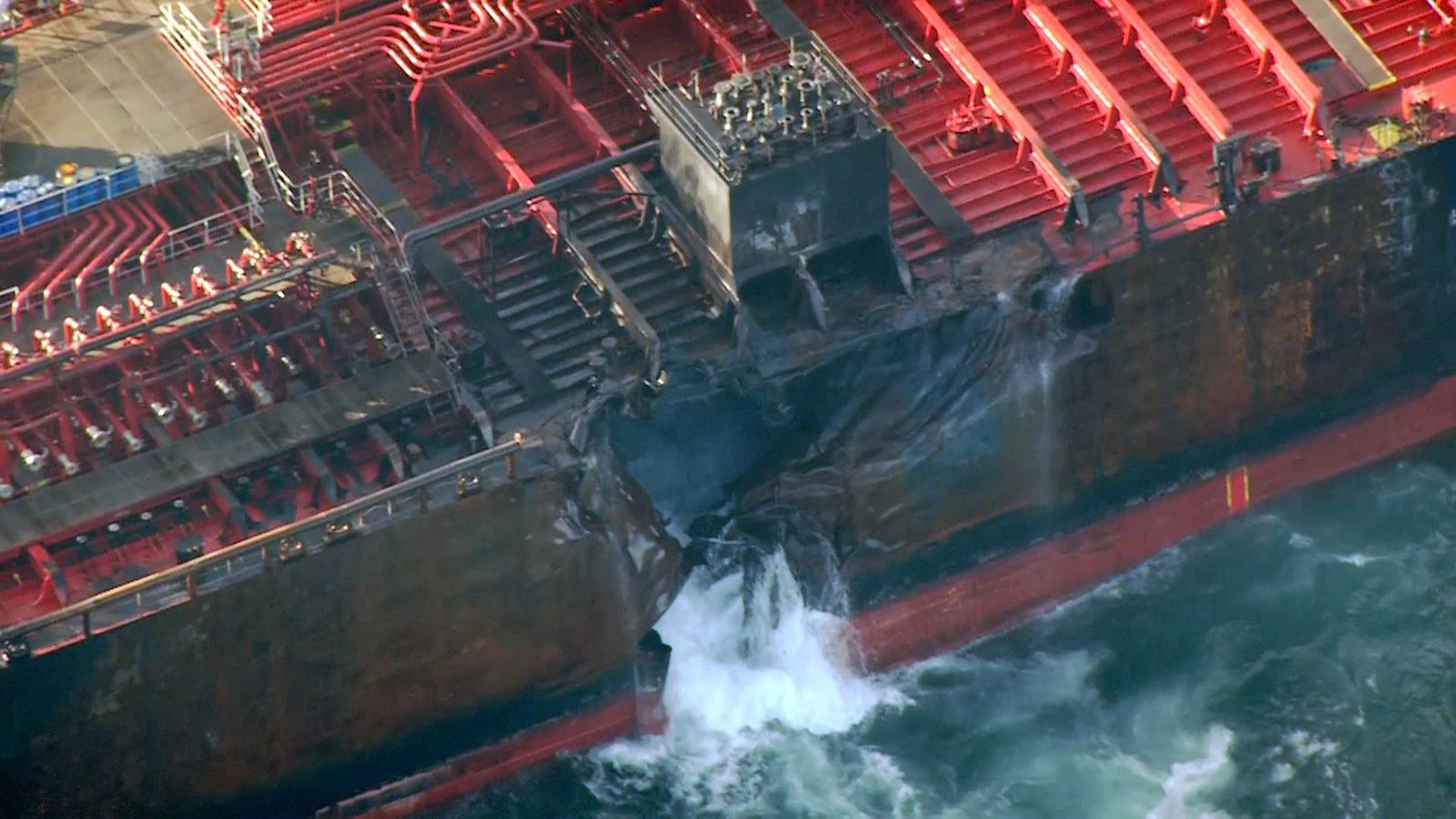
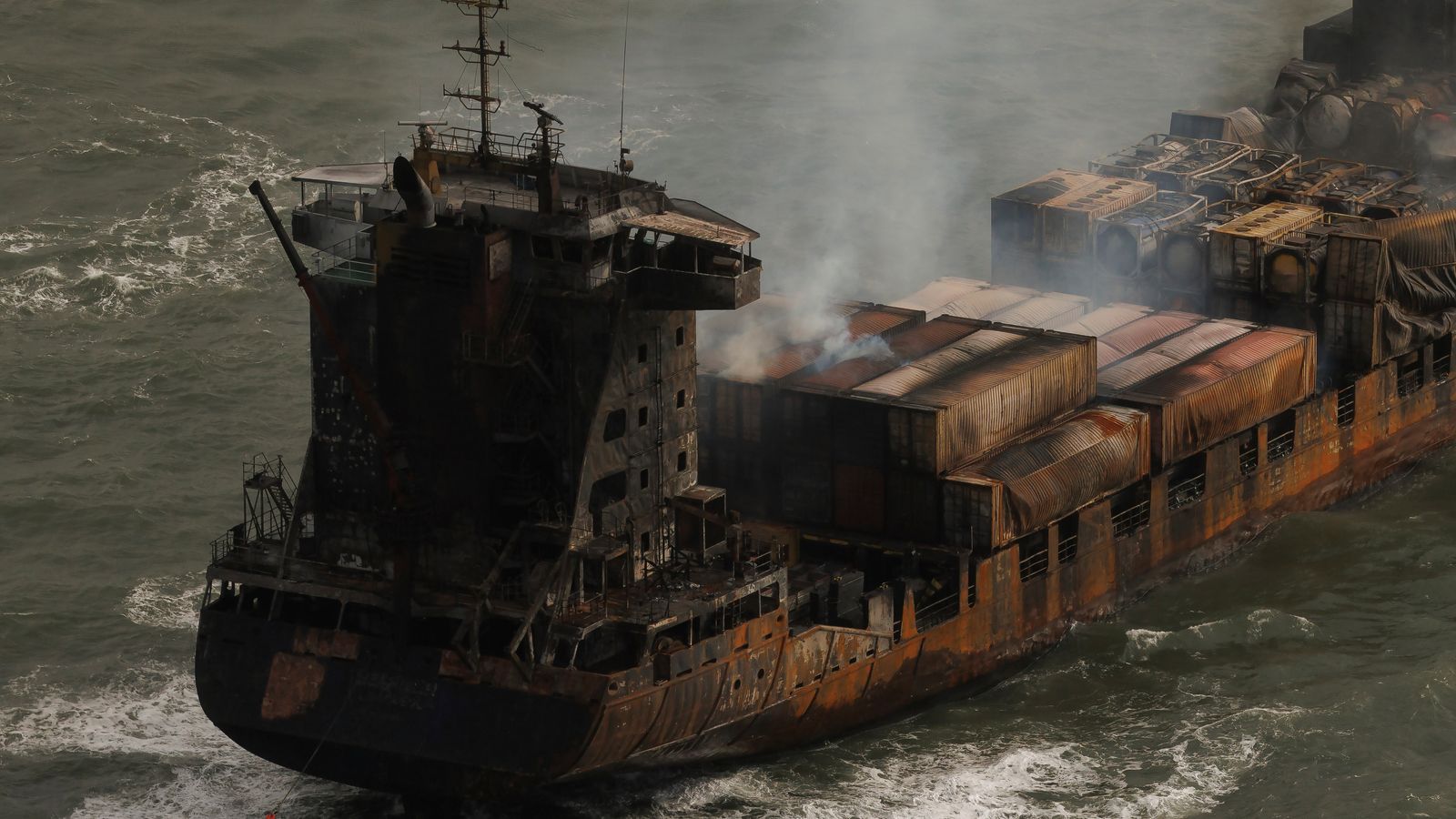
Not plane related but cargo ship full of sodium cyanide crashes into tanker full of us military jet fuel. WTF were they thinking. One boat was anchored 13 miles off the coast of England and the other one plowed right into it apparently.

Captain reportedly said, "sorry, didn't see you there" (j/k)

 
Like driving in a blizzard, speed kills!
Running on auto pilot with out a proper watch on duty is the likely cause here, running at high speed through a known anchorage, on auto pilot, in pea soupe fog, without a standing watch running MK-1 eyeballs and watching the radar scope, at a reduced speed for the conditions, yea, .......
Both ships will sink, it's not even a question of if now, only when, between the impact damage and the fire fatigued metals, there is almost zero chance of saving either vessel at this point, and the world's 6 most power salvage tugs are on scene, but even they cannot save those two ships! So now we have another serious environmental issue that will cost Billions to mitigate, and I'm sure the United States will get stuck with a big chunk of the bill being a U.S. Flagged ship loaded with U.S. Fuel to be supplied to the U.S. Navy, so, now we see what happens!
 
737-800 catches fire after taking off from Colorado Springs. Diverted to Denver. Passengers had to get out on the wing (free showers for all! :s0112: )

View: https://x.com/flynnstone/status/1900337785250471944?ref_src=twsrc%5Etfw%7Ctwcamp%5Etweetembed%7Ctwterm%5E1900337785250471944%7Ctwgr%5Ea10fa520fbb5cccf67a9e2579790a437c699cd0f%7Ctwcon%5Es1_c10&ref_url=https%3A%2F%2Fnypost.com%2F2025%2F03%2F13%2Fus-news%2Famerican-airlines-plane-catches-fire-at-denver-international-airport-passengers-evacuated%2F


Last Edited:
737-800 catches fire after taking off from Colorado Springs. Diverted to Denver. Massagers had to get out on the wing (free showers for all! :s0112: )
Hey everyone, go out and stand on top of the fuel tank of a burning plane. I mean, what could go wrong? I get you might have to evac there, but it might not be the best place to hang out.
 
Hey everyone, go out and stand on top of the fuel tank of a burning plane. I mean, what could go wrong? I get you might have to evac there, but it might not be the best place to hang out.
Certain engines installed on the latest 737 have a problem that causes leaking oil to enter the compressor section, and the bleed air from there that pressurizes the interior can carry smoke into the cabin if it happens to the right engine. In this case, the fire was in the right engine. If that was the case, the immediate need was to get the passengers out of the cabin, and opening an over-wing exit would be the fastest way to accomplish that. Even getting those in the center section of the cabin out there, while those seated in the front and back exited through the fore and aft exits makes sense. That smoke is toxic.
 

Upcoming Events

New Classified Ads

Back Top