


JavaScript is disabled
Our website requires JavaScript to function properly. For a better experience, please enable JavaScript in your browser settings before proceeding.
Messages
4,357
Reactions
2,581
I have been arguing myself in circles on this one and need a tie breaker.

I am working on loading up some .308 ammo to use in my Remington 700P LTR rifle. My planned distances are out to 600 yard since that is where we have steel targets out to at our other property, but it would be nice to get out to 1000 yards. I am not hunting or competing, just having fun at those distances.

I have done some basic case sorting with all being once fire LC 87 brass trimmed to the same length. I am using 168gr Combine Technologies bullets and WC 846 surplus powder. I just loaded 50 rounds using my RCBS Chargemaster to trickle/weigh the powder and that feels time consuming. It is taking me at least 4x as long to load this way vs throwing powder and right now I have 750 rounds to load, and I might pick up 250 more.

For my 24" target AR I load mixed headship/mixed fired brass, with WC 844 thrown, and topped with a 55gr Nosler ballistic tip which keeps me sub MOA. I have loaded a couple thousands round of this. I feel like pistol is more forgiving but I have loaded and shot several thousands of rounds like this.

Once I get the drop charge set it is very rare that it throws a charge more than 0.1 over or under.

So, is it worth it to keep loading these by weight or do I just need to put my powder thrower back on the press?

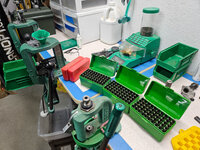
20250303_090641.jpg
 
If you are trying to get the best possible accuracy? Then yes, you want to make sure everything is exactly the same. Cases, and powder. Now if it gets old doing it that slow and you just want to ring the steel? A decent measure will of course work fine. One thing to try? Using same brass load up a box of rounds both ways. The try them on paper at that distance and see if you notice some real difference.
 
For precision work I weigh every charge, for range stuff I weigh about every tenth round to verify it's still consistent. My ole RCBS with the precision insert doesn't ever disappoint.
 
Obviously, ball powder (as is WC844) goes through the powder drop quite well, often much better than non-ball powders. I've loaded a lot of 748 and 296, through a powder drop.

As has been said, ideally you'd weigh everything but maybe weighing every 10th charge or so makes good sense. Personally, if what I'm doing is ringing the steel, I'd not bother.

One man's opinion....... :cool:
 
spent 35+years weigh every single powder charge,
weigh the brass, trim etc etc etc enough rabbit trails to wear out 20 hunting dogs
the powder measure i use is now is within .5 grain at the worst
so at those yards i can weigh each one and "ring" all day
or throw and "ring" half day :D
 
For rifle ammo I weigh every charge.

For revolver ammo I throw them all with bulky powders and weigh them occasionally as well as visually check every case, multiple times. If I feel a hitch in the powder-thrower lever that could affect the harmonics of the throw, that charge is also weighed.
 
As others have weighed in here (pun intended), there are variables.

I consider myself just a service grade shooter, not a precision one. Small groups are nice. But with limitations to my vision, how good is it going to get? I'm looking forward to cataract surgery soon.

Stick powders need a closer look than ball powders. Fluffy pistol powders need a closer look than ball powders.

I used a beam scale for years, a tenth of a grain was never noticed. When I switched to a digital scale, I was aghast at the inaccuracy!! Not really, it's just that your attention is drawn to it. I've also used the RCBS powder "measure" (thrower) for decades, with caution. It's interesting how much charges of stick powders can vary. Ammunition factories don't measure every charge; they have a range of tolerance +/-.

I am a lot more concerned with ensuring that each case has A charge, and with some pistol cartridges, only a single charge.
 
I weigh every time, but I use a drop on a stand with a trickler next to the scale. I don't want to have to trust the rounds I grab are going to do any job I want them to do whether it's 200 or 800 yrds but I only use them on moving targets not steel/paper. I would think that if you have a powder that drops as consistently as you say then go for it. In my opinion it shouldn't matter at the small difference you get at under 1,000yrds. I would however just run a small batch and verify it does all the distances you want to ring the plates.
 
If you want everything the same, you've got to MAKE everything the same -- including your brass hardness, length, weight, primer pockets and bullets -- not just the charge weight!
What you should really do is load 10 rounds using thrown charges without checking all that including run-out! Then load 10 more rounds doing everything to uniform absolutely everything including your brass, bullets, run-out and weigh all 10 charges. Then shoot your targets at 600 yards! Only that will give the correct answer -- but you may have to do all that more than once to get the absolute correct answer!
HOWEVER -- if you're hitting your target now with acceptable accuracy at 600 yards -- I wouldn't bother with all that and just throw your charges!
 
Well I used the trickle again today and did another 50 rounds. Just multi tasked and did other things between the "beeps".

Now just about 600 more to go.....
 
No one weighs pistol charges even though 1/10 of 5 is much smaller than 1/10 of 50. I throw both pistol and rifle charges with a powder measure.
 
No one weighs pistol charges even though 1/10 of 5 is much smaller than 1/10 of 50. I throw both pistol and rifle charges with a powder measure.
When working up a charge/testing I do. Otherwise they get thrown once the desired load has been determined.
 
Rifle charges for guns expected to produce precision are always weighed. Fine work requires more time (in EVERYTHING, not just handloading). If your primary motivation is production rate, you are reloading, not handloading.

The exception is for rifles such as the M94 Winchester .30-30's here, where the load batch will be fired in various guns, and is ball powder. A scoped Marlin 336 that rivals fat varminters for accuracy gets the Cadillac treatment for its dedicated fodder.

Pistol charges (for the most part) are thrown, checking consistency on the scale often.

Once again, I am surprised that no one mentioned the chronograph as a measure of consistency. It will tell the shooter in numerical fashion whether or not the thrown charges are as consistent as the weighed charges.

My electronic scale crapped out some time ago, and I dusted off my trusty Ohaus 304 dial-beam and fell in love again. Don't think I'll go back.

Having said all that, realizing that an appropriate charge of H322 fills the .221 Fireball case brim full, I once charged cases by merely scooping the primed brass into a small cereal bowl of H322, and group sizes (out of a custom Sako/Douglas rifle) at 100 yards were indiscernible from those produced by weighing the powder.

I believe this is more of a tribute to the cartridge and the rifle than it is any comparison of charging technique. Velocities DID vary more with the scooped loads, and longer ranges may have indicated this inconsistency.
 
Last Edited:
WC846 is basically BL-C(2) and I 100% trust the powder throw for powders of that consistently. I do check the throw weight every 25 rounds or so but those ball powders stay right on for me. Like I seriously doubt I can shoot the difference between that and weighed.

Stick powders do not usually throw accurately enough for my ADHD brain so I throw a bit light and trickle up for those. Although I probably can't shoot the difference there either LOL
 
For those perhaps "not in the know", the Ohaus 304 actually operates on energy from a very mysterious force that is not propelled by outside fuel sources such as electricity, but rather from an energy source that some believe may be centered in the core of the earth as it rotates in space.

Gravity.

Look into it.
 
For those perhaps "not in the know", the Ohaus 304 actually operates on energy from a very mysterious force that is not propelled by outside fuel sources such as electricity, but rather from an energy source that some believe may be centered in the core of the earth as it rotates in space.

Gravity.

Look into it.
Witchcraft!!!
 
Here is 190 of the ~250 round I have loaded so far.

This time of year is when I have time to spend loading. As we get further into spring and summer other things occupy my time. Then an as soon as fire season is over we will be heading out in our RV for several months.

20250313_083728.jpg
 

Upcoming Events

New Classified Ads

Back Top