


JavaScript is disabled
Our website requires JavaScript to function properly. For a better experience, please enable JavaScript in your browser settings before proceeding.
Elemental depositing is a thing in a vacuum, not just for carbon. But that usual manifests as an even coating on the exposed side, not a scorch mark. I don't know what kind of fuel they use in that universe, but if it is carbon based most external surfaces will probably get a pretty decent dusting any time multiple ships congregate in the same area.

But if we are talking scorch marks, that is from a localized high energy event. It could possible be from welding with carbon containing materials, or in a carbon rich environment, but I do not see a lot of that kind of material on screen, unless there is a lot of plastic on those ships. My guess is still that those are the leftovers of some carbon based life form that had a high energy event happen to it. Hell, R2 has some of his own high energy equipment, I wonder if that may have been from him trying to weld his way out of a confrontation with someone.
Or the "laser" blasts are actually plasma'd carbon gas or some such with magnetic fields (explains why the garbage masher is magnetically sealed)

Edit wait actually, I remember it now. "Carbonite" seals the Tibanna gas and apparently seals carbon based life forms into hibernation too, so it stands that the gas used is in fact carbon based.
 
Or the "laser" blasts are actually plasma'd carbon gas or some such with magnetic fields (explains why the garbage masher is magnetically sealed)

Edit wait actually, I remember it now. "Carbonite" seals the Tibanna gas and apparently seals carbon based life forms into hibernation too, so it stands that the gas used is in fact carbon based.
Sure? But now we are getting into the really geeky side of things. I do not know if the Tibanna gas was "fuel" in the form of energy production or as in reaction mass for ships. It is the reaction mass that is emitted from the engines, but most Star Wars ships use some kind of reactor for energy production. I am absolutely not going to go down that rabbit hole, someone else can do the leg work on that.
 
Sure? But now we are getting into the really geeky side of things. I do not know if the Tibanna gas was "fuel" in the form of energy production or as in reaction mass for ships. It is the reaction mass that is emitted from the engines, but most Star Wars ships use some kind of reactor for energy production. I am absolutely not going to go down that rabbit hole, someone else can do the leg work on that.
In Legends (formerly Expanded Universe), Tibanna Gas was stated to be what powered the laser cannons on the Rebels' ships. But yeah. We know they use some kind of fuel, we see hoses being disconnected from starfighters, Han explicitly says "running on fumes", reactors apparently can leak, and in newer materials, we get some more vague description of fuels and the like. But back to the topic.... Carbon. :s0140:
 
But back to the topic.... Carbon. :s0140:
I think the actual topic of this thread is something about tires. I forget what exactly now though. But hey, this is NWFA, we don't care about thread topics here, I'm just in it for the BSing, and to hook up with hot singles in my area -er- maybe swap some gun stuff with like minded individuals. Thread drift is a way of life yo. If we take a detour through albuquerque Star Wars legends lore I am here for that.

But carbon is pretty cool stuff. You know that is what life is mostly made of?
 
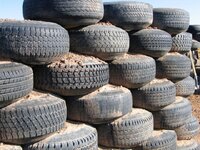
Start by filling those tires with sand and gravel and they become bullet proof. the filled hoops also don't collect water and bugs. and the thick walls hold there temp so once warm they stay warm without much extra heat. these work out like sod houses on the prairie. DR
It seems I've seen underground survival structures like these constructed in Rural desert locations, like Arizona and Southern Nevada. I think it's a good budget option for off grid preppers, that have a decent amount of land, and can thrive in a harsh desert environment. I'm too old for that crap, but I can envision younger people doing this.
 
Tires for gun range
IMG_1883.jpeg
 
Here you go! Packed earth tire houses: https://earthship.com/systems/garbage-management/

Some people live in tire houses.
earthship-design-principles-garbage-materials-2.jpg

My local landfill charges $5 each to dispose of used tires that are not on a rim (more for tires with rims). Something you might want to consider before unmassing a huge used tire collection.

tire-retaining-walls6.jpg


There's no shortage of used tires—at least 2.5 billion are currently stockpiled in the United States, with 2.5 million more discarded every year.


Tire Walls

Structural, Bearing and Retaining Walls made with rammed earth encased in recycled steel-belted rubber tires. Very strong, Economical, Local, Sustainable.
The major structural building component is recycled automobile tires filled with compacted earth to form a rammed earth brick encased in steel belted rubber. This brick and the resulting bearing walls it forms is virtually indestructible.


The tire is used as found without any modification. The process of ramming them full of densely packed earth is achieved with simple human labor and can be done with whatever type of earth is available on the building site.
Common people of all shapes and sizes can easily learn to gather tires and pack them full of earth with simple hand tools and with the same type of human energy used while trying to tone up their bodies in the local gym.
The impact of large scale use of this idea would result in depletion of the giant tire mountains that have become a serious problem in many cities. This building block is therefore achieved with little additional energy.
Thermal Mass
There are few materials of any kind that would provide better, more dense mass for storing
temperature than rammed earth. The rubber tire casings provide a natural form for humanly manageable production of thermal mass building blocks with little more than human energy. There are also very few materials that would provide the structural bearing capacities and homogeneous qualities of an earth rammed tire wall. The diameter of the tires (2'-4″) sets the thickness for the walls of the building. This amount of dense mass surrounding every room provides a thermal battery that helps to keep the building comfortable with no fossil fuels.
Durability
The durability of tires filled with earth can not be surpassed. A buried tire (which is in effect
what we have in a tire wall) will virtually last forever. The only thing that deteriorates rubber tires is sunlight or fire. Since they are filled with earth and ultimately covered with earth and concrete plastered over, they never see sunlight. Tires only burn when surrounded by air. When they are filled and coated with earth and concrete plaster, trying to get them to burn would be like trying to light a phonebook on fire as compared to a wad of paper. The very qualities of tires that makes them a problem to society (the fact that they won't go away) makes them an ideal durable building material. Earth and tires by virtue of their very nature will last forever.
Resilient
Whereas a rammed earth tire wall is amazingly strong, it is obviously not brittle. It can vibrate or move without fracture or failure. Since these walls are so wide and the loading on them is widely distributed, the entire structure would have the potential of absorbing and moving with a considerable horizontal shock from an earthquake. There is probably no other material available at any price that has the reliance that earth rammed tires would have.
 
Last Edited:

Upcoming Events

New Classified Ads

Back Top