Join the #1 community for gun owners of the Northwest
We believe the 2nd Amendment is best defended through grass-roots organization, education, and advocacy centered around individual gun owners. It is our mission to encourage, organize, and support these efforts throughout Oregon, Washington, Idaho, Montana, and Wyoming.
We are indeed in the sticks and once moving on, the goal is to be even farther away from "civilization". Thanks for the idea; I will do some homework on this.
We are indeed in the sticks and once moving on, the goal is to be even farther away from "civilization". Thanks for the idea; I will do some homework on this.
I can do some math, $14,500 for the two power packs, plus $4,000 for installation, then you are going to need about a 14kW solar system for about another $35-$40K. If you are building a house out in the sticks and they local utility is going to charge you $30K or more to bring power to your project, going off grid looks pretty good, if you are already tied to the grid, shelling out $50-$60K is going to take some dedication.
Its not the subsidy, it would be a lease or power purchase agreement, they lean your house so even getting a re-finance on your mortgage can be a hassle.
If you go with propane,
Buy your tanks.
Get enough storage for more than a year.
Stay away from keep full.
Buy in July or Aug.
Prepay or pay on delivery.
Cash is king.
Check prices including all fees
Check all companies in your area.
Make sure there is no contract, some companies give you a great price once. Part of that great price is a 3 year contract, that won't be cheap.
Most propane companies won't tell you this. They want to fill every 2 to 3 months alot of times the first $30 is fees.
I own a propane company.
Its not the subsidy, it would be a lease or power purchase agreement, they lean your house so even getting a re-finance on your mortgage can be a hassle.
nope, if you paid cash there is no hassle. I haven't been in the solar industry since 2011 but I believe the federal investment tax credit expired in 2016, there still may be some state subsidies though, normally they give you a rebate on the net watts installed. When the economy tanked in 2007 SolarCity pioneered the solar lease so they could stay in business and continue to grow. The got investments from companies like google to fund these solar leases that could get you a solar system installed with no money down. The problem is someone else owns that solar system, so they have to put a lean on your property to protect their interest, that is the source of all the hassles. If you just paid for it outright or used an equity line of credit, then there are no long term hassles.
Reports of Tesla solar installations at Walmart catching fire might be something to take into consideration -- unless your lawyers and insurance are better than Walmart's
nope, if you paid cash there is no hassle. I haven't been in the solar industry since 2011 but I believe the federal investment tax credit expired in 2016, there still may be some state subsidies though, normally they give you a rebate on the net watts installed. When the economy tanked in 2007 SolarCity pioneered the solar lease so they could stay in business and continue to grow. The got investments from companies like google to fund these solar leases that could get you a solar system installed with no money down. The problem is someone else owns that solar system, so they have to put a lean on your property to protect their interest, that is the source of all the hassles. If you just paid for it outright or used an equity line of credit, then there are no long term hassles.
Reports of Tesla solar installations at Walmart catching fire might be something to take into consideration -- unless your lawyers and insurance are better than Walmart's
Well, almost six years laters, same question after, presumably, the technology has advanced: anyone setup with one or more of these? If so, what sort of overall setup?
We have 2 solar arrays. Each array feeds 2 power walls and then that feeds a home and an outbuilding or 2. Basically 2 independent systems that connect to a single meter then the transformer to PGE. We have had them about 4 years.
No trouble except we needed to restart a gateway for a communication issue as I recall.
You need energy storage in order to use the power you produce, otherwise you can only feed into the grid. 2 power walls are needed to overcome the startup load of a well pump, or so I was told.
Shop around if you are in the market. Our second array and the power walls were installed by Power Northwest. Garret Hartwell, with Power NW, knows what he is talking about.
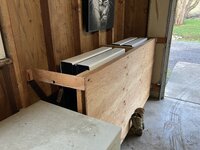
Here is a picture of 4 powerwalls for an idea of how much room they take up. I added the wood shielding to prevent kids from bopping into them.
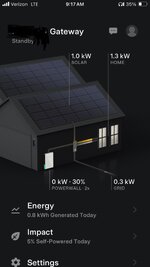
Also pictured is a screenshot to the Tesla app from one of our arrays. It's all automated but you can see track production , change what you have for backup, etc.
The powerwalls are tax advantaged if included as a part of a photovoltaic system, the particulars change. I think it is for this reason that you can't charge them from grid power, here anyway. The exception being that the powerwalls will automatically charge from the grid if there is a weather warning that will likely result in outage. Batteries may make sense without power generation if your utility has variable rate pricing for electricity, we don't have variable rate pricing here.
I think having an electric vehicle with bi-directional charging is the best way to go. When we did our systems this was not an option, leaf to home was around but building code didn't allow it. Given the cost and storage capacity of a car vs. dedicated storage, the ability to move your battery investment and the utility of having an extra car this seems to be the best.
If our Supporting Vendors don't have what you're looking for, use these links before making a purchase and we will receive a small percentage of the sale