



My reloading mistakes over the years, too many to count. But I haven't yet blown up a gun so that's on the plus side of the ledger.
"Rainbow Brass."
Lately, I had a small, mixed lot of brass that I wanted to clean up. To fully remove the carbon and soot from handgun brass, I often start out by washing it in a mild solution of phosphoric acid, in this case trade name Iosso. Usually it works well.
Last time I was out in the hills shooting, I found some of those two piece 9mm cases. Aluminum base, stainless steel shell. Such as Shell Shock Technologies makes, NAS3. I picked up about two dozen to take back and experiment with. Cleaning being the first step.
In this small batch, I had some nickel plated .38 Super and .357, some plain brass .38 Super, and the NAS3 two piece 9mm. They weren't in the solution more than give minutes before I noticed that something terrible was going on. Everything was turning black. So I took them out, rolling them in my nitrile gloved hands to remove as much of the black as possible, then placing them in the rinse water.
I'm not a chemist, but it appears that aluminum and phosphoric acid do not want to mix. Once mixed together, the combined solution then started to take the nickel plating off the other cases.
Once the 9mm NAS3 cases were dry, I tried running a few through a sizing die. Which wanted to pull the aluminum heads off. Even lubed, the carbide sizing ring wanted to pull them off. So for my purposes, they aren't reloadable.

The NAS3 cases are waste material. The discolored other cases I will run through the dry tumbler for a few hours and see if they clean up any. But lifted off nickel plating won't rejuvenate.
"Rainbow Brass."
Lately, I had a small, mixed lot of brass that I wanted to clean up. To fully remove the carbon and soot from handgun brass, I often start out by washing it in a mild solution of phosphoric acid, in this case trade name Iosso. Usually it works well.
Last time I was out in the hills shooting, I found some of those two piece 9mm cases. Aluminum base, stainless steel shell. Such as Shell Shock Technologies makes, NAS3. I picked up about two dozen to take back and experiment with. Cleaning being the first step.
In this small batch, I had some nickel plated .38 Super and .357, some plain brass .38 Super, and the NAS3 two piece 9mm. They weren't in the solution more than give minutes before I noticed that something terrible was going on. Everything was turning black. So I took them out, rolling them in my nitrile gloved hands to remove as much of the black as possible, then placing them in the rinse water.
I'm not a chemist, but it appears that aluminum and phosphoric acid do not want to mix. Once mixed together, the combined solution then started to take the nickel plating off the other cases.
Once the 9mm NAS3 cases were dry, I tried running a few through a sizing die. Which wanted to pull the aluminum heads off. Even lubed, the carbide sizing ring wanted to pull them off. So for my purposes, they aren't reloadable.
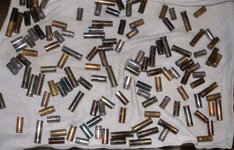
The NAS3 cases are waste material. The discolored other cases I will run through the dry tumbler for a few hours and see if they clean up any. But lifted off nickel plating won't rejuvenate.




 .
.