


JavaScript is disabled
Our website requires JavaScript to function properly. For a better experience, please enable JavaScript in your browser settings before proceeding.
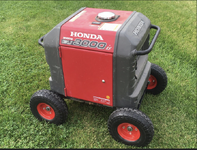
Only use clear gas if you buy a gas powered generator,, if you put ethanol gasoline in it, slap yourself, and get it out of there. since a generator sits unused alot, it will corrode the insides,of your carb. I like to drain the gas out of mine in the spring, then refill it with fresh gas in the fall, to prep for winter. Glock of generators,, I have the Honda 3000is, with large tundra tire kit mounted on it to push it around, its heavy at 150lbs, but is very quiet... I have had it for at least 5-6 years, no issues.

Screenshot 2024-06-08 at 7.49.26 PM.png
 
Last Edited:
The biggest problem with gas generators is the amount of time they sit unused. If you are not on top of things all year round, when you need it it wont run.
That's carburetors normally. That is the reason the gasoline ones are kind of a pain if not used often. You have to now and then put some gas in, run them a few, then get all that gas out of the carb and of course don't leave any in the tank. Last time this came up I had no idea how easy it was to covert one to LP gas. One of the posters here mentioned Harbor Freight. Though they did not have the kind at that time that use both he showed a link to the converter which is a super simple set up. Just feeds the LP gas in at the carb. That way you can make one that is set up for gasoline run on the bottled stuff which is super nice. Easy to store, after you run the genset you don't have to drain off old gas and such.
 
Two years ago I purchased a Westinghouse dual-fuel (gas & propane) 12.5KW generator and wired it into my current breaker box with an Interlock Plate covering the main breaker and a 50amp breaker. When the Interlock Plate is engaged, the main is turned of and only then can the 50amp breaker can be engaged for all of the house circuits

This is a different setup from a Transfer Switch since you have to preselect a set of circuits you want to run with the transfer switch. With this I can use my whole 200amp service set of breakers, then not use high-use appliances like a dryer, AC, etc.

My generator will run my entire house with minimal disruption in what we use. Admittedly, we have a gas fireplace, oven, and hot water heater, but we dynamically choose when to use the high-amp appliances.

The 30ft cable runs to my back patio so I can keep an eye on the generator, since many can't be trusted look-but-not-touch. 😡

I check the generator every 3 months.

View attachment 1895765 View attachment 1895766 View attachment 1895770
NICE!
 
Gas and diesel have relatively short shelf lives. If you have natural gas at the home, that is THE way to go.
 
Believe it or not Harbor Freight's Predator series generators are top-notch. They basically have Honda engines in them.

I bought a 9Kw Predator (non-inverter type) that I converted to tri-fuel (gasoline, LP, NG) with a carburetor retrofit kit from Amazon, and I also added a run-hour meter to it that looks factory.

If you require a quiet model capable of powering most (if not all) of your house then go with this inverter model.

 
For larger applications, Generac and Onan are the gold standards. Homes, large RV's... they have a very long and high reliably service record. The downside... they are big, heavy and expensive. Professional servicing can be a little problematic and expensive as well, but they have such a long running track record and in such common use that online tutorials and such for the DIY'er are plentiful.

On the smaller side, as mentioned, Honda or Yamaha are going to be equally reliable and have the longest standing reliability record than anything else on the market.. in their class. Highly efficient and... like the Generac and Onan... provide clean pure sinewave current. With these type of portables they also have more "multi-use" capability. By that I mean portable enough to use for camping trips and such but also 2 of them can be run in parallel for heavier duty applications that require more current.

In either of the above, rated output is accurate, surge and peak output durations are more than adequate, well regulated under load and some of the longest in the industry.

To be aware. MFG with accurate output ratings and durations is RARE! Sadly, the above are really the exceptions and not at all the "norm". There is no industry regulatory agency or standard for advertised outputs. Rating are determined solely by the MFG under whatever criteria the MFG sees fit.

IE., A genset MFG might claim a surge output of 4300w on a 4100w genset. What they won't advertise is that the 4300w surge output is limited to only 2 seconds (virtually useless in many applications). They also won't advertise that the 4100w is "peak output" that is only sustainable for 5 minutes before before reducing to the continuous of 3500w.

A good genset... surge may be 10+ minutes and peak may be 30m to an hour before dropping into continuous output mode.

The other consideration is the type and quality of the current output. IE., Many contractor type gensets may still only output a modified sinewave. For an electric motor that'll work, but it's pretty harsh. Electronics... it's never a good thing and some devices won't operate at all on a modified sinewave... or... worst case... be destroyed.

Where contractor type gensets excel is that they are typically quite cheap and the output really doesn't have to be all that clean if you're using electric motors... as intended. Many may have pure sinewave output, but they are notoriously "dirty" simply due to the MFG keeping the costs inline within the "contractor type" generator class.

The additional downside is that they are typically incredibly loud, not very highly efficient and many may not have preinstalled spark arrestors. Although that's not a major issue and can be fairly cheaply and easily installed after the fact. Simply something to be aware of.

That's the "ugly", but even gensets that have pure sinewave output the stability and "cleanliness" of the sinewave pattern can widely vary. How the output acts under load can also "dirty" up the current due to poor regulation. A genset that can maintain a clean pure sinewave at the proper frequency, even under load, is the best option to protect your electrical devices attached to it.

The other option is to place a line conditioner between your genset and electronics, but that adds additional cost (they are NOT cheap) and an additional point of failure. It's generally best to simply go with a genset that will produce the cleanest output from the get go.

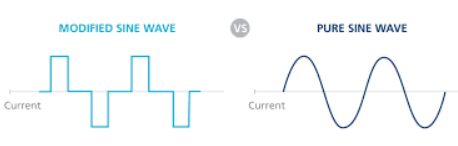
1717937017985.png

Just to illustrate the different sinewaves. The "slamming" up and down of a modified sinewave is what creates large amounts of heat in your electronics vs. a pure sinewave. The most notorious appliances that will either not run at all on a modified sinewave are cooling compressors (fridge/freezer) and microwaves. Some microwave magnetrons won't fire at all... OR... can be immediately burnt out.

Fine electronics, like computers, etc, are also very susceptible to an early death on "dirty" current. Most inverter gensets these days do proved pure sinewave output, but again, there can be a big disparity on how "clean" and stable the output regulation is.

I think one of the other very real considerations might be serviceability. IE., Honda, Yamaha, Generac have service centers all over the place, and many of the regular maintenance items are available "off the shelf". On the flip side, lesser brands, parts may not be readily available, not at all available, or incur large shipping expenses to far off service center.
 
Last Edited:
They basically have Honda engines in them.
For clarification. "Basically". Meaning... they are chinesium knock-offs of a Honda engine with very distinct component material variations. Also to be aware that what makes a good genset a good genset has less to do about the reliability of the engine as it does the quality of the governor and electronic inverter inside. IOW, electricity generation and output.

All the engine is doing is providing the mechanical power.😁
 
I have owned multiple generators over the years, and have used many more in the trades, for decades. I've also had many other Honda power products.

Honda lives off their previous reputation. Most of my newer Honda equipment has been a pain, with a mostly worthless Warranty, because the local dealers are so swamped, it can be months of waiting until they can address your machine. In fairness, I must also say I have owned a big Yamaha outboard that gave me problems. I have lost faith in the major brands of the past.

Simply, the best generator I've had in the last ten years has been the relatively inexpensive Champion 4000. It always started easy and operated flawlessly.

My most recent generator, the Honda 2200i operates well once it's running, but too often it takes way too many pulls to get it running.

I also tried Costco's brand, Firman. Electric start and all, I could not get it running, brand new. It went back to Costco.

Sorry to say, as I hate all this Chinese crap... I've been around some Harbor Freight generators that performed very well. I cannot speak of their longevity, but a relative has an electric start model that sits out in the rain continuously. They use it often on the race circuit, and it always starts and operates easily. We see many of these Harbor Freight generators in the race car camps. They are quite popular.


.
 
Last Edited:
...because the local dealers are so swamped, it can be months of waiting until they can address your machine.
That's why mine are Yamaha's. 😁 The same quality level, but I like the idea of metal gears over plastic (even though the Honda plastic gears don't seem to be much of a failure point) and gravity fed fuel. No fuel pump as an additional potential point of failure.

Yamaha has fewer service centers, and "off the shelf" parts in a B&M isn't as widespread of an option, but easily available online and their service centers aren't nearly as swamped. Turn around is quite fast. Honda has a much more extensive/aggressive marketing scheme in the U.S., and marginally lower price point, but in most all respects they are equal in performance.
 
I have had multiple generators over the last few years. I've also had many other Honda power products.

Honda lives off their previous reputation. Most of my newer Honda equipment has been a pain, with a mostly worthless Warranty, because the local dealers are so swamped, it can be months of waiting until they can address your machine.

Simply, the best generator I've had in the last ten years has been the relatively inexpensive Champion 4000. It always started easy and operated flawlessly.

My most recent generator, the Honda 2200i operates well once it's running, but too often it takes way too many pulls to get it running.

I also tried Costco's brand, Firman. Electric start and all, I could not get it running, brand new. It went back to Costco.
You may look into a Yamaha generator if one needs replaced again. Look for a real Yamaha, not the knockoff junk Costco sells/sold. Mine is over ten years old and starts in the first pull. As always, only non ethanol gas, as well as running the carb dry before long term storage.

Someone mentioned earlier that Predator generators are gtg but I have to disagree. Not sure what the odds are but in the last several months, several people have mentioned dead Harbor Freight Predators of varying sizes. Most of them have dead spark and a lot of shops won't touch them for repair.
 
That's why mine are Yamaha's. 😁 The same quality level, but I like the idea of metal gears over plastic (even though the Honda plastic gears don't seem to be much of a failure point) and gravity fed fuel. No fuel pump as an additional potential point of failure.

Yamaha has fewer service centers, and "off the shelf" parts in a B&M isn't as widespread of an option, but easily available online and their service centers aren't nearly as swamped. Turn around is quite fast. Honda has a much more extensive/aggressive marketing scheme in the U.S., and marginally lower price point, but in most all respects they are equal in performance.
Plus, if I recall correct the Yamaha's are quieter than the Hondas.
 
A bit ago I grabbed myself a basic gas inverter generator, 4500 watts with 3.5gal fuel tank and rated running of 18hrs on 1/4 load which is just over 900w.

Basically, it will do the basics and it will do them quietly with decent efficiency. It will just be used for a few lights and periodic fridge freezer.
 
I have owned multiple generators over the last few years, and have used many more. I've also had many other Honda power products.

Honda lives off their previous reputation. Most of my newer Honda equipment has been a pain, with a mostly worthless Warranty, because the local dealers are so swamped, it can be months of waiting until they can address your machine.

Simply, the best generator I've had in the last ten years has been the relatively inexpensive Champion 4000. It always started easy and operated flawlessly.

My most recent generator, the Honda 2200i operates well once it's running, but too often it takes way too many pulls to get it running.

I also tried Costco's brand, Firman. Electric start and all, I could not get it running, brand new. It went back to Costco.

Sorry to say, as I hate all this Chinese crap... I've been around some Harbor Freight generators that performed very well. I cannot speak of their longevity, but a relative has an electric start model that sits out in the rain continuously. They use it often on the race circuit, and it always starts and operates easily. We see many of these Harbor Freight generators in the race car camps. They are quite popular.


.
I had been leery of HF for a long time but I too keep hearing and often seeing models of theirs that just keep doing what they are supposed to do. Enough so that if I ever need another I will probably give one a shot. The one I use all the time is a WEN 2K inverter gen. I bought it when we moved here just to take power around the property. So when I have to take tools to some part of the place I just toss it in the vehicle. I really did not expect it to last as long as it has. Couple years ago my gas string trimmer gave up so rather than buy another I bought an electric one and use that gen for that too. Just pick up the Gen and move it to where I need to work.
Its a Damn shame Honda has let their stuff slip like that. For so many decades they were the top of the game. Guess they got lax being the go to for so long but nice to know. Would REALLY piss me off to spend that kind of money and then have problems. :mad:
 
Plus, if I recall correct the Yamaha's are quieter than the Hondas.
It depends what mode it is operating in. (Surge/peak/continuous/eco/parallel) One might be a fraction quieter in one mode than the other, or vise versa, so it kind of evens out... and the differences are quite minute.

If it's an important factor then it would be good to compare them in the mode you're most likely going to be running them in. Mine are typically in Eco mode or parallel on occasion. IIRC, the Yamaha is slightly quieter than the Honda in Eco, but the Honda's are slightly quieter in parallel... if you're running the primary + companion/slave gensets. I don't recall if that's true if you are running 2 "primary" Honda's in parallel though. It's been awhile since I spec'd them.
 
I'm sure everyone that is connecting a generator to their home is making sure there is a means of disconnecting them from the power company. :rolleyes:

The people working on repairing your power really get upset if you back feed a line they think is dead. :s0001:
 
Thanks for posting this thread -- it reminds me to do my quarterly maintenance on my generators.
AC/furnace, freezer, fridge, and
Forget A/C, forget the electric water heater, forget the microwave -- unless you want to invest in a 15K or bigger genset. If you're going that big, you'll also be investing in an automated transfer switch, which will also be expensive.

I purchased three old, used gensets for $465 over the years. A 1980's 1500 Coleman alternator for $15, a rebuilt BE i3500L inverter set for $300, and a Devilbiss 5KW construction generator for $100. Only the Devilbiss needed any work -- a fuel line and fuel cutoff valve.

The Coleman is small, loud and ugly, and keeps resistive loads working well. I wouldn't power anything else on it. The BE produces nice clean, power, and the Devilbiss produces a two phase 58-62hz sinewave at 105-110VAC

With the wind storm / ice storm that happened early this year, I was out of power for five days in Beaverton. The Coleman kept one neighbor from freezing using space heaters, the Devilbiss kept my whole house powered (gas hot water), and the BE kept my other neighbor's furnace and lights running.
I use a poor man's transfer switch, with a custom 8 gauge hookup between my genset and my welder outlet. I use older, thermal circuit breakers. My connection procedure is to shut off the main, shut off heavy load breakers (dryer, stove, etc), shut off the breaker for the genset connection, start the genset, plug it into the house, and then close the genset (welder) breaker. It works. Saved me from thousands of $$ in meat loss this year.

Any genset you buy, you *must* maintain. Bare minimum is gas management (i.e. emptying tank and float bowl) and running it every so often. You need to check and change your oil too. Most gensets have a low oil cutoff float, but never trust that, and don't be the guy whose generator runs out of oil in the middle of the night.
The problem, as I see it, with 10% Ethanol gas, is that moisture in the air will be absorbed by the ethanol in your gas. The water eventually separates out and pools at low points, and will find it's way to your float bowl. This is why many gas mowers won't start in the spring. Drain the float bowl, and off you go.
I have seen float bowls corrode from being empty, and gas tanks rust while holding pure gasoline, though I cannot say that ethanol gas won't cause the rusting or corrosion mentioned above. I pour stabil in my genset gas and run them for about a half hour every quarter.
 
I also tried Costco's brand, Firman. Electric start and all, I could not get it running, brand new. It went back to Costco.
My experience was opposite. I bought the 9K generator for the house in case of extended power loss and I was so impressed with it, I got their 3.2K for the RV. Both electric start. Big one is tri-fuel and little one is dual fuel. Both start and run every time. Told my buddy about them and he's got the same setup and happy with them. I guess it's luck of the draw.
 
TL;DR

A couple of things I throw in when someone asks about gensets for SHTF purposes:

1) Allow extra capacity for loads that use an electric motor. Things like a fridge, freezer, air conditioning, have a motor in them for their compressor. Central heating/air has often has a fan run by a motor. A well pump. Tools like air compressors, etc.

These motors put a temporary load on the genset when they start up - sometimes the motor load is double its running load. So if you look at your well pump and see it requires 2KW to run, allow 4KW (or more) for it to start.

Resistive loads, like a simple portable portable heater without a fan, an electric stove, a water heater, or a toaster, does not have this kind of extra load.

2) Speaking of water heaters - a number of items in the house take 220-240VAC; electric water heaters, electric stove, electric clothes dryer. Also, many modern clothes washers have a water pressure sensor in them so that they will not start unless the water pressure is 40-60 PSI - so if you have a well, but it isn't powered, eventually you won't be able to use your clothes washer even though it has power. Without hot water, no warm/hot showers and your dishwasher might not get your dishes clean (they often have their own water heater, but still use the hit water line).

3) Consider dual or triple fuel gensets, but be aware that on propane a genset makes less power than when used with gasoline, even less when used with natural gas. One advantage of propane or NG, is that they burn cleaner and the engine will last longer. Speaking of efficiency and an engine lasting longer, a genset that uses an inverter for the load will often run at lower RPM when the load is light, and adjust its RPM for the load. Gensets without an inverter must run at a set RPM to provide the right frequency (60hz in the USA). OTOH - inverters are electronic so more complex and theoretically vulnerable to EMP/CME/Myake events - but I would assume that many modern gensets probably have enough electronics to be vulnerable anyway.

4) For long term SHTF events, consider a diesel genset. Diesel engines have a longer lifetime, especially some diesel gensets that run at 1800 RPM instead of 3600 RPM. If the genset has an inverter and is diesel powered, then even better. You might also be able to "fumigate" the engine with propane (inject propane into the intake) for better efficiency, more power, cleaner running and fuel diversity - but to do this you have to know what you are doing and how to do it right.

5) Consider having a battery bank or at least a "power station" as an adjunct power source. Besides being able to use solar (at least from spring to fall - maybe not in the winter) to charge the batteries, you can use the batteries for lighter loads and turn off the genset to save fuel. I do this; I run the genset to charge the batteries (and emergency/backup lighting) and run the fridge/etc. for an hour or two, then turn the genset off and use the batteries to run my internet, laptop, phone, etc. That way I am not running the genset 24/7, I save fuel/wear & tear on the genset, and it is quieter.

Some of my neighbors have automated backup systems; a battery backup to power their house while their automated genset comes online to provide power. They may not even notice the power went out - sometimes I don't immediately notice because about half of my lighting has tiny batteries in the LED bulb, my laptop of course has a battery and my internet access (5G cell & wifi) is on a UPS.
 
Some already mentioned this in the thread... start by determining what you want to power and how much you're willing to spend.

This is from an old email, but generally still relevant. It assumes an approach with a portable generator...

So the three big things you'll need:
- generator
- generator-transformer box (aka gentran)
- thick 220v cable from generator to gentran
- certified electrician to install the gentran, and make you a cable

I was into mine for say $1,500 back in 1997. You could probably get into same for $3,500-$4,000 today with an install by a certified electrician.

If you choke on the price, ask yourself what it might cost to replace the food each time in the fridge and freezer. Add to that any costs if you went to a hotel, and then of course the intangible value of simply continuing most of your current way of life without too much interruption.

First, what can you power?
- Yes to a gas furnace. You're just running the blower and the temp sensor. Probably no on an electric furnace.
- Probably no to an electric hot-water tank (if gas, no electricity required)
- Yes to a microwave
- Yes to a 120v fridge
- Yes to a 120v freezer
- Yes to TV, computers, lights
- No to an electric oven or cooktop.
- No to an electric dryer
- Probably yes to a sump pump (if you have one, and if it's 120v)

You'll need to assess what can be powered by the generator. There are limits. You can't have everything running at once since the generator will have a finite output of electricity. For example, the microwave call pull up to 1000 watts for a large, hi-power model. The good news is that everything doesn't run at once, but I do try to keep the total load down on my generator so as not to damage it.

Generator. Many options. You can probably get a good one at Costco for $800. Two key considerations are total continuous watts available, and then do you go with manual/pull start or electric start. Mine is 7,000 watts continuous and 8,800 surge/temporary watts. I would recommend at least 6,000 watts for a typical home. My generator is also an electric start with a backup pull start. The pull start on a 10hp engine is fine for me but difficult for my wife. A generator with an engine larger than 10hp may be harder to pull start.

Gentran. This controls what circuits get powered by the generator, and keeps the electricity within your house. Buy a unit/panel with at least 10 switches. 1 switch = 1 circuit breaker in your house. Also, you might get one with a watt meter for each side of switches since this gives you an indication of how many watts you're pulling at that point in time. Each Gentran switch tends to have 3 positions: Line (typical power), Off, and Gen (your generator). So in real use you flip the individual switch from Line to Gen and *tada* that circuit is now getting juice from the generator. It's that easy. It's also safe since your generator is not providing power back out on the line, energizing the transformer, and potentially jolting/killing a lineman upstream from you.

Wiring in the Gentran. Work with the electrician to determine what circuits you want to connect to the Gentran (you might even pre-identify and mark the circuit breakers if you're paying the electrician by the hour). The electrician can take it from there.

Cable. The electrician can make you an appropriate cable with 220v connectors on each end. Ensure that the cable is long enough so that the generator is not running right next to your house. Mine is 50 feet long and I think it cost me $5/ft at the time (it is almost 3/4" thick). I keep my generator in the garage to reduce exposure to the elements when it is idle, but when it's running I've had it out un-sheltered in the wind/rain/snow and never had a problem.

Maintenance on the generator. This is critical. Don't let it sit for a year or two and assume it will magically start. I pull my generator out 3-4x a year and run it for 20min. I also change the oil every Fall regardless. If you have an electric starter then you'll want to keep an eye on the battery on the generator. I had the same $500 generator 1997-2018 and it never failed us (I got a new one in 2018). Most outages have been a few hours, but in 2006 there was a bad windstorm and we were on the generator for perhaps 30 hours. I also tend to run the generator for 20min in advance of a large storm.

Spare fuel. Every generator is different. Mine burns approx 5 gallons of gas every 8-10 hours. I try to keep about 20 gallons of fuel in the shed, and use/replenish via the generator, lawn tractor, etc. such that the fuel isn't too old.

Suggestion. Buy the generator at Costco (or other), and then perhaps the Gentran at Home Depot if they're still offering a referral service to certified electricians.
 
CountryGent posted: "We've had a 20kW whole house Generac for a little over ten years now. Auto-on/off on outages, which are fairly common here. Maintenance is easy. Feeds from a 500-gallon propane tank. Zero complaints whatsoever."


Our set up as well although we have a 22kw stand by. Otherwise the same. Our Generac had worked like a champ for the last four years
 

Upcoming Events

New Classified Ads

Back Top