


JavaScript is disabled
Our website requires JavaScript to function properly. For a better experience, please enable JavaScript in your browser settings before proceeding.
Messages
19,598
Reactions
35,703
With so many articles and even more opinions on how and when to clean a barrel its tough for someone to learn whats best for them. Ive had some theories on my own left unanswered until I watched this recent video from Bryan Litz discussing not just the how but the benefits and it seems to validate some theories Ive had.

Theories:
New rifles should be cleaned to bare metal and shot that way. Over the life of the barrel the smoother bore will yield [slightly] faster velocities and be easier to clean. The trade off is after each deep cleaning the muzzle velocity (MV) will lower until the bore re-roughens up from firecracking. So the cleaning interval should be more frequent to maintain zero and or velocity.

Old rifles I hear many shoot better fouled, if thats the case don't change anything. However storing a dirty barrel can pit the barrel surfaces degrading accuracy, needing to be left in a fouled condition to smooth out the bore. Deep cleaning may be good prior to long term storage. Older barrels that are still in great shape may still benefit from a deep cleaning regimen but the trade off is fouling shots ($) will be needed to get back to zero if the bore has pits.

Put together, if you maintain a clean barrel regimen with a new rifle the bore should last longer, be easier to clean, and yield [slightly] faster velocities.

Thoughts?

View: https://www.youtube.com/watch?v=meXn3GiMhns
 
I don't lose any sleep over barrel cleaning, unless l have a rifle that won't shoot
I have one rifle (stainless) that started out with 3 rounds fired, then cleaned, repeat, repeat. I think it was a waste of time and probably won't do that again.
It's accurate, but not quite as accurate as the blued steel version I had previously. (both I purchased new)

Both of the rifles would shoot a bullet from a cold, clean bore to a different point of aim than the groups it would shoot once it had a bullet or two down the bore first. Craig Boddington was the first I saw put this into print. Also both of these rifles once the barrel was fouled with a shot or two, would put the first bullet from a cold bore right onto the point of aim.
I never go hunting with a squeaky clean bore. It's the first shot that's the most important.
 
I clean my firearms after every shooting session.
That works well for me ...for the firearms that I own...and for how I shoot.

Back when shooting for me could easily turn into a life or death matter....
I still cleaned my firearms after every shooting session.
That said...
I did have a M21 rifle that shot better if the bore was a little fouled.
I would shoot that one at the range , and not clean it , before heading out.

I do not think that there is a hard and fast rule here.
In my experience with my firearms that I owned...both past and present a clean firearm shoots just fine.
However....I have read or heard of too many others that shoot better if fouled , to discount that notion.
Andy
 
Last Edited:
Both of the rifles would shoot a bullet from a cold, clean bore to a different point of aim than the groups it would shoot once it had a bullet or two down the bore first.
I never go hunting with a squeaky clean bore. It's the first shot that's the most important.
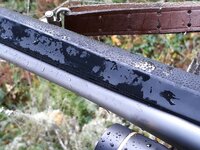
And in reality I am making this a bigger issue than it really is, at least for my uses. The difference is mostly horizontal and is probably an inch or so off at 100 yards. Since I'm not a long range hunter it's not likely that inch would mean anything significant, but it's there. And it's an easy fix. After the season the rifle gets cleaned. If it's subject to lottsa water I'll tape the bore before hunting and will clean the gun as needed, mostly to dry it out. I used to be skeptical of the possibility of screwing up what I'd worked so hard to attain, accuracy of that first shot, by pulling the action out of the stock to dry it. I later checked that theory. Would it shift POI on the next "first shot" after being taken apart and put back together? Nope. Even though stainless can make one lazy, when you turn your rifle upside down and water runs out of the stock, you know that baby needs some love!

wet rifle.jpg
 
Last Edited:
And in reality I am making this a bigger issue than it really is, at least for my uses. The difference is mostly horizontal and is probably an inch or so off at 100 yards. Since I'm not a long range hunter it's not likely that inch would mean anything significant, but it's there. And it's an easy fix. After the season the rifle gets cleaned. If it's subject to lottsa water I'll tape the bore before hunting and will clean the gun as needed, mostly to dry it out. I used to be skeptical of the possibility of screwing up what I'd worked so hard to attain, accuracy of that first shot, by pulling the action out of the stock to dry it. I later checked that theory. Would it shift POI on the next "first shot" after being taken apart and put back together? Nope. Even tough stainless can make one lazy, when you turn your rifle upside down and water runs out of the stock, you know that baby needs some love!

View attachment 2001533


Bruh.... that thing don't need no TLC, it needs SCUBA gear.

:s0108:
 
Black powder, after every trip shooting.
Bolt rifles, when I buy them and then once a year or if they look dirty. I've purchased some old gems that, when inspecting, looked clean, but the copper I would get out of the barrel was impressive.
ARs, typically every 2nd or 3rd outing, when the soot buildup in the upper receiver is easily noticeable.
 
Im only curious if anyone has any experience or thoughts on the theories I listed. The Bryan Litz video is the first Ive seen that seems to support my observations.

I have a few new rifles now, one with a new match barrel so Im leaning to conditioning it to shoot from a clean bore. The Litz video seems to suggest to smooth out the new bore perfectly clean (no fouling), he uses JB Bore paste as part of the cleaning regimine (though I dont think he means every time but its not clear).
 
With so many articles and even more opinions on how and when to clean a barrel its tough for someone to learn whats best for them. Ive had some theories on my own left unanswered until I watched this recent video from Bryan Litz discussing not just the how but the benefits and it seems to validate some theories Ive had.

Theories:
New rifles should be cleaned to bare metal and shot that way. Over the life of the barrel the smoother bore will yield [slightly] faster velocities and be easier to clean. The trade off is after each deep cleaning the muzzle velocity (MV) will lower until the bore re-roughens up from firecracking. So the cleaning interval should be more frequent to maintain zero and or velocity.

Old rifles I hear many shoot better fouled, if thats the case don't change anything. However storing a dirty barrel can pit the barrel surfaces degrading accuracy, needing to be left in a fouled condition to smooth out the bore. Deep cleaning may be good prior to long term storage. Older barrels that are still in great shape may still benefit from a deep cleaning regimen but the trade off is fouling shots ($) will be needed to get back to zero if the bore has pits.

Put together, if you maintain a clean barrel regimen with a new rifle the bore should last longer, be easier to clean, and yield [slightly] faster velocities.

Thoughts?

View: https://www.youtube.com/watch?v=meXn3GiMhns
He said in the video barrels get faster because chambers pressure increases the dirtier or rougher they are. Some people say velocity will drop over time due to throat wear. I guess clean less often as the barrel gets older and the two will cancel each other out.

On my match AR barrels, I don't see a change in accuracy with a clean verses carbon fouled barrel. I first see pressure signs as carbon builds up since we run near max on loads. I do see minor shifts in elevation over the life of a barrel or environment changes. However, each match sighting shots are made and zero is adjusted as needed.

He mentioned having a couple hundred rounds on that barrel since last cleaning. He also suggested cleaning like that every 100 rounds in later barrel life. I am not going to waste my time or deal with the mess of JB every 100 rounds. I do JB new barrels to knock of high spots in the throat and every 1500-2000 rounds to remove carbon for pressure reasons. Between that, barrels get a handful of patches and about three stroke of a brush.

I have experienced a modern CZ barrel shoot much tighter groups on a barrel coated heavy with carbon. When I used JB until it was clean, accuracy became worse. Since then, I don't clean with JB more than needed.
 
He mentioned having a couple hundred rounds on that barrel since last cleaning. He also suggested cleaning like that every 100 rounds in later barrel life. I am not going to waste my time or deal with the mess of JB every 100 rounds. I do JB new barrels to knock of high spots in the throat and every 1500-2000 rounds to remove carbon for pressure reasons. Between that, barrels get a handful of patches and about three stroke of a brush.
He mentioned more cleaning intervals with older barrels but not why and mentioned that uncleaned barrels roughen back up more increasing velocity to where you dont want it to be... Im guessing he means pressure. He seems to advocate in this video to keep a smooth bore but didnt mention why.
 
Lots of good opinions here.

I'm thinking it depends on your intended use.

For me, I am an accuracy nut but I don't shoot competition. I'm just a NUT.

Studies suggest that a barrel gets more accurate as you shoot it without cleaning (meaning constantly smaller groups) up to a certain point.

Depending on the cartridge, groups get tighter and tighter up to some point around 300 to 500 rounds fired.

After that, the groups begin to open up and spread wider.

And THAT. IS WHERE YOU CLEAN THE BARREL.

Don't get me wrong, Chambers and Bolt Faces get cleaned quite regularly, but BARRELS According to the above.

My 2 Cents.
 
I've purchased some old gems that, when inspecting, looked clean, but the copper I would get out of the barrel was impressive.
This is what I've found. Clean to the eye, but blue/green patch after patch come out of the bore.
 
I have used all sorts of copper cleaners for barrels. Sweets is good but you cannot let it soak
too long. Damage to blued finishes. What I do now for Copper remover is good old Hoppe's #9.
Let it soak overnight and the next day the patch will be blue. Repeat letting it soak overnight
until patches are no longer blue. I have been a long time proponent of JB Bore Paste. Smooth
up new match barrels for break in. And every 1K to 2K rounds. Smoothing up the barrel a few
inches from the chamber. Also to clean the dreaded carbon ring. You can feel the barrel is
smoother after using the Bore Paste. After smoothing up a barrel it will shoot tighter groups
in my experiences.
 
I have been told by guys into precision shooting games, cleaning to bare steel frequently is more for eliminating variables. It is easier and more predictable. Finding a range of number of rounds fired that optimize accuracy requires testing. A match barrel would be worn out before you would get any meaningful statistical results. Instead you test with a clean barrel using up to the number of rounds typically used at a match.
 
These replies seem to support my theory that new rifles should be cleaned to bare metal and shot that way.

I do JB new barrels to knock of high spots in the throat and every 1500-2000 rounds to remove carbon for pressure reasons.

I have been a long time proponent of JB Bore Paste. Smooth
up new match barrels for break in. And every 1K to 2K rounds. Smoothing up the barrel a few
inches from the chamber. Also to clean the dreaded carbon ring. You can feel the barrel is
smoother after using the Bore Paste. After smoothing up a barrel it will shoot tighter groups
in my experiences.

So I have a new barrel on a rifle thats shooting very precise groups. I had the throat custom lenghtened to shoot longer higher BC bullets and when I got it borescope showed sharp edges on the leads to the lands so I used a cleaning paste to smooth out the bore, the barrel looked shiney smooth and groups and velocity are very nice. I did that on my own whim guessing it was the right path but have been wondering about using abrasive cleaning pastes on a new barrel so its nice to see some confirmation that its a common practice.
This is why I made this post. appreciate these responses.
 
I have been told by guys into precision shooting games, cleaning to bare steel frequently is more for eliminating variables. It is easier and more predictable. Finding a range of number of rounds fired that optimize accuracy requires testing. A match barrel would be worn out before you would get any meaningful statistical results. Instead you test with a clean barrel using up to the number of rounds typically used at a match.
This also supports my clean bore theory. But I'm not a match shooter and don't know how many rounds are used in a match, but so far Ive gone up to about 40 rounds between cleaning without any loss in precision so I'm probably good with that cleaning interval to mitigate any variables from the bore fouling more and rougher firecracking.

I do wonder if regular smoothing out the throats firecracking increases the rate of throat erosion?


Lots of good info here in this thread.
 

Upcoming Events

New Classified Ads

Back Top