


Follow along with the video below to see how to install our site as a web app on your home screen.
Note: This feature may not be available in some browsers.
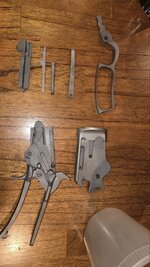
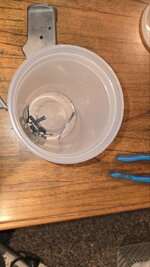
After the sandblast cleaning, honestly, even before polishing, the breech bolt glides very nice now. cleaning these up a bit more soon, will polish and blue the pieces and will post pictures soon. Stock is on the way.Since the 39 is a 22 rimfire, the last thing I would worry over is the thing blowing up. Not going to happen. The frame and or bolt can be warped enough from the heat that once reassembled, it's not going to cycle very well, matter of fact, it will likely be very hard to cycle the action. The bolt may not even lock up enough to be in battery. I have seen more than a couple of these old fire damaged rifles "restored", and the problem was always a stubbornly stuck action. The owner would muscle and hammer on the lever (or the slide on a pump) the bolt suddenly flying forward, chambering a round, and the impact would cause it to fire. Use a lot of Prussian Blue to figure out where things are going to get sticky in the action, and address that first. After determining that you did or did not have to remove too much material, get that action heat treated properly. Remember that the parts between the trigger and the firing pin have to be working in concert. A warped action does not lend itself to such mechanical harmony.
After the sandblast cleaning, honestly, even before polishing, the breech bolt glides very nice now. cleaning these up a bit more soon, will polish and blue the pieces and will post pictures soon. Stock is on the way. Finding parts for the EARLY 39 is difficult, but that's half the battle / fun. I'll post pictures again after the blueing.After media blast cleaning, here's an update of the project.
View attachment 2007266 View attachment 2007267 View attachment 2007268
Thank you!!Looking good, things seem to be progressing along nicely. Appreciate you taking the time to document your progress.
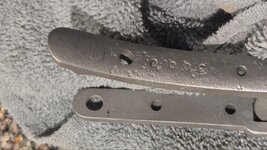
After blasting, the serial number became visible, and it is 3000. So for anyone that knows how to date the early Marlins by serial number, let me know what that tells us! Thanks everyone.After media blast cleaning, here's an update of the project.
View attachment 2007266 View attachment 2007267 View attachment 2007268
I believe, the serial number should start with the letter. Was the magazine tube answered aluminum or brass?After blasting, the serial number became visible, and it is 3000. So for anyone that knows how to date the early Marlins by serial number, let me know what that tells us! Thanks everyone.
The early 39's did not have a letter in the front. the ones from the 20's. there was no magazine tube when i received it.I believe, the serial number should start with the letter. Was the magazine tube answered aluminum or brass?
The 39 A, came out in 1939/1940, According to my research, the A models have a letter to begin the serial #. I got this from the Marlin Collector's site.A quote from another forum on Marlins:
The Marlin Model 39 was made in 3 different series from 1921 to 1939. The first series had a serial number with no letter prefix and was made between 1921 and 1925. The second series had the letter "S" as a prefix to the serial number and was made from 1925 to 1932. The last series was made from 1932 to 1939 and had a "HS" serial number prefix.
If your gun does not have a serial number prefix or the letter "S" prefix, then it is an earlier version, and you should not use modern, high speed ammunition in it. You should only use either standard velocity or target ammunition in it. The last version with the "HS" prefix are guns that were updated to use the new, high speed ammunition at the time.
I forgot to mention, I only got the receiver, the barrel and tubeI believe, the serial number should start with the letter. Was the magazine tube answered aluminum or brass?
And prior to 1939, there were models that were just 39, not 39a. They were from the early 1920's.The 39 A, came out in 1939/1940, According to my research, the A models have a letter to begin the serial #. I got this from the Marlin Collector's site.
Best,
Gary
Based on the pics, and the OP's original comments,I forgot to mention, I only got the receiver, the barrel and tube
And prior to 1939, there were models that were just 39, not 39a. They were from the early 1920's.
View attachment 2008087
It doesnt match up with a 39A serial nomenclature though, and the tang is the longer tang, the 2 and 7/8 inch. the serial number is clearly no letter in front, and its not worn off or scratched off, I will post a picture later of that.Based on the pics, and the OP's original comments,
It is my understanding we are discussing a 39 A.
Best, Gary
It doesnt match up with a 39A serial nomenclature though, and the tang is the longer tang, the 2 and 7/8 inch. the serial number is clearly no letter in front, and its not worn off or scratched off, I will post a picture later of that.
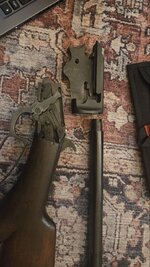
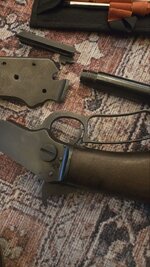
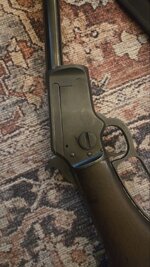
By the way, the barrel breech and the receiver match up perfectly flat when the "bolt notch on the barrel matches up with the bolt notch on the receiver" -perfectly mated surfaces.So here is the project so far,
Now, my question is: When installing the barrel, it goes on just fine, but it goes just slightly past the point where the bolt will not mate up with the notch in the barrel for the bolt.
Does anyone know the shimming process for the barrel? Or is there a "key" to lock it into place?
View attachment 2017513 View attachment 2017514 View attachment 2017515 View attachment 2017516 View attachment 2017518