


JavaScript is disabled
Our website requires JavaScript to function properly. For a better experience, please enable JavaScript in your browser settings before proceeding.
Messages
9,404
Reactions
19,572
There must be good money in self storage facilities, because over the decades that I've lived around here many new ones have sprung up. I don't have any numbers to support this view, but firms wouldn't build them if they weren't profitable. Bigger and fancier they tend to be. "Self" storage seems to be an operative word, because the traditional moving companies that sold storage space like Bekins and Hansen Bros. are not prospering these days. The names that I see on the sides of the newest and largest self storage places are firms like U-Haul. Which along with their existing self moving equipment rentals, are cutting even more into the traditional moving business with their Pods systems.

Only one time in my life did I rent storage space. For a couple of months. While I was disposing of some of my dad's things after he died. Which was all old car parts. I wound up selling most of that stuff in bulk anyway. I would've been better off just taking it down to the scrap yard in the first place. I mistakenly valued someone else's ideas of utility over those of practicality for myself. My rule now is, if I don't have covered storage for it, it goes. Sell it, give it away, or throw it away.

One thing about storing objects is the value over time. Which has several considerations. But for anything remotely thought to be collectible, value over time is important. Some things will only become more valuable over the passage of time. As they become increasingly scarce for various reasons. So you have to have some accurate (however tenuous predictability might be) idea of what has a chance of monetary appreciation over time. This is a form of gambling, however educated. To start the process, most people have to have extra money. Some people don't have it to spare even when things are cheap and still relatively plentiful. Then the objects have to be stored for years or decades while fate and society decides if they are to appreciate.

Objects thought to be collectible may or may not pan out as good candidates for storage. To my mind, a couple of categories that have done well are old car and gun stuff. Which in any number of cases have appreciated way beyond any realistic measures of inflation. BUT: A lot of the fancy appreciation of these two types of things is notional and situational. Because much of this outsized inflation occurred during a period when many Americans had more money and more spare time than previous generations to indulge in hobbies. Simply more people chasing fewer things.

Even then, appreciation over time can be fickle. A Lincoln part can be worth three times the value of a Studebaker part that is three times older.

Some objects will never be worth much if anything over time. A moth-eaten old blanket will never have value, unless it's an ancient Egyptian artifact. That blanket will always be thrown away, now or 30 years from now. Or badly scarred and worn K-Mart furniture. Or fill in the blank. Some stuff just isn't worth storing in the first place.

Practical versus collectible things, those two need to be thought through. Like for example a case of paper towels in storage because you will some day eventually use them. Yet during their time in storage, you are paying toward a new case every month. Practical (truly or imagined) items, lose value over time. Quickly for items of low cost. Saying it another way, it can be cheaper to replace something than to store it.

Not to even mention the concept of deterioration over time while objects are in storage. Practical or collectible.

The worst phrase that can run across your mind is, "Oh, I may be able to use this some day." Next thing you know, you've got 1,000 random items taking up space. If and when that "day" ever comes, there is the need to sift through 999 items to find the 1,000th one you are looking for.
 
If I have so many things I need to rent a storage space then I need to get rid of them. Even if I have the space at home to store things, it still costs me money to store things, space is valuable. There are some things that are hard to get rid of though... its not easy to purge our belongings.

There's an old saying "never possess more than you can carry across a river".
 
I've had to use them throughout my life several times, usually between moves.

They seem to be low effort and overhead businesses that pretty much run themselves.

Given what land and building prices are like now though, I can't imagine you'd start turning a profit for quite a while if you had to start from scratch.

It's like a lot of things these days, if you want to make a million, you better start with ten million.
 
I knew the guy that started Daryl's Mini Storage. He owned a triangle of land that was too small to farm and not in a good location to build homes. He rented it to a guy who bought surplus items. The guy bought a train load of US government tin roofing. This was during a down turn in the economy. He found he could not resell the tin, and abandoned it on the property.
Daryl was looking for a way to use the tin and the odd shaped property. He came up with mini Wherehouse's for local businesses. It turned into a place where people clean out their garages without getting rid of anything.
He told me the average rental goes 3 to 5 years with most of the contents going to the dump at the end.
I have from time to time paid to store our stuff during a move or remodeling. Each time when I rented the space I told them it would be short term, each time the renting agent said "sure thing" and were surprised when I moved out! DR
 
It's a great way to hold commercial property with minimal risk, even if profits aren't very high.
Yes, I've noticed the more recent constructions tend to take place on crappy parcels of land. Places that don't lend themselves to other commercial enterprises. Odd sizes, bad corners, left over after highway construction, etc.

I've had to use them throughout my life several times, usually between moves.
Perfectly reasonable use of such facilities. My thoughts were more about the viability of long term use. Which is plenty common. There is an active enterprise of people who go around buying contents of abandoned lockers. Typically what they turn out containing is regular household reject stuff.

There was a member of the range I belong to, in his later years he was in that business. He turned up gun stuff from time to time, which as often as not was reloading supplies. But I never heard of his making any big scores. He would sell to range members, then take stuff to the WAC gun shows. I've bought some powder from him. Some of the oldest Hodgdon I'd seen in my life was in his finds. That is, until lately when a NWFA member posted pictures of powder he had for sale.

Given what land and building prices are like now though, I can't imagine you'd start turning a profit for quite a while if you had to start from scratch.

It's like a lot of things these days, if you want to make a million, you better start with ten million.
Yes, probably why U-Haul and so on are interested. They can borrow money on favorable, long term rates to make them work. Also likely why the newer the facility, the more massive it usually is. Economy of scale.
 
There is an active enterprise of people who go around buying contents of abandoned lockers.
I did that once. I bought the unit that was right next to mine because I roughly knew what was in it - lots of auto parts, some higher end mountain bikes, misc household goods (mostly worthless and got donated to Goodwill) and a complete, built 426 Hemi. I made almost $10k after I sold everything and used that money to buy my two tax-stamped HK MP5-SD!
 
There does seem to be a TON of those things around here with new showing up every few years. We used one a couple times during moves. I have long had to guess its mainly people who live in an apartment and have no place to keep "stuff"?? Some of them I see have places for a boat or RV which makes sense. As many of the things as there are around here they must have found a hell of a market for them.
 
Yes, I've noticed the more recent constructions tend to take place on crappy parcels of land. Places that don't lend themselves to other commercial enterprises. Odd sizes, bad corners, left over after highway construction, etc.


Perfectly reasonable use of such facilities. My thoughts were more about the viability of long term use. Which is plenty common. There is an active enterprise of people who go around buying contents of abandoned lockers. Typically what they turn out containing is regular household reject stuff.
We used to like watching that TV show about the people buying the places that were left. I read a couple articles years after that show got going saying it was sending a lot of people out to flush money down the crapper. The show of course make it look like people were regularly scoring huge wins. So many would start going to the auctions of the things and end up paying a LOT of money for stuff they had to haul to the dump. Made sense and the vast majority of the ones someone just abandoned were full of crap the owners just did not want or they would not have left it to the storage place . It was great for the places selling them for a while. People were bidding the things up real high until they kept getting burned.
 
Was curious so I looked up prices nearby randomly and I just cant imagine paying that for long term storage.
 
I had looked into units out in the Kalispell area to keep my tractor, dump trailer and misc. tools in so I didn't have to haul it all to/from WA, or leave it on the property over the winter risking having trees fall on it.

Prices ran in the $600-$800/month range. That's more than the mortgage on the 20 acres of property!
 
I have a storage unit. I live in a small house on a city lot. I own a business so buy things like cardboard boxes in bulk because that's where the price breaks are. The storage unit is handy for bulk things like that and I write it off as a business expense.
 
I used to rent spaces in San Diego during overseas military deployments, big enough to stack boxes around the walls and squeeze a loaded vehicle in between. Not especially handy, but it beat paying rent on a whole apartment while I was gone for 8-12 months.

Rented another one here in Portland/Beaverton when I moved back home 22 years ago. I found that the closer to town you get the higher the prices go - exponentially. I chose something mid-price (6-7 miles out), with 24-hour drive-in access to the garage door of my unit.

I'd NEVER rent one where I couldn't park directly in front of my actual space, yank open the door, pull things out of my vehicle, walk 5-6 feet and set them down right where they'll be sitting for however long.

I see those storage places downtown and wonder what that must be like...

- Find someplace to park, maybe near the building maybe not.
- Pay for parking.
- Pouring rain? Too bad.
- Unload whatever I can carry.
- Cart it to the building and through a coded locked door.
- Load it onto an elevator - if it's there.
- Go to my floor and unload the elevator.
- Cart it down a hall and unlock my storage space.
- Move my stuff in.
- Lock my storage space.
- Return to the elevator, and repeat, repeat, repeat as needed.

Two words describe such a process "...that" being the second one.
 
Last Edited:
We used to like watching that TV show about the people buying the places that were left. I read a couple articles years after that show got going saying it was sending a lot of people out to flush money down the crapper. The show of course make it look like people were regularly scoring huge wins. So many would start going to the auctions of the things and end up paying a LOT of money for stuff they had to haul to the dump. Made sense and the vast majority of the ones someone just abandoned were full of crap the owners just did not want or they would not have left it to the storage place . It was great for the places selling them for a while. People were bidding the things up real high until they kept getting burned.
Yes, I've figured that those shows are done for entertainment, not factual finding of goodies. Salted or staged. Most people aren't going to abandon anything good unless they just suddenly die and nobody else knows about it. More apt to leave behind a stash of tranny porn or whatever.
 
Rental storage is a very lucrative business for sure. In the city where I am employed, I've had several land use adjustments from industrial to commercial so that storage units can be built. Most people that use them are not very good at math, these facilities seem to prey on them. But, it's a free market here so to each their own.
 
My parents did the POD thing.

After paying for it for way to long I convinced them to buy a used enclosed trailer and we moved all of the stuff from the POD to the trailer.

Then it took me holding their hand to unload the trailer over the next month or three and when it was empty I sold it for more then they bought it for.

Obviously you would need space to park a trailer but most residential houses have a 2 car driveway (not all but a lot do) and I honestly don't understand why people don't think to buy a used trailer over a storage unit. On the wet side of the PNW used enclosed trailers tend to hold their value if taken care of and are fairly easy to sell all year round - the wet season being when prices are highest ( basically the opposite of motorcycle prime sell times).


If I had the money to buy cheap land and could build a concrete and metal storage facility I would.

Worst case I have a place to live as management pretty much always lives on site and best case I could hire someone to manage it and just collect the cash flow over the cost of running and maintaining it but I'm betting most of them are metal and concrete for the minimal maintenance involved. I guess the spread and liability of a fire spreading also makes that attractive.
 
My brother rents two storage units, for his resale business inventory at two places and for the pop up sales events like the one at The Fussy Duck. Most of the regular vendors at the flea markets and antique malls have their excess/seasonal inventory in such storage units. Often we would buy estate sales leftovers,go thrifting and to yard/garage sales, to acquire more inventory to sell off. It's been consistently profitable after paying storage fees, vendor space rents and commissions.

Edit
There are lean months, and fat months but we have yet to be in the red (knock on wood veneers)
 
For some people, storage...and I mean long term storage not something short term...but storage is an easier proposition than getting rid of their precious stuff. If you've got the money for it, then go crazy.

I will simply add...you should shop around for storage because the rates can vary significantly depending on the location. And if you aren't going to need to access your stuff all the time, it may be well worth it to drive across town or to the outskirts a couple of times a year when you need your stuff, as it could save you a bunch.

Also, if you're a renter, it's usually cheaper to rent a place with a garage than it is to pay for something in a storage facility. But rental prices can vary a lot so YMMV.

Lastly, a very wise man once said, "Do you own your stuff...or does your stuff own you?" :)
 
Storage sites are nothing more than extra garage space. Consider it part of your rent. The math on them is typically pretty simple; is it cheaper to get a storage unit for your stuff, or rent a larger place where it all fits? Now granted it can be a little more nuanced than that, like if you are storing furniture you cannot use until you do get that larger space, at that point you need to consider the cost to sell old stuff now and re-acquire replacements when you do get that larger place (assuming the old stuff has only monetary value to you. Sentimental stuff has math that transcends raw dollar amounts). That math is pretty simple, and actually works out in favor of the storage units for a reasonable number of decent quality pieces.

Then there are the people who use them as actual rented garage space and store tools and toys they actually use regularly. For them this is often cheaper than finding rentals with actual garages to store their stuff on site (with the added convenience factor ignored, of course). I know people who shoved a whole sand fail into one, because it was cheaper than any other alternative storage solution. They can be especially cost effective in urban environments. There was a place in SF that advertised units that could fit a motercycle, and there was one a little south of there that was built on a weird skinny lot between to apartment complexes that sized their units to hang to bikes vertically with some space for boxes underneath. That place in particular was wildly successful, though I am sure even with that success margins were probably thin. Land is expensive by the bay.

Point is it's not really much more complicated than asking if you want to increase your rent to have a bit more space to store stuff. For a lot of people the answer is "yes" and the storage unit is actually cheaper than a bigger residence. If you don't want to pay more rent to keep more stuff, then, you know, don't and just get rid of the stuff you don't have room for.
 
I have one that is 25 miles away in Halsey. I absolutely hate it. It's costing me $59/month for about 10 boxes that could have just gone into another room. Dumbest thing I've ever bought, and it's costed me way too much in the two or three years I've had it. And because it's located outside, it has also become full of spiders....my menaces. And because I'm a fatass and out of shape with a bad back, I damn near killed myself trying to move this bubblegum out of my house and into this storage unit.

I want to close it, but I'd have to pay someone to help me move it, or do it myself and spend another $100+ on a U-haul like I did the first time. And then spend eternity brooming everything off and spraying the creepies with Raid.

Sigh.

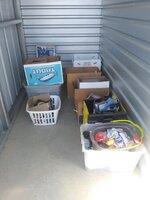
Storage Unit.jpg
 

Upcoming Events

Back Top