


JavaScript is disabled
Our website requires JavaScript to function properly. For a better experience, please enable JavaScript in your browser settings before proceeding.
I dont trust electronic scales
I at one time 'considered' an electronic scale - not really knowing why other than thinking it might be faster for hand weighed loads - but before I even got close to looking at any specifically I read more negative reviews on them than positive so I just kind of forgot about it.

Kind of like calipers. I only own dial style and not digital as I have heard similar negative reports from machinists about them, but like anything I am sure many use them. Maybe the higher prices, better 'names' are more accurate but nothing I need.
 
I at one time 'considered' an electronic scale - not really knowing why other than thinking it might be faster for hand weighed loads - but before I even got close to looking at any specifically I read more negative reviews on them than positive so I just kind of forgot about it.

Kind of like calipers. I only own dial style and not digital as I have heard similar negative reports from machinists about them, but like anything I am sure many use them. Maybe the higher prices, better 'names' are more accurate but nothing I need.
When I first started handloading I bought a cheap electronic scale and learned the hard way it was inconsistent. Having already bought it is the only reason I use it to get up close to the charge weight fast, but I dont use it to finish weighing. This is for low volume rifle loads.


I have been using both types from Mitutoyo for over 25 years now both professionally and now for handloading, I prefer the electronic calipers and have never had them wear out. My Mitutoyo dial calipers are a bit worn and need to rezero the needle occasionally, so for me in my experience I trust the electronic ones. But Mitutoyo's are not cheap, if I hadnt worked in metal fabrication Im not certain I would have bought them just for handloading.
 
I'm sure it's by volume. Heck, my powder measure throws charges by volume, but charges are listed by weight in the manuals.
Since there's not listing of volume by anyone besides Lee, we have no options but to measure by weight.

@oremike and @Cerberus Group can certainly speak on this better than I can.
Most powder checks go by volume, so if the powder isn't level and even in the case you can get a slightly different check, depending on how sensitive the powder check is. Volume has weight, so you adjust the load by weight and powder check by volume.

Most powder drops will do +/- .1 of a grain, which is most fine for almost any type of shooting. Long range/precision shooting, you may want to weigh each charge etc.

The type of powder also determines how consistent the charge is. As has been discussed, flake powder meters ok, and will generally get you in the +/- .1 powder drop range, as for stick powder...nope. The drum type powder drops don't like it, you can hear the grind as they crunch the sticks as its being actuated. I've not seen +/- .1 drops with stick powders using a drum type of powder drop....at least not consistent. When I'm doing rifle rounds with stick powder, I use an auto dispenser and set it for .1 - .2 grain low, then trickle in the last bit.

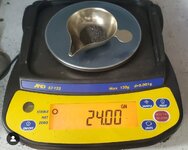
Now, if you're using powder that resembles micro ball bearings such as Ramshot TAC, you'll get amazing consistent accuracy with the powder drop. With the Mark 7 auto machines, we can get +/- .01 accuracy, and it is checked using a lab type scale that measure such tolerances. So you'll need a scale that measures out to the 1/100 of a grain.

scale.jpg

With that you'll get consistent results at the chrono..

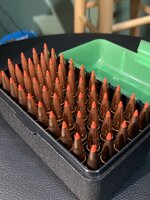
77 Gr Garmin.jpg

Another thing to try are magnum primers. During covid when primers were scarce, all CCI had were small rifle magnum. I tried those in our 223/5.56 and it made a great difference. Better powder burn and better accuracy, with no pressure signs and without changing the powder charge weight.. It's all I use now. If your loads aren't burning all the powder, try magnum primers, your loads will shoot cleaner. Magnum primers don't burn hotter, they burn fractions of seconds longer to get the high volume powder burned.
 
I use both a balance beam and a digital scale for all my reloading. Weighing of a known weight, the balance beam is a bit more accurate, about 2 tenths of a grain on a 300 grain object. Since I know my Lyman digital is going to read a tad light, it's no problem using both types to get a proper read as to weight. Using one to keep the other honest if you will.

I do check often to make sure settings haven't changed. Factors like moisture, air circulation, temp., do make a difference. I reload in my garage so I try to warm it up before I start throwing powder. RCBS powder thrower, one round at a time for about 20 years.
 
I'm sure it's by volume. Heck, my powder measure throws charges by volume, but charges are listed by weight in the manuals.
Since there's not listing of volume by anyone besides Lee, we have no options but to measure by weight.

@oremike and @Cerberus Group can certainly speak on this better than I can.
Absolutely correct. A dipper is volume, however that volume is a matter of weight. Hence every chart made that regards volume (generally in CC's) lists specific powders that are safe to use within that volume. Hence certain powders are safe to use in that volume. And when adjusting the volume on your measure you are verifying the proper volume with the scale.
 
Just asking, but if not near a maximum charge why the caution?
Caution is not the issue. Like I said I am looking for the best accuracy out of my Henry but in reality I am sure I wouldn't see much of a difference with a powder measure 'thrown' charge - HOWEVER because of the granular size of Unique I have occasionally experienced a 'jam up' when using a powder measure. This requires several 'taps' of the lever to free it up, or pulling on it harder to try to 'crunch' the stuck kernel and get it to function.
 
I've been loading a ton of .45 ACP lately. It is my favorite cartridge to reload because it's easy! Anyway I seem to be getting a tenth of a grain difference both ways when weighing every tenth round. Or if I weigh randomly I get the same tenth or so difference. So to try to keep things consistent, I've started to take my 5.5 gr. of Unique and weigh 10 charges and adjust my thrower to equal the balance beam scale set to 55.0 grains.

Thoughts please on a better way (no pun intended) to get more consistency. All RCBS equipment, single stage press.
What I do is tie wrap or tape an older sonic toothbrush to the hopper to vibrate it. Really improves the accuracy when using the larger flake powders and I have to do it with any power in the Lee disc type on the pro-1000 progressive's I have. Normally unique meters well but I always double tap on the top and bottom of the stroke
 
Great ideas from all, I'm going to try these new-to-me ideas over the Holidays.

Merry Christmas and a Happy New Year to all!
 
Yet 3031 is much larger then Unique per kernel but the smaller kernel causes problems with packing in the measures chamber?
If my memory serves I have dealt with powder jamming the measure with a few powders and It could have happened with 3031 as well.

This is what influenced me to try other powders that were more powder measure 'friendly' when loading higher volumes of say pistol ammo, such as Titegroup. Bulleseye meters well also .

However I do NOT shoot any high volume rifle ammo and find hand weighing the charges perfectly satisfactory when loading them - especially when using Unique.
 
Last Edited:
I just loaded up some 300BLK with Accurate 1680 and the RCBS Uniflow meter was spot on even to less than .1 grains.

Due in part to the nature of the type and shape of powder.
 
I'm with DizzyJ, I too use AA 1680 and WC 680 for 7.62x39 and it is a joy to use in my RCBS Uniflow.
 

Upcoming Events

New Classified Ads

Back Top