


JavaScript is disabled
Our website requires JavaScript to function properly. For a better experience, please enable JavaScript in your browser settings before proceeding.
Messages
1,288
Reactions
2,668
I'll try to be succinct and describe my problem.
Currently wrenching on a 2004 GMC Yukon with the 6.0L V8. Purchased 14 months ago with 150k on the odometer, did all the fluids, rear brakes, axle seals, exhaust manifold (driver side) and a few other things, wifey has been dailing it and really likes it.
Fast forward to last Friday, she told me it felt like it was stuttering and wasn't running right, plugged in the scanner and sure enough cylinders #2 and #6 had a misfire. No big deal I says, new plugs and wires coming right up. Replaced previously mentioned items and decided to clean up the engine bay a little. NO water or super clean got on the distributor or batt.
Wife drove it Saturday to work and on the way home told me check engine light came on, scanned it when she got home and it gave me P0332 knock sensor bay #2, eff me! So I got Delco sensors, harness etc and replaced also complying with the TBS that says to RTV seal around the sensor plugs/caps. Put everything back together, started it and smelled fuel really strong and got code P0300 (multiple misfires) I then triple checked ALL connections including injector harnesses.
Started it again and got same code, pulled the intake manifold off again to verify I installed gaskets correctly, re-installed manifold and again triple checked ALL connections (also has new intake gasket).
Started it again and gave me code P0135 O2 sensor bank 1 sensor 1. WTF? So I just got done installing new O2 sensor, started it and fuel smell is VERY strong in engine bay, sounds like it's sucking air and still giving me the P0135 code. PLEASE SOMEBODY HELP!!!! Sorry for being long winded I just wanted to paint the entire picture. Thanks in advance!
 
Obvious first question, are the plugs connected in the correct firing order? This includes ignition coils as well if you have them? Second question, is the alternator going bad? Third question, have you checked all of the fuel lines and connection points for leaks? Fourth question, are any of the fuses or relays bad?
Incorrect firing order will cause this as well as the coils being in the wrong order. A bad or under preforming alternator can cause these issues as well. Intake manifold gasket should have no effect on fuel if it's fuel injected.
 
Original problem was scanner showed cyl. 2 and 6 misfiring. Okay, the truck is running okay, next thing you know, you've got two holes misfiring. How likely is that two holes would go bad out of the blue together like that? Or is there some underlying cause that would make 2 and 6 go bad together? That new plugs and wires wouldn't fix? Just asking.
 
Obvious first question, are the plugs connected in the correct firing order? yes they are.This includes ignition coils as well if you have them? I triple checked each connection. Second question, is the alternator going bad? I don't think so, especially out of the blue with it being fine before I did plugs, wires, and knock sensors.Third question, have you checked all of the fuel lines and connection points for leaks? Yes, no visible leaks and no moisture on my hand after running along fuel rail, connection and back of manifold. Fourth question, are any of the fuses or relays bad? I haven't checked any fuses or relays, I struggle with electrical big time but I haven't gone there yet.
Incorrect firing order will cause this as well as the coils being in the wrong order. A bad or under preforming alternator can cause these issues as well. Intake manifold gasket should have no effect on fuel if it's fuel injected. It is fuel injection, LS V8 6.0L I can test the alternator but that doesn't account for fuel smell, when I changed the plugs/wires it is pretty dummy proof. The wires coming out of each plug are directly under the coil pack so I know I didn't screw that up. I guess I can retrace my steps from the beginning for the 4th time but I'm 98% sure I didn't make a mistake in reconnecting everything.
 
Original problem was scanner showed cyl. 2 and 6 misfiring. Okay, the truck is running okay, next thing you know, you've got two holes misfiring. How likely is that two holes would go bad out of the blue together like that? Or is there some underlying cause that would make 2 and 6 go bad together? That new plugs and wires wouldn't fix? Just asking.
The plug electrodes for cylinders 2 and 6 were both degraded quite a but more than than the rest. Not sure as to why, the plugs I pulled were a cheap AutoLite brand and I replaced with OEM Delco(even though they are chicom garbage now). So I am assuming the scanner picked up those 2 cylinders running really lean.
 
When #2 and #6 were indicated as misfiring, you need to know why. Changing the plugs & wires may not have been the solution to the problem. Example: It may have been a lean misfire caused by improper injector pulse width or perhaps a vacuum leak aligned with those two cylinders.

A scanner only points an experienced mechanic in a certain direction. Very often, the real problem is not what a scanner says but something related to that subsystem.

Have you asked yourself if 2 and 6 reach TDC at the same time? This will provide additional clues.

The knock sensor might not have been bad. It could have been pointing you to examine other possibilities for the sensor being triggered.

The smell of fuel is also a key indicator. You need to find where that smell is coming from, and when you do, it could point to the real problem. I use my freon sniffer device to find fuel leaks at times, works pretty good.

Many times, a vacuum leak can be found by spraying chem tool at various locations around places like the intake gasket. If it was a lean misfire caused by a vacuum leak, the idle will smooth out temporarily when you spray the right part - leak found.

Another suggestion is to erase DTC's and wait and see if the same DTC's are reset.

Just because an O2 sensor sets a code does not mean the sensor is bad. Go to a different section of your scanner and watch the live output from that O2 sensor. The output voltage will tell you if A/F mixture is lean or rich. More info!

And just some more salt in the wound - Your ECU may be corrupted. If this is the case, you need a lot of experience to determine as such.
My Jeep had "sudden unintended acceleration" a few years back. I spent two days tracing it out. One of the wires in the wiring harness had chaffed to ground between the firewall and engine. This corrupted the ECU's AIC output so that the bypass pintle would open but not close.

Problems like yours sometimes require an immense amount of experience and sometimes specialized tools to sort out since the variables & permutations are very high. What you have described does not sound like a pattern failure. However, I have given you a few extra tools that might not be in your toolbox.

🤪
 
the variables & permutations are very high.
Very true. It took me 30 years to perfect my skills working on 1960's vehicles. Knowledge which in the meantime had become quite obsolete. The avalanche of technology that goes into vehicles is unrelenting. I've wondered for some time about what it must be like to work on hybrids which have both ICE and EV systems aboard. Now there are pure EV's with all kinds of digital integration to make things go (or not go). At some point, an owner just has to send it to the shop. And hope they can figure it out.
 
When #2 and #6 were indicated as misfiring, you need to know why. Changing the plugs & wires may not have been the solution to the problem. Example: It may have been a lean misfire caused by improper injector pulse width or perhaps a vacuum leak aligned with those two cylinders.

A scanner only points an experienced mechanic in a certain direction. Very often, the real problem is not what a scanner says but something related to that subsystem.

Have you asked yourself if 2 and 6 reach TDC at the same time? This will provide additional clues.

The knock sensor might not have been bad. It could have been pointing you to examine other possibilities for the sensor being triggered.

The smell of fuel is also a key indicator. You need to find where that smell is coming from, and when you do, it could point to the real problem. I use my freon sniffer device to find fuel leaks at times, works pretty good.

Many times, a vacuum leak can be found by spraying chem tool at various locations around places like the intake gasket. If it was a lean misfire caused by a vacuum leak, the idle will smooth out temporarily when you spray the right part - leak found.

Another suggestion is to erase DTC's and wait and see if the same DTC's are reset.

Just because an O2 sensor sets a code does not mean the sensor is bad. Go to a different section of your scanner and watch the live output from that O2 sensor. The output voltage will tell you if A/F mixture is lean or rich. More info!

And just some more salt in the wound - Your ECU may be corrupted. If this is the case, you need a lot of experience to determine as such.
My Jeep had "sudden unintended acceleration" a few years back. I spent two days tracing it out. One of the wires in the wiring harness had chaffed to ground between the firewall and engine. This corrupted the ECU's AIC output so that the bypass pintle would open but not close.

Problems like yours sometimes require an immense amount of experience and sometimes specialized tools to sort out since the variables & permutations are very high. What you have described does not sound like a pattern failure. However, I have given you a few extra tools that might not be in your toolbox.

🤪
I heard some rigs out there don't have a crank keyway any more, just friction fit so they slip and lose time.
 
I had a similar situation. After $1800 in 'repairs' by one qualified mechanic & one dealer, it turns out a power? cable ($6.00) that fed the computer had a bad connection and made the computer generate different codes. Neither one gave me any money back & I never used them again.

Dan
 
Very true. It took me 30 years to perfect my skills working on 1960's vehicles. Knowledge which in the meantime had become quite obsolete. The avalanche of technology that goes into vehicles is unrelenting. I've wondered for some time about what it must be like to work on hybrids which have both ICE and EV systems aboard. Now there are pure EV's with all kinds of digital integration to make things go (or not go). At some point, an owner just has to send it to the shop. And hope they can figure it out.
Sooooo correct!

All my experience with carburetor's is about worthless.

And new cars of today have up to 30+ onboard computers controlling different systems. I was recently working on my wife's car that has EPS (electronic power steering). What a CF that was - a computer controlling the steering assist! And it can be programmed for different ride control - if you have a $3,000 scanner with the right software.

Furthermore, these complications are by design. To eliminate the home mechanic. I was talking to the manager of a local auto parts store years ago, and he recognized that auto stores have a bleak future because a lot of repairs needed on newer cars require proprietary knowledge that the manufacturer is unwilling to give up.

Some new cars no longer have dipsticks for the engine oil or auto transmission. Really! The design is so that you have to pay the dealer to even check or change your oil!

Lesson learned - keep your old car. A car that humans can work on!
 
Almost sounds like plugged fuel injectors or rail.
I agree. Sounds like a stuck open injector or a cracked intake. If you have a temp gun shoot temps of each cylinder exhaust manifold before I
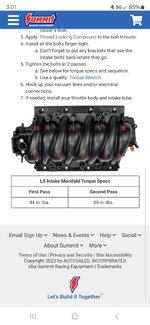
it goes into the collector. If you have a dead cylinder the temp difference will be obvious. When reinstalling the intake are you using the proper tightening sequence? If all that looks good I would check fuel pressure after the regulator on the manifold.

"NO water or super clean got on the distributor or batt."

I am a bit confused why you have a distributor as this should be a coil on plug?

Screenshot_20250327_150156_Samsung Internet.jpg
 
Last Edited:
Just to throw more gas on the fire ( so to speak )...consider the fact that the wiring harness is 20 years old and messing with everything may have compromised it...been there, done that...
 
Have you checked the Ignition Coil packs for proper resistance with a meter?

Being you had misfires in the beginning
Good call. Pretty easy to swap entire coil pack banks and see if the problem moves from bank 1 to bank 2 also. The multiple misfire and fuel smell leads me think its injector or regulator failure though. A bad ground or ground strap can make the coils behave funny also.
 
Furthermore, these complications are by design. To eliminate the home mechanic. I was talking to the manager of a local auto parts store years ago, and he recognized that auto stores have a bleak future because a lot of repairs needed on newer cars require proprietary knowledge that the manufacturer is unwilling to give up.
I completely agree. But Wall Street has other ideas. Both Auto Zone and O'Reillys are very high flyers right now. For one thing, the threat of tariffs has pumped them up. But they were going high before that. Question mark???

Lesson learned - keep your old car. A car that humans can work on!
You're preaching to the choir on that one with me. Four cars, 1972, 2004, 2006 and 2012. Of course all are ICE. What worry I have over them now is, will gasoline become a specialty product in my lifetime?

I keep a couple of spare power valves for the carb. in the 1972. My home mechanic code scanner happens to be common the 04, 06 Fords and 12 Hyundai. I've used in with success three times.

I used to keep all kinds of spare parts around. Learned that habit from my dad who was in the business. Ever since the internet came about, I've given that up. Let someone else be the warehouse. You put away 1,000 things you might need, later you only need two or three but you can't find them because they are buried under the other 997.

The prices of high mortality parts have actually gone down over the years thanks to Chinese competition.

Admittedly I have retained quite a few parts for my 1972 Ford wagon because I already had them from the days when I bought abandoned vehicles at the auctions and parted them out. But I've got a lifetime and beyond supply of alternators, starters and so on. I'll never use them. I have gone through three station wagon tailgate glass replacements, with only one remaining "in stock."
 
Sooooo correct!

All my experience with carburetor's is about worthless.

And new cars of today have up to 30+ onboard computers controlling different systems. I was recently working on my wife's car that has EPS (electronic power steering). What a CF that was - a computer controlling the steering assist! And it can be programmed for different ride control - if you have a $3,000 scanner with the right software.

Furthermore, these complications are by design. To eliminate the home mechanic. I was talking to the manager of a local auto parts store years ago, and he recognized that auto stores have a bleak future because a lot of repairs needed on newer cars require proprietary knowledge that the manufacturer is unwilling to give up.

Some new cars no longer have dipsticks for the engine oil or auto transmission. Really! The design is so that you have to pay the dealer to even check or change your oil!

Lesson learned - keep your old car. A car that humans can work on!
I am actually surprised at the amount of diagnostic equipment that is available for the home mechanic nowadays...not saying its cheap or can do everything, but the market is light years ahead of where it was 20 years ago. I got out of retail automotive 19 years ago partly because of seeing the complexity of newer cars and knowing it was a matter of time before shade tree work would be a lost art...and partly because pay was crap..:s0110:

I'm still stubborn and do all my own repairs though...although I question as to why sometimes....like finding out there were reman steering knuckles with bearings for our Mazda after I bought a 12 ton press to swap them myself...:s0037:
 
I completely agree. But Wall Street has other ideas. Both Auto Zone and O'Reillys are very high flyers right now. For one thing, the threat of tariffs has pumped them up. But they were going high before that. Question mark???


You're preaching to the choir on that one with me. Four cars, 1972, 2004, 2006 and 2012. Of course all are ICE. What worry I have over them now is, will gasoline become a specialty product in my lifetime?

I keep a couple of spare power valves for the carb. in the 1972. My home mechanic code scanner happens to be common the 04, 06 Fords and 12 Hyundai. I've used in with success three times.

I used to keep all kinds of spare parts around. Learned that habit from my dad who was in the business. Ever since the internet came about, I've given that up. Let someone else be the warehouse. You put away 1,000 things you might need, later you only need two or three but you can't find them because they are buried under the other 997.

The prices of high mortality parts have actually gone down over the years thanks to Chinese competition.

Admittedly I have retained quite a few parts for my 1972 Ford wagon because I already had them from the days when I bought abandoned vehicles at the auctions and parted them out. But I've got a lifetime and beyond supply of alternators, starters and so on. I'll never use them. I have gone through three station wagon tailgate glass replacements, with only one remaining "in stock."
Wall Street is PROFOUNDLY corrupt! So, there is that! o_O

And with the price of new cars, perhaps more people are trying to keep the old one running. Therefore, needing parts.
For example, my 04 Jeep Grand Cherokee Laredo Has well over 300,000 miles on it. I have rebuilt almost everything on it! It looks & runs like new.
I refuse to buy a new vehicle. I paid less for my property than the price of a new vehicle!
 
I am actually surprised at the amount of diagnostic equipment that is available for the home mechanic nowadays...not saying its cheap or can do everything, but the market is light years ahead of where it was 20 years ago. I got out of retail automotive 19 years ago partly because of seeing the complexity of newer cars and knowing it was a matter of time before shade tree work would be a lost art...and partly because pay was crap..:s0110:

I'm still stubborn and do all my own repairs though...although I question as to why sometimes....like finding out there were reman steering knuckles with bearings for our Mazda after I bought a 12 ton press to swap them myself...:s0037:
I can relate. I have many tools that have been used only once and will probably never be used by me again.

Things like the front diff axel seal installer for a Dana 35.
I like to do things right, so when I rebuilt my differentials on my Jeep, I purchased correct tooling.
 
Last Edited:
Just to throw more gas on the fire ( so to speak )...consider the fact that the wiring harness is 20 years old and messing with everything may have compromised it...been there, done that...
That is experience talking!

I remember long ago, when dinosaurs roamed the earth, that simply moving a spark plug wire, could snap the core and render them useless.
 

Upcoming Events

Back Top