







Bronze Vendor
Gold Lifetime
- Messages
- 316
- Reactions
- 1,073
I often struggle to explain how surface prep impacts the finished product when hot bluing guns. This most recent batch of bluing, I had a wide variety of different finishes, and figured it would be a good opportunity to showcase how they impact the finished product.
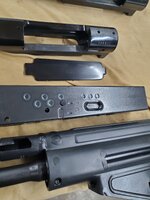
The AK receiver had zero prep work done. It was left with the mill finish, straight off the stamping dies. I believe this would be similar to how some Chinese AKs were blued. You can see a lot of the details in how the receiver was manufactured, such as tooling marks and spot welds. Any shine that was in the metal prior to bluing is still there, but there is inherent unevenness to the level of gloss.
The G3/Cetme receiver was bead blasted with 80gr glass bead media. It comes out a nice, even matte finish. In terms of effort involved, this is one step above doing nothing. The parts are loaded in the cabinet and then blasted, removing any existing finish and giving the metal an eggshell like sheen. Tooling marks are far less visible or gone entirely. Any pitting that was present from rust is still there, but much less noticeable. It can sometimes appear close to a parkerized finish, depending on several factors.
The Mauser floorplate was polished to 320gr with sandpaper. This is where labor starts to become a significant factor. Sometimes the part gets media blasted first to remove any rust or paint. The part is then sanded with ascending grits of sandpaper. Pitting becomes more visible at this point, and if it is not filed out prior to sanding, can be an eyesore. Some parts were not manufactured with the intentions of being polished (IE Mauser receivers) and have significant tooling marks that take time to smooth over. A brushed finish will hide some sins, but not many.
The Winchester receiver was buffed to a high gloss. Same as the Mauser floorplate, but you continue up the grits up to 1000 or higher, and then move to the buffing wheel and polishing compounds. This takes lots of time, but the results are very attractive. At this level of gloss, any imperfections in the metal become very apparent. Holes that have been plugged and welded will have a different shade of black. Pitting is obvious. Scratches from the sanding process can be visible if done poorly. Just to do the receiver shown was around 2-3 hours of sanding and polishing.
Each finish has its application. I would not want to polish that G3/Cetme receiver. Likewise, the owner of the Winchester receiver wanted it refinished because the prior gunsmith had sandblasted it prior to bluing, while the rest of the gun had been polished. I am a believer that the sandblasted finish can retain oil a little better, and as a result, will not rust as easily as a polished finish. That could be argued, I suppose. I hope this helps someone.


The AK receiver had zero prep work done. It was left with the mill finish, straight off the stamping dies. I believe this would be similar to how some Chinese AKs were blued. You can see a lot of the details in how the receiver was manufactured, such as tooling marks and spot welds. Any shine that was in the metal prior to bluing is still there, but there is inherent unevenness to the level of gloss.
The G3/Cetme receiver was bead blasted with 80gr glass bead media. It comes out a nice, even matte finish. In terms of effort involved, this is one step above doing nothing. The parts are loaded in the cabinet and then blasted, removing any existing finish and giving the metal an eggshell like sheen. Tooling marks are far less visible or gone entirely. Any pitting that was present from rust is still there, but much less noticeable. It can sometimes appear close to a parkerized finish, depending on several factors.
The Mauser floorplate was polished to 320gr with sandpaper. This is where labor starts to become a significant factor. Sometimes the part gets media blasted first to remove any rust or paint. The part is then sanded with ascending grits of sandpaper. Pitting becomes more visible at this point, and if it is not filed out prior to sanding, can be an eyesore. Some parts were not manufactured with the intentions of being polished (IE Mauser receivers) and have significant tooling marks that take time to smooth over. A brushed finish will hide some sins, but not many.
The Winchester receiver was buffed to a high gloss. Same as the Mauser floorplate, but you continue up the grits up to 1000 or higher, and then move to the buffing wheel and polishing compounds. This takes lots of time, but the results are very attractive. At this level of gloss, any imperfections in the metal become very apparent. Holes that have been plugged and welded will have a different shade of black. Pitting is obvious. Scratches from the sanding process can be visible if done poorly. Just to do the receiver shown was around 2-3 hours of sanding and polishing.
Each finish has its application. I would not want to polish that G3/Cetme receiver. Likewise, the owner of the Winchester receiver wanted it refinished because the prior gunsmith had sandblasted it prior to bluing, while the rest of the gun had been polished. I am a believer that the sandblasted finish can retain oil a little better, and as a result, will not rust as easily as a polished finish. That could be argued, I suppose. I hope this helps someone.

Last Edited: