


JavaScript is disabled
Our website requires JavaScript to function properly. For a better experience, please enable JavaScript in your browser settings before proceeding.
Messages
16
Reactions
18
I've known many people who identify as survivalists or preppers but none of them have ever practiced or have been able to share with me how to safely construct a functional water filtration system. Everyone is quick to share their sharp and pointy things, things that go bang, ways to cook food, and ways to stay warm… but without water, you can be dead in a few days. So my question: why aren't more people flexing their creative (and functional) ways to preparing water? In the PNW it's not hard to find a clear stream but that's only true in PNW. Is it weird to ask people to start doing this?

And yes I know you can boil or use iodine tablets but if you're keeping a family or a community alive, you'll need something better. Also, store bought filters will break or plug at some point.
 
Also, store bought filters will break or plug at some point.
Or go out of business, so they won't be able to procure more of their proprietary water filter.

Sounds like their hobby focuses more on fun things, less on the complicated and not so fun things. It probably is weird to ask people to start learning how to filter water, but whatever floats your boat 🤷‍♂️
 
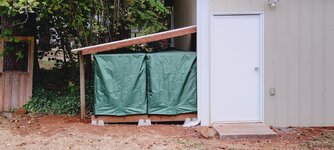
Potentially available, but I wanted to prove I could catch potable water like we used to do in Ketchikan, AK, so I bought 2 300+ gal totes from a neighbor and ran a set of RV potable water hoses from the gutter of my shop with an online RV water filter. I was able to fill one in 30 days during late fall and then tested the water with a test kit. It passed potable, for sure.

My only issue was being able to store them outside under a lean-to with UV covers on them through the summer. It was okay until July, then the water started growing things.

IMG_20221004_150215646_HDR.jpg
 
Or go out of business, so they won't be able to procure more of their proprietary water filter.

Sounds like their hobby focuses more on fun things, less on the complicated and not so fun things. It probably is weird to ask people to start learning how to filter water, but whatever floats your boat 🤷‍♂️
The wording was poor in my request for people sharing their filtration builds but with many people on a prepping forum seems like the right place to share such a request. Humans learn from others even in passive ways. It would be nice to hear thought, designs, builds on water filtration set ups. That's all I was getting at.
 
Potentially available, but I wanted to prove I could catch potable water like we used to do in Ketchikan, AK, so I bought 2 300+ gal totes from a neighbor and ran a set of RV potable water hoses from the gutter of my shop with an online RV water filter. I was able to fill one in 30 days during late fall and then tested the water with a test kit. It passed potable, for sure.

My only issue was being able to store them outside under a lean-to with UV covers on them through the summer. It was okay until July, then the water started growing things.

View attachment 2125719
This is a cool idea and in most of the year it seems viable and "easy" after the initial construction.
 
So my question: why aren't more people flexing their creative (and functional) ways to preparing water? In the PNW it's not hard to find a clear stream but that's only true in PNW. Is it weird to ask people to start doing this?
IMO I would not trust any stream in urban environments, probably less trust after any such natural disaster.
Im not a true prepper but have 55gal water storage and a bottle of bleach to purify it if needed. Bleach is pretty simple.
 
IMO I would not trust any stream in urban environments, probably less trust after any such natural disaster.
Im not a true prepper but have 55gal water storage and a bottle of bleach to purify it if needed. Bleach is pretty simple.
Bleach is your friend for keeping potable water potable. Lifestraws are part of the kit as well.
 
Bleach is your friend for keeping potable water potable. Lifestraws are part of the kit as well.
Water storage can only last so long, I suppose even urban streams are a viable source in a true emergency. I do have a lifestraw and some Sawyer filters.
I do shudder at the thought of drinking urban streamwater though. Bleh. :p
 
*SO*

Great question, bro.

The other part is availability. I am in a suburban area with about a two-block hike to a major river here locally after the water heater empties out. Once availability is a non-issue, then I will employ @nammac 's method as described above (bleach, after boiling, one or other or both together).

Sheesh. Hope it doesn't come to that. But I figure I will open carry on my treks to the River and back. :) Possibly with a security detail. Opens up a whole lotta more considerations and questions. 😳
 
Better than boiling? Ain't no such thing. Especially under primitive conditions.

Before boiling, to remove sediment and improve clarity and palatability, simple filtration systems can be made from such readily available materials as plastic bottles, sand, charcoal, and dried grass (there are lots of internet resources, including YT videos that describe in detail how to do this). Of course, these materials will have to be replaced periodically to maintain effectiveness. But to kill disease organisms, you will have to boil after filtering. Fortunately, in the PNW, there is no shortage of natural fuel for boiling.

BTW, a clear stream is not a safe stream. Giardia thrives in cold, clear, fast running water.
 
I've known many people who identify as survivalists or preppers but none of them have ever practiced or have been able to share with me how to safely construct a functional water filtration system. Everyone is quick to share their sharp and pointy things, things that go bang, ways to cook food, and ways to stay warm… but without water, you can be dead in a few days. So my question: why aren't more people flexing their creative (and functional) ways to preparing water? In the PNW it's not hard to find a clear stream but that's only true in PNW. Is it weird to ask people to start doing this?

And yes I know you can boil or use iodine tablets but if you're keeping a family or a community alive, you'll need something better. Also, store bought filters will break or plug at some point.
Potable water should be #1 priority. People should also practice their filtering methods while hospitals are still open.
 
It's not easy (or cheap) to treat surface water adequately to make safe, potable water. It has to be a pumped system with enough pressure to flow through several stages of filtration to remove particulates, then a disinfection stage using UV, chlorine, or another disinfectant. You can buy complete off-the-shelf systems. www.wecofilters.com/uvx320.html

Rainwater is another matter. It's basically distilled by mother nature and is absolutely clean until it hits your collection surface.

I've been using rainwater collection for about 8 years now. I collect off a metal roof and have several storage tanks, 7000g total capacity. I periodically treat the stored water with hydrogen peroxide (industrial strength 30%, not the 3% stuff they sell in stores). I don't use chlorine because the chemical byproducts of the chlorination process are known carcinogens.

In my kitchen I have a Berkey counter top filter to treat water for drinking, cooking, etc. The filter elements need to be cleaned a couple of times a year but this is easy to do. I have a supply line hard plumbed to the Berkey so it's very simple to fill. Berkeys aren't cheap but they're the gold standard. usaberkeyfilters.com/products/big-berkey-water-filter/ I've seen plans to build your own using plastic buckets and the same type of filter elements but I avoid drinking out of plastic containers.

I'm collecting off 400 square feet. 1" of rain yields 250 gallons, so a typical winter of 50 inches of rain is over 12,000 gallons, far more than I use. (The typical household uses 30-40 gallons per person per day.) My system is plumbed to either collect water or dump it. At the beginning of the rainy season I wait til after a couple of good hard rainfalls before collecting, and when the tanks are full I go back to dumping.

As far as prepping goes, a year's worth of water is a nice thing to have. You can do without a lot of things, but water's not one of them.
 
The wording was poor in my request for people sharing their filtration builds but with many people on a prepping forum seems like the right place to share such a request. Humans learn from others even in passive ways. It would be nice to hear thought, designs, builds on water filtration set ups. That's all I was getting at.
Apologies for my misunderstanding. I revise my answer to not weird!
 
It's not easy (or cheap) to treat surface water adequately to make safe, potable water. It has to be a pumped system with enough pressure to flow through several stages of filtration to remove particulates, then a disinfection stage using UV, chlorine, or another disinfectant. You can buy complete off-the-shelf systems. www.wecofilters.com/uvx320.html

Rainwater is another matter. It's basically distilled by mother nature and is absolutely clean until it hits your collection surface.

I've been using rainwater collection for about 8 years now. I collect off a metal roof and have several storage tanks, 7000g total capacity. I periodically treat the stored water with hydrogen peroxide (industrial strength 30%, not the 3% stuff they sell in stores). I don't use chlorine because the chemical byproducts of the chlorination process are known carcinogens.

In my kitchen I have a Berkey counter top filter to treat water for drinking, cooking, etc. The filter elements need to be cleaned a couple of times a year but this is easy to do. I have a supply line hard plumbed to the Berkey so it's very simple to fill. Berkeys aren't cheap but they're the gold standard. usaberkeyfilters.com/products/big-berkey-water-filter/ I've seen plans to build your own using plastic buckets and the same type of filter elements but I avoid drinking out of plastic containers.

I'm collecting off 400 square feet. 1" of rain yields 250 gallons, so a typical winter of 50 inches of rain is over 12,000 gallons, far more than I use. (The typical household uses 30-40 gallons per person per day.) My system is plumbed to either collect water or dump it. At the beginning of the rainy season I wait til after a couple of good hard rainfalls before collecting, and when the tanks are full I go back to dumping.

As far as prepping goes, a year's worth of water is a nice thing to have. You can do without a lot of things, but water's not one of them.
Very good as long as you have power.
 
Survival tip:

Q: How do you boil water without a fireproof container?

A: Old Native American/frontiersman method: Requires a bit of time, but here goes - Dig a hole in the ground about 8" in dia. and 8" deep near your campfire. From a stream bank or other source, obtain some clay. Line the hole with about 1/2" of clay. Let dry. Build a small fire (not too hot) in the bottom of the hole to bake the clay. Remove the ashes. Pour the water to be boiled in the hole. Place a number of small stones in your campfire. When heated, use a pair of sticks (not your hands) to place a few stones in the bottom of the hole. Remove and replace the stones as needed until the water reaches boiling temp.

Disclaimer: Never tried it, but it sounds good. :s0092: :s0144:
 

Upcoming Events

New Classified Ads

Back Top