


JavaScript is disabled
Our website requires JavaScript to function properly. For a better experience, please enable JavaScript in your browser settings before proceeding.
I precision load for a 6ppc, 6mmBR, 20VT and the .223. I have explored the outer reaches of insanity of reloading you are getting into.

I reloaded .223 and 6mmBR for a long time neck sizing only with outstanding success. When the cases would start to get tight, I would use my Redding body die to bump the cases back about .002. I could neck size about 5 or 6 times before I had to body size.

I quit neck sizing as the result of a entire batch of .223 rounds that were way too tight in my chamber and a few got stuck. Nothing during the prior shooting to indicate in any way this was going to happen - they were in no way tight during the extraction process. So I sold all my Redding Competition dies (neck, body and seater) and went to Redding FL type S dies and Wilson seating dies. No more stuck cases. (Never had problems with the BR...just the .223)

Accuracy result difference from neck sizing only to FL sizing each time (.002 bump) has been no change. If anything accuracy improved in the 6BR. Now I have total piece of mind that I won't get any .223 stuck cases.

Someone gave you advice to get some wind flags. I echo that 100%. Learning what the wind is doing to the flight path of your bullets will allow you to shoot smaller groups than 90% of the tweaks you can do to your reloading process. Anyone serious about accuracy will at the very least have surveyor ribbon on dowels, spread out about every 25 yards or so down the range.

I tried weighing cases. I consider sorting cases by weight a waste of time. If anything you need to measure the internal of the case...that is what will affect the pressures that could influence accuracy. If the extra weight of the case resides in the rim which is usually the case, that will have zero impact on accuracy. I don't bother with internal volume though...I use Lapua brass and consider it good enough. I focus on the wind rather than case weight.

BTW - calipers can't measure to the ten-thousandth. Sure the caliper will show it as a reading...but compare it to a micrometer reading and you will see. I would trust a good caliper to the thousandth...but no finer than that.

The groups you are shooting are outstanding. For a factory rifle, you are kicking butt actually. Can you do that 5 groups in a row?
 
I precision load for a 6ppc, 6mmBR, 20VT and the .223. I have explored the outer reaches of insanity of reloading you are getting into.

I reloaded .223 and 6mmBR for a long time neck sizing only with outstanding success. When the cases would start to get tight, I would use my Redding body die to bump the cases back about .002. I could neck size about 5 or 6 times before I had to body size.

I quit neck sizing as the result of a entire batch of .223 rounds that were way too tight in my chamber and a few got stuck. Nothing during the prior shooting to indicate in any way this was going to happen - they were in no way tight during the extraction process. So I sold all my Redding Competition dies (neck, body and seater) and went to Redding FL type S dies and Wilson seating dies. No more stuck cases. (Never had problems with the BR...just the .223)

Accuracy result difference from neck sizing only to FL sizing each time (.002 bump) has been no change. If anything accuracy improved in the 6BR. Now I have total piece of mind that I won't get any .223 stuck cases.

Someone gave you advice to get some wind flags. I echo that 100%. Learning what the wind is doing to the flight path of your bullets will allow you to shoot smaller groups than 90% of the tweaks you can do to your reloading process. Anyone serious about accuracy will at the very least have surveyor ribbon on dowels, spread out about every 25 yards or so down the range.

I tried weighing cases. I consider sorting cases by weight a waste of time. If anything you need to measure the internal of the case...that is what will affect the pressures that could influence accuracy. If the extra weight of the case resides in the rim which is usually the case, that will have zero impact on accuracy. I don't bother with internal volume though...I use Lapua brass and consider it good enough. I focus on the wind rather than case weight.

BTW - calipers can't measure to the ten-thousandth. Sure the caliper will show it as a reading...but compare it to a micrometer reading and you will see. I would trust a good caliper to the thousandth...but no finer than that.

The groups you are shooting are outstanding. For a factory rifle, you are kicking butt actually. Can you do that 5 groups in a row?

Fantastic wisdom and insight. Thank you for your contribution and the time you took to write this all out.

Next step: flags...
 
Just as a follow up and only submitted since the word precision was used in the OP and BR shooting was mentioned:

A very wise and accurate match shooter once told me to ignore differences in brass and bullet weights that were less than 5% from the median of the batch weighed. He also mentioned that a .3 grain variance +/- in powder weight was not a problem. He was talking about a .30-06 cartridge. I also heard the same advice given by Jack Neary in a BR shooting seminar. Jack was talking about the 6mmPPC, a cartridge that used a lot less powder and a lighter bullet. So the message I have taken to heart and has served me well over the last 50 years or so is that whatever you do on the loading bench is insignificant compared with what you do on the firing line.

Does this mean that you can buy Lapua or Norma brass and Bart's or Knight's or Precision Balistic bullets and Norma and Vihtavuori powders and Federal Gold Medal primers and just forget about case prep and ladder tests and etc....etc...
Of course it does not--especially if you are planning on any SERIOUS competition with your custom made ladeda match rifle. Some of us have been around long enough to remember the horrible, earth shaking scandal of the great Lapua outsourcing debacle. Some of us might remember recalls from some of the other name brands above - and some of us have lived long enough to never NEVER trust to luck or a businessman's promise. It may not pay to always double check the specs of your components, weight, base to ogive length, powder density, primer size and weight, but if you do not--the day will SURELY come when you get screwed. So, buying premium brands will certainly help to reduce flaws in your components, but it will not eliminate them. Buying a large quantity of a known good lot of any component is a tried and true method of quality assurance. That way you only need weigh, measure, test when changing from the old lot to the new lot. To those people who think that this is not cost effective or it can be done in small lot or on the cheap--let me suggest that your commitment to real precision shooting is not on a level that will garner any Honorable mentions, let alone trophys and that match shooting is probably not for you.
 
@SinisterSouthpaw
Thank you for that.

So when it comes down to it... what I'm doing is irrelevant in small batches.

I really don't want to chase my tail on this. I should be more concerned with a consistent load, keeping brass at similar size (I'm currently full length sizing at .002/.003" below my chamber for ease of chambering), neck size for fun, keep my seating consistent, work on my breathing, trigger pull, flags and have fun?


Update:
I will say that since I've done some as neck size only (no trimming), and I just sized a batch today that I did the slightly under chamber dimensions in full length. I trimmed an average of .001" of brass from the end of maybe every 5th piece of brass.

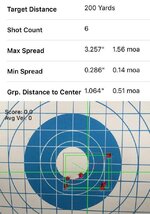
The same recipe that gave me the .3 MOA, also gave me this yesterday:
12239561_1551407415134250_4797329303277432646_n.jpg
The constant was the bullets and bipod. and this time there was a mild breeze (5mph or so) vs the gusting the first day.
I cannot say that the shooter was consistent, or the weather. It was 46* outside when these were shot vs the warmer 60* on the other day. I can't see a spread that much from one powder (IMR4320). That issue is for another day though.
Heck I shot a 2" total group with Federal Premium 180gr's.

Anyway, I think the one behind the rifle is to blame for that group. Next time I go out, I will put it in the vice, strap it down to the bench and see what happens when human error is removed.
 
Couple questions.

Is minimum spread or group center relevant for anything or just intrinsic value?

Especially during load development or trying to satisfy my inner OCDeamons I would be shooting 3-5 round groups at 100M off two point sandbags or vice.

All I see is a 1.56 MOA 6 round group, Please enlighten.

This exact same recipe yielded .6" at 200 last outing? If you had these same results with a sterile shooting platform I'd really be concerned about powder/temp stability. Have you loaded any with Varget?
 
Couple questions.

Is minimum spread or group center relevant for anything or just intrinsic value?

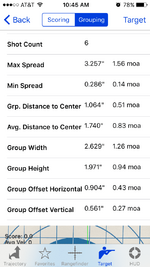
The app that I'm using on my phone does the spread, as relevant to the overall center of the pattern. It also gives me the distance from point of aim. I have all that information It just requires a different image to show it all. Next paragraph explains it a little better.

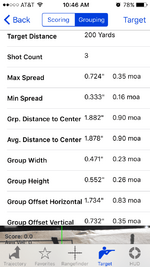
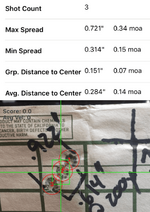
Attached is the full data based on the apps calculations. The user is required to input proper scale, and locate the POA for the target. Both of which were located on the image.
Second outing:
Photo Nov 24, 10 45 53 AM.png
First outing
Photo Nov 24, 10 46 07 AM.png

jLuck said:
Especially during load development or trying to satisfy my inner OCDeamons I would be shooting 3-5 round groups at 100M off two point sandbags or vice.
Ah yes. The original zero on the rifle was done @ 100. Sadly I didn't know the Ballistics app would do these calculations for me. Odd, after 4 years I never explored target record functions. I did do my 100y zero and it was damn perfect. Then I stretched out to 200 and got the good results.

jLuck said:
All I see is a 1.56 MOA 6 round group, Please enlighten.

This exact same recipe yielded .6" at 200 last outing? If you had these same results with a sterile shooting platform I'd really be concerned about powder/temp stability. Have you loaded any with Varget?
Capture.PNG
POA was right 1.5" and up .5". There was a clothes pin holding the paper target up and I was aiming at the bottom of the clothes pin. I know it doesn't look like much, but the reticle on the scope really let me see exactly where I was aiming. Which is why I picked such an odd target reference point.

I'm considering it heavily (running some Varget). I have 20 rounds left of this recipe that I'm going to check in a couple days and see if it was human error or if I'm getting inconsistent results based on powder. I will have some in my breast pocket under a jacket and sweatshirt to keep them warm while I keep the others out in the air and load them one at a time. Not quitting, but it's apparent that it's not a brass problem. :D as they are all similar, bullets all weigh the same, powder is dropped to the same within .05gr. Human error has to be or I got damn lucky.

For kicks and giggles, this was the Federal ammo at 180gr factory stuff that I shot at 200y when the rifle was on its first outing from Sportsmans Warehouse.:
Photo Nov 24, 10 55 23 AM.png

Powder burn rate is interesting, as Varget and 4320 are sleeping buddies on the scale. 101 and 102 respectively. I've also considered a quicker powder such as the IMR3031 that I seem to be stocked up on deep here as well. I'm not getting a lot of muzzle flash from unburned powder exiting, it's just a thought as well.

Photo Nov 24, 10 45 53 AM.png

Photo Nov 24, 10 46 07 AM.png

Capture.PNG

Photo Nov 24, 10 55 23 AM.png
 
Last Edited:
Thanks a bunch. I'm hoping to remain consistent throughout the process that's all. I'm trying to find that most reliable method, most consistent method without spending time obsessing over .0005" of setback or cutting powder grains in half. After all my RCBS scale only registers to .1 grains.


Reloading experience:
Couple years now. I've had good luck shooting .120"@50 groups in a .223 and loading hole for hole rounds in .243. This is the first time I've went forward with the idea of neck sizing and making brass for one rifle. I used to load rounds (powder and OAL only) for each rifle but it's now getting more precise than that.

That's all good info. The brass I was using was Remington, I was checking headstamp earlier. I did have 8 of 21 were Federal when I did those groups.

Not at the point of measuring concentricity yet.

Not weighing brass. Goes along with concentric rounds. Not yet.

I did weigh some just as an edit:
Federal on average was 10 grains heavier than Remington. I see the difference.

RCBS dies.

Some of the reasons I don't have a concentric gauge and other stuff is time and monies. Monies being the shortest side if the equation. I'm sure slowly I'll build up more precision equipment and stretch those legs when they come.

OK, I have been where you are. I bought a second hand 308 target rifle and never did get it to shoot well. I blame me for being more sensitive to recoil than I thought, but in fairness, the guy I bought the rifle from told me that if he didn't sell it, he was going to re-barrel it to another caliber anyway.
That said, I had it re-barreled to 6-BR. Now it shoots better. I have tried the concentricity gauge. It does help, There are a couple of companies that sell them, so shop around.

As far as the powder goes, I weigh every charge with an RCBS electronic scale. I know it is not the most accurate scale, but it came as a kit with the electronic powder dribbler and it seems to work. My personal best is 197 12X out of a possible 200 at 600 yards. I had 3 nines that time.

I am at a point where I have almost 2 grand invested in a 500 dollar rifle. I still do not neck size, I full length size, and hand prime.

If in your experiments, you only change one thing at a time, you can eliminate the the things that don't work. If it doesn't help, don't do it. Each step is time that you could spend on other things that do work.

Also, I have found that different brands of bullets do make a big difference. Berger is one of the best.

Good luck. I hope you have as much fun with your rifle as I have had with mine.
 
Once you get the dies set, it does not take any more time to partial full length size and set head space to -001/-.002 inches? I use Forster Dies and once they are set they hold tolerance.
 
@Oldtrader3
Yeah, I think I have mine set now! I'm running 1.622+\- a fudge depending on spring in the brass.

I should have just done this instead of buying that neck only die
 
Maybe I missed it, but what bullets are you shooting? Make/Weight.

Personally, I aim to set back the shoulder .002" and neck size with a bushing die about 2/3 the way down the neck with about .003-.005" neck tension, at least to start... If you can (and you know you can) just go get a box of Lapua or Norma brass, it's worth it - it'll last 15+ reloads NO problem if you're attentive and anneal it every 4-5 firings. Lapua seems to last bit longer than Norma, but both are terrific. It's just proven to me to be most consistent in weight, neck-wall thickness, etc. I used to turn all my necks, and even reamed for a couple of finicky wildcat calibers, but I don't anymore, as I don't notice a difference when using Lapua.

Initially, when I'm working up a load, I do all my testing with a scaled-down reloading setup that fits in a box that I take right to the range - a BIG time, brass, bullet, barrel saver! I also take care to insure that I (the shooter) can hold as tight a POA as possible, i.e. a nice rest, rear-bag, and the highest power optic I own is mounted (> x30+ is ideal). If it's a new load I intend to work with, I'll prep 50-pieces of brass (sized/primed), and head to the range with my setup and a pound of powder and a box of bullets,... I'll do a quick ladder test at 300-yards of approximately eight-to-ten shots @ 0.5-grain increments. I start with a low (read: safely in spec) charge and work up,... examining each piece of brass for signs of pressure. Depending on the bullet/mag-length I'll seat it well within magazine length if it's a field rifle,... I'll only consider distance to the lands if it's never going to leave the benchrest or a custom chamber that demands it, otherwise, I don't care.

Anyway, after shooting the ladder, and reading the vertical spread, 90% of the time I'll find a narrow range of charges to focus on. From here, I'll come back to 100-yards to eliminate any extra influence from the wind and shooter error, and shoot a few 3-round groups in .2-grain increments throughout the range of charges I've identified with a chronograph (magnetospeed for me, but any will do). From there, I'm looking at the velocity and SD,... particularly the SD - how low will it go and is it consistently low and can I determine the middle of the node i.e the center of that charge that yields the lowest SD? By now, I have a pretty narrow range of charges to work with (+/- .3-grains) and will start shooting 5-rounds groups with the chrono and seeing how tight I can get it grouping by tweaking the seating depth + & - .010". If it's liking a seating depth change in one direction, I'll push it a little more in that direction. If it opens up, I might have to +/- the charge a .2-grain increment depending on the direction. By this time, it's shooting about as good as it ever will with this combo and while it still can be tweaked further with seating-depth and neck tension adjustments, it's gilding the lily at this phase. By now I'll know if the combo is going to drill holes,... or not.

This last phase of the process is where you're kind of monitoring everything at once: the group, the SD, the velocity changes, seating depth, charge-weight,...etc. It's a bit of a dance, but you'll zero in on what your barrel likes,... or not,... If it's not working, don't waste powder, bullets, barrel-life, and most importantly, your time(!) to try and make a loser into a winner,... it will never get there. put 'em on the shelf or trade it away, but move on to the next combo.

In any case, with the method I describe above, I'll start at the range in the morning about 9 am and be done, or at least know if I have a winning combo, by lunch (1 pm), and will have shot about 30-rounds give or take,... I like to have the 20 extra in case I want to do more shooting.

Ryan%2527s_Desktop.jpg
 
I think most all precision benchresters just throw their powder, not weigh it.

The only reason they do is because at the accuracy node, the combination of velocity an that particular barrel, the allows you to change the delta V a little more so the charge is somewhat less important.

Stick with option 3. Best for the brass

Also think about this. It cut my groups 50% after dialing the load in

http://www.limbsaver.com/product/limbsaver-barrel-de-resonator/

$12 !!!

Also buy Lapua brass or nosler custom. Lapua is about $100 and you will not regret it. Nosler is more but they weigh the cases so each box is identical. With nosler use a sharpie to mark each piece from a box differently so you can keep them straight later. The markings stay pretty well but you may need to re mark them.

Berger and Sierra are the best for me. Noslers were a disappointment for me.

Good luck
 
What blurry said about neck turning and Lapua. Don't need to. Very uniform thickness.

Also look at LE Wilson dies. If you're in pdx be glad to show you. $120 for the dies $80 for the press and you're good at the range or hotel room or in front the TV.

I am in beaverton and happy to hook up and talk reloading. Can show you the dies and press in action too.
 
@Goosebrown, I'd always forgot about those attenuators and thought them always hokey/fiddly but did a tiny research and it's probably just the ticket for my lightweight, whip barrel Model 7 Remington in .223.
I reload for .223 and of course send military ball downrange, but the "accuracy" of that thing has always left me scratching my head.. and I don't want to chase down/work up a killer load for it.
Thanks for the "reminder".
 
@blurry6
Hornady 168gr AMax

That's what I thought,... with all the permutations you were trying, I thought you might be shooting 168's. I'm not familiar with the 168 AMax's (I've certainly shot a TON of AMax, they're great(!) just not the 168's), but personally, I've found .30-cal 168's, at least the SMK's, to be particularly finicky and troublesome. Something about them, could be the contour of the ogive, makes them incredibly fussy and require the reloader to maintain overly tight tolerances on everything,... at least in my opinion. If you'll entertain me, try some good 'ol 175gr SMK's with Varget,... you'll probably find that approximately 43.0gr +/- 0.5gr to be terrific! Great ballistics, and forgiving to load up,... Not sure what your twist is, but even with my 1:12 stock AIAE barrel, it drills raged holes,... The only shortcoming is your still hindered by the .308 Win's case capacity which doesn't really push the potential of the bullet. Just a thought.
 
Thank you @blurry6, I will give some 175's a go.

I have 1:10 on the barrel.

I plan to go Varget soon as I can. 175's + Varget may take me a spell to fund this close to Christmas.

But most surely I will try that combo.
 

Upcoming Events

New Classified Ads

Back Top