


JavaScript is disabled
Our website requires JavaScript to function properly. For a better experience, please enable JavaScript in your browser settings before proceeding.
Relative to the earth the bullet is moving at whatever speed it moves at but the Earth is moving through space much faster than you probably realize on multiple axis at many million of miles per hours. All speeds are relative . The bullet is just going faster than the earth on one axis for a few seconds.
 
Probably not, wings are shaped to produce lift going 'forward' and it's unlikely that they would produce much if any lift with the air flow reversed
And the air has to be moving over/under the wing to gain lift. If the plane isn't moving, it ain't lifting.

This subject, my friends, is mental masturbation.
 
Well not to go all scientifical on y-all, but as a teenager I have shot barn pigeons out the window of a moving vehicle on a relatives farm. If the vehicle is going the same speed as the bird, no lead is necessary! 😎:s0003:🦅
 
1038mph to be exact, what the Earth rotates exactly at the equator. For gunners that 1522fps, reasonable in many cartridges.
So this theory is if you stand at the equator, fire a gun (of that velocity) exactly west, the bullet is simply floating.... now if I grasp that correctly, it means its not moving just floating for a split second until gravity takes it over because you are the one moving backwards.

Ha Ha! Somebody slept thru high school physics. Relativity is a thing.
 
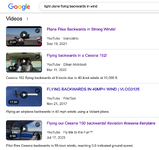
How about an aircraft flying backwards. If an airplane is flying through air moving faster then the stall speed of the aircraft it is possible for the aircraft to fly backwards in relation to the ground.
1752596018970.png

Bruce
 
1038mph to be exact, what the Earth rotates exactly at the equator. For gunners that 1522fps, reasonable in many cartridges.
So this theory is if you stand at the equator, fire a gun (of that velocity) exactly west, the bullet is simply floating.... now if I grasp that correctly, it means its not moving just floating for a split second until gravity takes it over because you are the one moving backwards.

When I was a kid I got a ride in a Piper Cub airplane. We were flying over a local highway and I pointed down as the cars driving under us were passing us!
The pilot looked down and saw this too. he slowed the plane to the point we were actually going backward! When we landed and could talk about it he said we were initially going about 50 MPH into a 30 mph headwind. But he slowed to about 35 mph, and when we had a wind gust it would actually move us backward in relation to the ground. But our speed had us traveling 35 mph through the wind.

I'm not sure how this relates to your bullet theory, But interesting! DR
 
Ha Ha! Somebody slept thru high school physics. Relativity is a thing.
Its the schools cirriculum fault, I woulda got staight As if I would have been able to test this theory with a 357 magnum.... 😜
 
1038mph to be exact, what the Earth rotates exactly at the equator. For gunners that 1522fps, reasonable in many cartridges.
So this theory is if you stand at the equator, fire a gun (of that velocity) exactly west, the bullet is simply floating.... now if I grasp that correctly, it means its not moving just floating for a split second until gravity takes it over because you are the one moving backwards.

You Round Earthers never cease to amaze me.
 
Unrelated to floating bullets.

If a person fired a bullet (straight ahead) on flat ground the bullet would likely hit the ground before losing all its forward energy.

Now imagine a person fired a bullet (straight ahead) while standing on top of a 10,000ft high cliff and it was sea level for many miles at the bottom of the cliff. Would at some point, that bullet run out of energy and then starting dropping more or less straight down?

Or would it continue in a long arc until it hit the ground?
 
Unrelated to floating bullets.

If a person fired a bullet (straight ahead) on flat ground the bullet would likely hit the ground before losing all its forward energy.

Now imagine a person fired a bullet (straight ahead) while standing on top of a 10,000ft high cliff and it was sea level for many miles at the bottom of the cliff. Would at some point, that bullet run out of energy and then starting dropping more or less straight down?

Or would it continue in a long arc until it hit the ground?
1752598506135.png

Bruce
 
So, if I'm in an airliner plummeting to earth, I should get out of my seat, and stand in the center aisle, and jump up into the air just before impact?

Edited to add: for the haters, that's part of another Bill Cosby joke.
 
So, if I'm in an airliner plummeting to earth, I should get out of my seat, and stand in the center aisle, and jump up into the air just before impact?

Edited to add: for the haters, that's part of another Bill Cosby joke.
On a side note, theres actually a true story of a lady who survived a plane wreck from full altitude... iirc, the plane broke apart, everyone got sucked out but she was seatbelted in her seat which just before impact turned upright cushioning the impact thru the jungle canopy. She broke bones but was able to walk out of the jungle to self rescue.
What like a 30000 ft freefall... true story.

Maybe it was at the equator... 🤔
 
Unrelated to floating bullets.

If a person fired a bullet (straight ahead) on flat ground the bullet would likely hit the ground before losing all its forward energy.

Now imagine a person fired a bullet (straight ahead) while standing on top of a 10,000ft high cliff and it was sea level for many miles at the bottom of the cliff. Would at some point, that bullet run out of energy and then starting dropping more or less straight down?

Or would it continue in a long arc until it hit the ground?
It's a parabola modified by the drag of the bullet and wind, so it may approach a vertical line as it drops but will never get there. Even if there is a headwind that cancels forward momentum it will slow it down and eventually push it backwards. There will be a single theoretical point during an infinitely small amount of time where it will be vertical.
 
It's a parabola modified by the drag of the bullet and wind, so it may approach a vertical line as it drops but will never get there. Even if there is a headwind that cancels forward momentum it will slow it down and eventually push it backwards. There will be a single theoretical point during an infinitely small amount of time where it will be vertical.
What if you shot a bullet perfectly verticle up in the air. Will it come down vertically? It's hard to imagine that it would develop an arc.
 

Upcoming Events

New Classified Ads

Back Top