


JavaScript is disabled
Our website requires JavaScript to function properly. For a better experience, please enable JavaScript in your browser settings before proceeding.
Messages
19,598
Reactions
35,704
I have 2 favorite knives. One has 154CM and the other has S30V material. When I search online for a knife steel comparison chart theres too many do pick from and some have different results. I basically just want to compare edge retention.
2 questions:

Between 154CM and S30V, which is the better material?

Whats a good reliable blade material chart to bookmark?


1725671949658.png
 
I have 2 favorite knives. One has 154CM and the other has S30V material. When I search online for a knife steel comparison chart theres too many do pick from and some have different results. I basically just want to compare edge retention.
2 questions:

Between 154CM and S30V, which is the better material?

Whats a good reliable blade material chart to bookmark?

View attachment 1946321
Knife nerds is by far the best source. To make it easier here is a chart where the person combined several knife nerd charts. Just look up the various knife steels.

IMG_9569.jpeg
As you probably already know, geometry, heat treat etc can have a huge impact. I have a hollow ground D2 Civivi blade that is darn near impossible to dull. A have different brand knife also d2 and it's completely different in edge retention.

For a source on knife materials I would browse the knife nerds website. For generalized and not as accurate source, bladehq has some general charts and descriptions that are still helpful.
 
I have 2 favorite knives. One has 154CM and the other has S30V material. When I search online for a knife steel comparison chart theres too many do pick from and some have different results. I basically just want to compare edge retention.
2 questions:

Between 154CM and S30V, which is the better material?

Whats a good reliable blade material chart to bookmark?


View attachment 1946321
Better edge retention generally means it takes longer to sharpen once it is dull.

I've stopped worrying about what steel is in what knife although I can say my D2 steel knives are generally my work knives that I will use on concrete if I have to and still use it to cut something open afterwards.

@ilikegunspdx had good ideas for charts that should be helpful but in the knife steel world, depending on how into something they are or are not it can be the equivalent of is 9mm or .45acp better? At least in my experience with some of my more knife nerd friends then I am.

I know how to sharpen a knife and as long as it cuts or stabs I'm happy lol.
 
Yep, Larrin over at knife steel nerds is the sort of the bible when it comes to blade steel properties. Just know that blade steel is only one (rather minor) variable in a blade's performance. Heat treatment, and blade geometry are going to be significantly larger factors in the way a knife cuts, holds an edge, and sharpens.
 
Knife nerds is by far the best source. To make it easier here is a chart where the person combined several knife nerd charts. Just look up the various knife steels.

View attachment 1946352
As you probably already know, geometry, heat treat etc can have a huge impact. I have a hollow ground D2 Civivi blade that is darn near impossible to dull. A have different brand knife also d2 and it's completely different in edge retention.

For a source on knife materials I would browse the knife nerds website. For generalized and not as accurate source, bladehq has some general charts and descriptions that are still helpful.
Yes, this! I LOVE Knife Steel Nerds! 🤓

View: https://youtu.be/dg4qcdDba9w?feature=shared
 
Ok the Knife Nerds site has an overload of information.

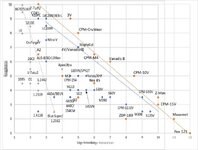
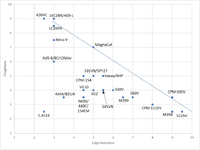
it looks like both my knifes are comparable and in the middle of the toughness/retention spectrum, with my S30V blade having better edge retention.

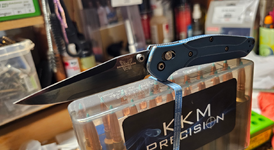
The Benchmade Osborn pictured is about 30yrs old and a limited edition polished blued steel, I have never seen that drop point on an Osborn since.
I tend to favor the Osborn over the much newer Benchmade Grizzly Creek S30V knife... so I was just curious if one was significantly "better"... yes I know thats subjective and based on use and how its sharpened. I can get either one razor sharp, the S30V takes longer to sharpen so I was correct it was a slightly tougher steel.

1725677921358.png
 
Ok the Knife Nerds site has an overload of information.

it looks like both my knifes are comparable and in the middle of the toughness/retention spectrum, with my S30V blade having better edge retention.

The Benchmade Osborn pictured is about 30yrs old and a limited edition polished blued steel, I have never seen that drop point on an Osborn since.
I tend to favor the Osborn over the much newer Benchmade Grizzly Creek S30V knife... so I was just curious if one was significantly "better"... yes I know thats subjective and based on use and how its sharpened. I can get either one razor sharp, the S30V takes longer to sharpen so I was correct it was a slightly tougher steel.

View attachment 1946367
154cm is the tougher steel. S30v will be more difficult to sharpen, and should hold an edge longer given all other things equal. Toughness in steel is generally the opposite of hardness. The vanadium carbides in S30v can make it harder to sharpen to a fine edge.
 
Good choices of steel, I have and regularly use blades with both S30V and 154CM, and D2.
For edge retention I would ask: How fine an edge are you wanting to retain?
For keeping a real "razor" edge for slicing I give the nod to S30V, but it is harder to sharpen than the 154CM.
Roughly speaking, I would like an S30V to skin a deer, but I'd like a 154CM to baton the firewood.
As always, heat treat, and sharpening angle have much to do with edge retention.

D2 has been mentioned, it's too bad that D2 has been given a lot of bad press as the "modern" steels have come out.
The old joke with D2 was, "D2 takes a dull edge and holds it forever", but it's a steel in which the heat treatment for its use is perhaps more important than for many of the other steels.
It was designed for metal shearing blades and punch press dies, neither of which are particularly sharp, but must last thru thousands of cycles while keeping a "moderate" edge.
It's also a steel that likes a bit of "tooth" to its edge, (so does 154CM,) its large carbides are hard to sharpen to a super fine edge, (you need to use coarser grits).
But for a good "workman's knife"" it's a great steel, (but it'll rust easily).
 
With my well known liking for classic and antique firearms...
It may come as no surprise that this same liking is for knives as well.

I have no idea of what sort of steel in in the knives below...other than some sort of carbon steel.
All three knives are from the 1890 -19 teens era.
All hold an edge for as long as need to use 'em...and are easy to sharpen.
All still get used often today.

I used to wonder about knife steel....nowadays I just know that I like old fashion carbon steel better..
I don't mind the patina a used knife can ( will ) get...and I enjoy sharping my knives.
Andy

 
With either of the two blade steels I have: will a "coarse" or "medium" sharpened edge last longer than a "fine" razor sharp edge?
 
I would suspect that edge retention is related to what is cut and how often the knife is used...
No matter what blade steel is used.

In my experience ...
A "fine" razor sharp edge...will dull down to "medium...then to "coarse"..then dull as many speeches I have heard.... :D
So I tend to keep most of knives to that "fine" edge sharpness.

I also have knives that are sharpen to a razor fine edge...and some that are meant for other work and while sharp...
Ain't sharp to that razor fine edge.
Andy
 
With either of the two blade steels I have: will a "coarse" or "medium" sharpened edge last longer than a "fine" razor sharp edge?
There has been some research done indicating that a toothy (400gr) secondary bevel will maintain a useable edge longer than a finely polished one.
 
Interesting that chart does not have one of the most popular custom knife steels from when I was a custom maker ATS-34 the Hitachi metals version of 154CM (there are differences)
 
A "fine" razor sharp edge...will dull down to "medium...then to "coarse"..then dull as many speeches I have heard.... :D
So I tend to keep most of knives to that "fine" edge sharpness.
This has been my thoughts on this but what Ive learned is as the razor edge wears down the blade isnt as sharp as a "medium" finish edge, it gets duller faster.

Ive been playing around with edge angles and "finishes" like "coarse" and "medium" and while a medium edge wont swiftly open an envelope it will dress out and skin a whole deer before dulling. It looks like 2Wheels comment above correlates with that experience.
 
There has been some research done indicating that a toothy (400gr) secondary bevel will maintain a useable edge longer than a finely polished one.
Thank you for this, this is exactly what I was wondering about and wanted to confirm. Its like how a serrated edge lasts longer because the tips protect the rest of the cutting edge from impacts, plus maybe a "sawing" effect.


My question now is what is the best edge angle and "finish" for keeping a sharp edge the longest? To be specific I will use my knives to field dress and skin a deer or elk.
 
Thank you for this, this is exactly what I was wondering about and wanted to confirm. Its like how a serrated edge lasts longer because the tips protect the rest of the cutting edge from impacts, plus maybe a "sawing" effect.


My question now is what is the best edge angle and "finish" for keeping a sharp edge the longest? To be specific I will use my knives to field dress and skin a deer or elk.
Everything is a tradeoff. A shallower final edge will cut better, and stay sharper longer, at the expense of strength. Nice kitchen knives are 10-15 degrees. General hunting/skinning knives can range from 15-25. If you are using a dedicated skinner and are careful about hitting bones, start with a 17-18° and see how you like it. I tend to make my knives on the steeper side for general use knives. I like 20-25 so I don't worry about rolling or chipping the edge.
 
With my well known liking for classic and antique firearms...
It may come as no surprise that this same liking is for knives as well.

I have no idea of what sort of steel in in the knives below...other than some sort of carbon steel.
All three knives are from the 1890 -19 teens era.
All hold an edge for as long as need to use 'em...and are easy to sharpen.
All still get used often today.

I used to wonder about knife steel....nowadays I just know that I like old fashion carbon steel better..
I don't mind the patina a used knife can ( will ) get...and I enjoy sharping my knives.
Andy

Were I to just hazard a guess, I'd guess a simple carbon steel in the 10XX series. I like 1095 a lot. But I like some of the newer super steels as well. personally I am not a 154cm guy. Why? I just can't get as fine an edge or as long as retention. 1095 doesn't hold an edge tremendously long but is bonehead simple to get razor sharp. I started forging 1095 and I just like working with it.
 
I'm for carbon if the heat treater knows what their doing, vis a vis; to achieve a hard edge to stay sharp but not brittle, and how to draw back portions for somewhat flexible spine and shank for flexibility.
Speaking from the standpoint of campcraft and survival, a knife that wont produce a spark with flint when needed does just seems remiss. Not that I've ever needed it to in desperation, thankfully.
 
I had a Benchmade in 154CM and it was easier to sharpen than CPM440V. Sharpening stuff like Aus6, Aus8, 440A, 440C,.. is easy. But for a pocket knife you want the edge to last and that's why you have "Steel Snobs"... Some steels are so hard and brittle you can only get a utility edge on them and they never get to the level of 'sticky sharp'.

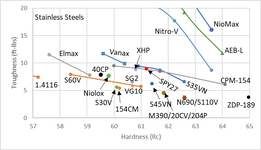
CPM440V/S60V is tough to sharpen because you can't raise a burr with it. S30V is easier to sharpen because it has less vanadium. S30V replaced CPM440V and both are made by Crucible Powder Metallurgy. CPM440V has more vanadium than other steels and requires diamond stones to sharpen it. S30V & 154CM are similar but corrosion resistance is better with S30V.

1726123673338.png

1726124325263.png

Cold Steel's Carbon V is similar to 1095 but has more vanadium. It's easier to sharpen than something like CPM440V that has alot of vanadium in it. Carbon V was sourced out by Camillus before they went out of business. The Camillus knives you see in stores today is not the same Camillus it used to be. Different owners, lower quality,...

Aus8A is one of the toughest and best steels you can get for the price. You can put a ridiculously sharp edge on it. The edge won't last but it's easy to touch up with any stone. It doesn't chip like D2 and when the edge folds over you can bend it back by resharpening it. With the heat treat and rockwell hardness being a major factor in performance.... but D2 chips before it bends.
 
Last Edited:
I'm for carbon if the heat treater knows what their doing, vis a vis; to achieve a hard edge to stay sharp but not brittle, and how to draw back portions for somewhat flexible spine and shank for flexibility.
Speaking from the standpoint of campcraft and survival, a knife that wont produce a spark with flint when needed does just seems remiss. Not that I've ever needed it to in desperation, thankfully.
I don't know if I want a flint to be able to be struck on my blades. I know where I like them heat treat wise, but I can't say if tempering them takes them out of that zone. Personally I would rather have a guard have a flint striker if it has to be super hard. Easier to replace.
 

Upcoming Events

New Classified Ads

Back Top