


JavaScript is disabled
Our website requires JavaScript to function properly. For a better experience, please enable JavaScript in your browser settings before proceeding.
I think the counterpoint here is that for years, most everyone does get repeatable results from small sample tests, or nobody would be doing the same way by now. Im not the most experienced handloader here but group size notwithstanding, if I repeat a charge weight I get the same result.

I think the confusion with that article is its not entirely clear, or convincing. Its been floating around for over a year now, and no other article supporting it... it stands alone. Lots of forum discussions but not a lot of people swearing by it.

Help me understand it better, it suggests if I randomly pick a safe charge weight anywhere in the min/max range, load say 20 rounds (or more) and shoot them.. the large sample group size will be the same at any other safe charge weight I could have picked? Essentially telling me right away if that component selection is worth using or to change?
So the point from the big sample guys is, despite what people say or believe, when you run enough rounds to get large samples, the apparent differences from small samples just go away. This article is the first I've seen from someone who tried running large samples for himself, and not just talking about what's always worked for him, and reloaded lore that has become 'fact'. The Hornady guys note powder makes a difference, and bullet makes a difference, and seating depth generally does NOT make a difference.

Them there statements gore a lot of sacred cows for a lot of fellers.

And yes, the reported data show that there is no or virtually no difference in mean dispersion among the different charge weights. Same with bullet seating depth.

The article prompting this thread is the first I've seen from someone who put his money where his mouth was, and ran the numbers of shots. I don't recall previously reading or hearing that the lowest charge showed least dispersion, that was interesting. I personally increased my zero groups to 10 shots minimum for finding close to "true" center, and 20 shots when it seems important.

As a side note, I've heard from 2 powder company ballisticians at 2 different times that the 'pressure signs' reading of brass is basically as good as reading the future with chicken entrails. Meaning primer appearance and case appearance had a near zero relationship to measured pressure levels. Some primers show 'pressure signs' at normal pressure, and some look fine at measured over pressure levels. Obviously some relate to over pressure. That took me by surprise, and should probably get some old timers riled up.
 
That took me by surprise, and should probably get some old timers riled up.
"old timers" How cute. A youthful agitator. Congrats! After four years on the forum, you're the first person I'm gonna put on ignore. I can't stand reading posts from people who are always right.
 
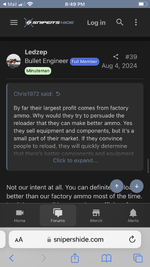
The Hornady guys note powder makes a difference, and bullet makes a difference, and seating depth generally does NOT make a difference.

Them there statements gore a lot of sacred cows for a lot of fellers.

And yes, the reported data show that there is no or virtually no difference in mean dispersion among the different charge weights. Same with bullet seating depth.
What does mean dispersion mean? Group size?
So Ive ran charge weight tests, then seating depth tests and seen group sizes shrink in both. A reloading channel from a pro Fclass shooter discusses/teaches how to do seating depth testing. This isn't just my own amateur observation. So then these small sample size tests simply "go away" if we just load to saami coal and pick a random charge weight? That doesn't make sense.


when you run enough rounds to get large samples, the apparent differences from small samples just go away.
This is the part that loses me, I'm not getting differences in my small sample sizes. I find my small sample results repeatable, different days, same recipe, same brass. I have a load Ive reloaded several times now, same group size.
 
Group size is measured at the outer limits. Mean dispersion or mean radius is the average distance of all the shots from the center of the group. A 1/2 MOA 3-shot group will not be 1/2 MOA with 20 shots, or 50. There will be too many of those dang flyers. Somewhere around 80-100 the outer edge will settle down. That's pretty much the dispersion for that rifle with that powder and bullet.

Fire 100 shots of your super consistent load. Fire 100 shots of the load that is .5 grain above or below. Or use the worst looking group from your charge weight testing. The odds are that there won't be a difference.

Never mind, you likely won't want to shoot 100 rounds of each. Neither would I. Cut it to 50 of each. Probably still won't want to do that, because maybe you know what you know, already proved it to yourself, this is all settled knowledge, etc etc.

Cut it to 30 rounds of each. Write it up and publish. I guarantee I will read it, if I know about it.
 
Fire 100 shots of your super consistent load. Fire 100 shots of the load that is .5 grain above or below. Or use the worst looking group from your charge weight testing. The odds are that there won't be a difference.
This doesnt make sense to me. If I shoot a charge weight that yields 1.5moa next to a charge weight that yields .75moa, both of those are different no matter how many rounds are fired. Its even more different if I compare the worst group in the test to the best group.

I fail to see how if I just picked a random charge weight and loaded a large sample size it would have told me, anything other than what that charge weight does with that seating depth.

To clarify does this large sample size test include flyers and shooter fatigue?
 
That's fine. Go prove it. You don't get to exclude flyers from the group for various whatever reasons. Especially not from your proven load. They all count.

I will read the results with great interest and respect.
 
That's fine. Go prove it. You don't get to exclude flyers from the group for various whatever reasons. Especially not from your proven load. They all count.

I will read the results with great interest and respect.
Really? How would any ammo test be reliable if it included shooter errors? Did the Hornady team or whoever include fliers?

You keep suggesting I go prove it. Im not the one making the claim, I dont have anything to prove here... have -you- shot 100 round groups to prove this theory?
 
Hell no. I've maxed out at 30. I'm not sure I'd refer to normal distribution within statistics, or sample size errors, as a theory but OK.

As my shooting buddy says, I guess if you sneezed or had a seizure or fell off the bench or something on the shot you could call it a flyer. Can't call a flyer based on the ole "that one didn't feel right" and went OUT of the group, but ignore the "that one didn't feel right" and went IN the group.

Man if I get to name every flyer based on my say-so, I can produce some KILLER groups. That outta save me some ammo right there!
 
Do the benchrest guys who shoot world record groups just choose a random charge weight and go for it?
 
Fliers are an interesting subject it their own right since they can be subjective, but IMO a person honest with themselves can accurately tell when they pulled a round off as the trigger broke free. Regardless, I dont see how any official lab test from the level of professional ballisticians would include shooter errors to judge group size from set components.

Subjective fliers aside, I don't expect anyone here to test large sample sizes and my guess is most recreational handloaders have no interest in such a load development technique... and thats part what makes this article/method, a theory.

Somebody correct me but I think F class shooters shoot 15-20 shots per match, and shoot 3 or 4 matches in a days event... to me, thats repeatable small sample size results...

Whatever it is that Hornady discovered, they are not articulating it well or it has no practical value for recreational handloaders, or even F class shooters and it certainly doesnt invalidate the classic OCW/ladder tests most people use, repeatably.
 
Interesting. I didn't know F-class shooters were doing load development testing in matches. Learn something every day.
 
Very successful hunting my first eight years with my .270 using hand loads made with a Lee hand loader a mallet, IMR 4350, Nosler bullets and a powder scoop.
No miss fires, no missed game, no following blood trails. The only game I missed was the ones I never saw.
Then, I bought a single stage and all the bells and whistles.
The game still died though, just as before, but dang, I was closer to point of aim, and consistently.
The ladder works for me. Usually I'd do four to five different loads (min. to max.) of five rounds each. Most times I'd bring back the top one to take apart, and end up in the middle. Couple times I've been over recommended max by one book or another.
Generally I knew what's what in less than fifteen rounds total, though I always shot all the rounds that didn't indicate unsafe.
Next time around would be a couple sets just a few grains above, and below. Generally didn't change things much but always need an excuse to shoot..
Hunting has seriously different tolerances than the rest of the shooting sports so maybe they need to stay off ladders..
 
I used to "ladder test" with 5 rounds at each charge level.
Always fired a "fouling shot" as the 1st round if the session.
The first bullet out of a clean bore with a film of oil in it almost never goes in the same place as subsequent shots.
We have problems getting a lot of the powders we're used to using, I'm sure not gonna be burning up components looking for a 1/4" reduction in a group size at 100yds.
Given the choices when more powders were available I'd usually start off with the powder that gave the lowest pressure for the velocity and start with a "lower-middle-of-the-road" charge weight.
(IIRC,) I've never gotten the best groups from the highest velocities.
Oh, it mostly seems that the best groups are the ones I fired in the middle of a session.
In the beginning, (and full of coffee,) I'm not "settled down". and at the end I'm tired.
YMMV.
 
Posted from a Hornady bullet engineer:

9C46B2E1-685D-4B30-8EF4-406E0D6A7DD4.png E72E8C29-98C3-4B09-9DC6-98CFD6338B5D.png 6ADC25D9-9656-41A5-8895-B089A93E0BB7.png
 
I'm not sure Hornady components are the best. They might be cheap for a reason. But, I shoot a lot of Hornady bullets because they are cheaper. I will say, I was successful in gaining decent accuracy from my Ruger M77 .22-250 thanks in large part to Hornady Custom Ammunition. In desperation, I paid up for their higher priced ammo and found some success. I was then able to gain just a little over that accuracy by using the same 60 grain Hornady bullet and experimenting with different powders.
 
I'm not sure Hornady components are the best. They might be cheap for a reason. But, I shoot a lot of Hornady bullets because they are cheaper. I will say, I was successful in gaining decent accuracy from my Ruger M77 .22-250 thanks in large part to Hornady Custom Ammunition. In desperation, I paid up for their higher priced ammo and found some success. I was then able to gain just a little over that accuracy by using the same 60 grain Hornady bullet and experimenting with different powders.
Yep varying components often leads to success. His comment about the Powder charge is what I was getting at. Varying the powder charge.
 
That Outdoor life article has been out for about a year now generating much forum discussions, but whats being missed about it is its written by a journalist not Hornady themselves.
So Hornady did a research study on something and talked about it on a podcast but hasn't published anything conclusive from it affecting how anyone should change their methods or techniques. The Outdoor Life article doesn't even do a good job explaining what the new process should be other than to shoot as many rounds as one can afford in some random charge weight and it either works or it don't. In the end thats not any different than the traditional way of finding an optimal charge weight using small sample sizes to learn you need to switch powder.
Other than that, its well know if you shoot large sample sizes of any single handload literally everyone knows your group size will only get bigger as you shoot more, yet we also know thats not the metric for judging that handloads precision.
 

Upcoming Events

New Classified Ads

Back Top