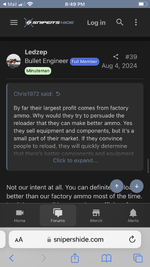






So the point from the big sample guys is, despite what people say or believe, when you run enough rounds to get large samples, the apparent differences from small samples just go away. This article is the first I've seen from someone who tried running large samples for himself, and not just talking about what's always worked for him, and reloaded lore that has become 'fact'. The Hornady guys note powder makes a difference, and bullet makes a difference, and seating depth generally does NOT make a difference.I think the counterpoint here is that for years, most everyone does get repeatable results from small sample tests, or nobody would be doing the same way by now. Im not the most experienced handloader here but group size notwithstanding, if I repeat a charge weight I get the same result.
I think the confusion with that article is its not entirely clear, or convincing. Its been floating around for over a year now, and no other article supporting it... it stands alone. Lots of forum discussions but not a lot of people swearing by it.
Help me understand it better, it suggests if I randomly pick a safe charge weight anywhere in the min/max range, load say 20 rounds (or more) and shoot them.. the large sample group size will be the same at any other safe charge weight I could have picked? Essentially telling me right away if that component selection is worth using or to change?
Them there statements gore a lot of sacred cows for a lot of fellers.
And yes, the reported data show that there is no or virtually no difference in mean dispersion among the different charge weights. Same with bullet seating depth.
The article prompting this thread is the first I've seen from someone who put his money where his mouth was, and ran the numbers of shots. I don't recall previously reading or hearing that the lowest charge showed least dispersion, that was interesting. I personally increased my zero groups to 10 shots minimum for finding close to "true" center, and 20 shots when it seems important.
As a side note, I've heard from 2 powder company ballisticians at 2 different times that the 'pressure signs' reading of brass is basically as good as reading the future with chicken entrails. Meaning primer appearance and case appearance had a near zero relationship to measured pressure levels. Some primers show 'pressure signs' at normal pressure, and some look fine at measured over pressure levels. Obviously some relate to over pressure. That took me by surprise, and should probably get some old timers riled up.