Join the #1 community for gun owners of the Northwest
We believe the 2nd Amendment is best defended through grass-roots organization, education, and advocacy centered around individual gun owners. It is our mission to encourage, organize, and support these efforts throughout Oregon, Washington, Idaho, Montana, and Wyoming.
The Philomath mill made dimensional lumber, like 2x4 and 2x6, plus some larger sizes. It took logs from 8" up to 30" diameter, which is kind of standard nowadays. Logs larger than that are getting rare, and there are still mills that will take them, but they will have to be trucked a long distance.
This mill was bought a couple of years ago by Interfor, a Canadian company. It is thought that they were trying to expand their operations out of Canada, because bug damage had decimated the log supply there, and also to avoid import duties (tax) that were making it difficult to sell into the USA. Georgia Pacific had operated the mill for decades, and was pulling out of the Northwest. Speculation is that Interfor was not able to make a profit from operating this mill.
The mill isn't "state-of-the-art", but isn't obsolete. Right now the lumber price is very low because builders fear high interest rates will dampen demand for new housing. Without a base of company-owned timber, Interfor had to buy logs on the open market, which is priced very high right now. This pricing is due to limited supply of logs, partially because of the huge fires a few years ago, and also because landowners are trying to keep up with increased costs and increased regulations preventing or restricting harvesting.
Just down the road, a new "stud mill" (making 2x4's and 2x6's of lengths ready-to-install as studs) has opened. It takes logs as small as 5" diameter at the small end, which is a different market. This is a highly automated mill, with few operators. It is the wave of the future, but does not take the same size logs as the Philomath mill did.
The future of sawmills appears to be headed for a few huge, highly automated mills ("Mega-mills") that move massive amounts of lumber. The logs will have to be trucked long distances to these mills. There will be fewer jobs per board foot of lumber made, and huge corporations will dominate the market.
About the only hope for mills like Philomath would be for timberland owners to form "co-ops" to maintain mills in areas not served by the "Mega-mills." I think that would be difficult to accomplish, but would be the best thing for rural areas.
I hunt near the Interfor mill in Crescent. In early November they had more lumber there than I have ever seen there or anywhere. I've been hunting there a long time.
If you know someone losing their job there who wouldn't mind moving an hour north for a good paying industrial job with a stable company, let me know. I'm surprised we haven't had more applicants.
Do you have any idea how timber harvesting really works?.....dumb question on my part as your statement says you do not. Harvest plans and timber management have changed in the last forty years that keep the forests safer for wildfires, keep a steady supply of timber in rotation, and better utilize the available water to maximize growth.
I have been around logging for 35+ years and currently work for a college that has a full, real, logging operation that starts at forest health, forest management, harvesting, processing, transporting, and ends with a final product that is actually sold.
One thing that has changed over the years has been small logging operations and their numbers. Mechanized logging has taken boots off the ground and put them in machines. Small logging operations have no choice to stay small as logging practices got better for the forest with mechanization. The benefits of this new method of logging is healthier for the forests, has less impact on the ground and makes regrowth happen five years faster than old methods. These new methods are changing all the time to refine the process to maximize health of the forests. The logging operations of today have evolved where the same sized crew that put out 7 to 10 loads a day are now knocking out 30 loads in a day. A small operation cannot justify the machinery cost if they stay small. We have lost the number of workers in the woods but the trucking numbers have stayed steady.
Back in the 80's I hauled into 33 mills. Some of these were large and some small. Of the 33 I hauled into only 7 remain. There were other mills in this area , that I never hauled into, that are still going and some that are gone as well. All the small niche market mills except for a few, are gone and the larger mills have upped their game with mechanization to take in more wood.
Modernization has consolidated things and taken more workers out of the equation. Even at that we cannot get anyone interested in any great numbers to get into logging. Loggers are aging out, the workforce is full of grey hair and the young one's are not seeking to work the woods or mills as much as previous years. We are desperately trying to get a younger generation of loggers in place before all the old timers and their knowledge is lost.
Driver shortages are real and getting drivers that are capable to haul logs has been a struggle. With that, getting capable drivers that want to commit to the demands of what it takes to haul logs has been another stopping point. I can get about 25% of my driving students interested in taking a ride along in a log truck and of those less than 5% are ready to commit to the job demands.
The current generation of workers have flipped their priorities, from past generations, while the work demands have stayed constant. No longer does the worker value his job first, his family second, and himself third. Now it is himself first, his family second, and work third. That mentality cuts the workforce availability down for logging type jobs that demand hard work.
While harvest plans, forest health, and timber management have all improved on private timber lands the world marches on and further mechanization and consolidation will occur.
One hot button for me is when people make statements that loggers are raping the forests. Loggers are not killing trees for enjoyment....they kill them because you want them. Without a market for timber there is no logger. Without the need for timber the forests would overgrow and burn more, causing widespread loss of forests and a waste of resources. Customers want wood and timber companies provide it for you using the best practices they can employ to ensure a steady supply....a steady supply means a healthy forest.
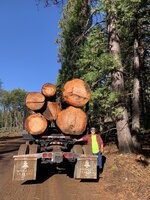
There is still lots of big timber around, even in the interior of the states. These trees pictured have been allowed to grow very large but guess what?, they are worthless for anything structural. Most of these are cut up into wood to make pallets, some make moldings. The timber company is harvesting these out and replacing them with faster growing higher value trees to maximize land and water use. These big trees will be replaced by trees that will triple the benefit, value, and water use in the same time it took these guys to grow. This tract of timber also has huge set backs for wildlife and natural resources, meaning timber for animals is retained and critical water ways (streams, low lying areas) are preserved.
I remember vividly many years ago when the LP pulp mill closed in Ketchikan AK. It was a generational employer, but I guess the economy at the time made it unprofitable. It really made things tough in town for a while, but tourism quickly took it's place. All the cool bars and the 100 plus year old barbershop downtown quickly sold out to the trinket shops. My extent of 'mill experience'.
BTW, anyone who thinks forests are unsustainable and not renewable is willfully ignorant, in my humble opinion.
I worked in a paper mill for 38+ years. The ownership changed hands three times while I was there, and at one time our company also owned the cladwood mill in Philomath.
Originally, Publishers Paper owned a lot of sawmills, some paper mills, and they owned the most timber land of all the private companies in Oregon.
A foreign firm, Jefferson Smurfit, bought all of Publishers holdings, and started shutting mills down and selling off the timber holdings. Eventually, my mill was decimated to the point that the employees bought it, and it stayed open for another 10(?) years. And my mill is now also closed completely.
The newer local folks, and local media hate lumber and paper mills. These same folks have no idea the families that were supported, as well as the local communities that were supported by mills.
But the tree huggers got their way. They would rather see the forests burn down, along with the towns these fires take with it, than to keep forests managed for future use as well as the jobs it creates today.
But along with this, even though mills pay a living wage for non-college families, it became very difficult for us to hire folks. Youngsters just didn't want to work, and they especially didn't want to work in a mill, in spite of the decent pay and full benefits from day one.
Do you have any idea how timber harvesting really works?.....dumb question on my part as your statement says you do not. Harvest plans and timber management have changed in the last forty years that keep the forests safer for wildfires, keep a steady supply of timber in rotation, and better utilize the available water to maximize growth.
I have been around logging for 35+ years and currently work for a college that has a full, real, logging operation that starts at forest health, forest management, harvesting, processing, transporting, and ends with a final product that is actually sold.
One thing that has changed over the years has been small logging operations and their numbers. Mechanized logging has taken boots off the ground and put them in machines. Small logging operations have no choice to stay small as logging practices got better for the forest with mechanization. The benefits of this new method of logging is healthier for the forests, has less impact on the ground and makes regrowth happen five years faster than old methods. These new methods are changing all the time to refine the process to maximize health of the forests. The logging operations of today have evolved where the same sized crew that put out 7 to 10 loads a day are now knocking out 30 loads in a day. A small operation cannot justify the machinery cost if they stay small. We have lost the number of workers in the woods but the trucking numbers have stayed steady.
Back in the 80's I hauled into 33 mills. Some of these were large and some small. Of the 33 I hauled into only 7 remain. There were other mills in this area , that I never hauled into, that are still going and some that are gone as well. All the small niche market mills except for a few, are gone and the larger mills have upped their game with mechanization to take in more wood.
Modernization has consolidated things and taken more workers out of the equation. Even at that we cannot get anyone interested in any great numbers to get into logging. Loggers are aging out, the workforce is full of grey hair and the young one's are not seeking to work the woods or mills as much as previous years. We are desperately trying to get a younger generation of loggers in place before all the old timers and their knowledge is lost.
Driver shortages are real and getting drivers that are capable to haul logs has been a struggle. With that, getting capable drivers that want to commit to the demands of what it takes to haul logs has been another stopping point. I can get about 25% of my driving students interested in taking a ride along in a log truck and of those less than 5% are ready to commit to the job demands.
The current generation of workers have flipped their priorities, from past generations, while the work demands have stayed constant. No longer does the worker value his job first, his family second, and himself third. Now it is himself first, his family second, and work third. That mentality cuts the workforce availability down for logging type jobs that demand hard work.
While harvest plans, forest health, and timber management have all improved on private timber lands the world marches on and further mechanization and consolidation will occur.
One hot button for me is when people make statements that loggers are raping the forests. Loggers are not killing trees for enjoyment....they kill them because you want them. Without a market for timber there is no logger. Without the need for timber the forests would overgrow and burn more, causing widespread loss of forests and a waste of resources. Customers want wood and timber companies provide it for you using the best practices they can employ to ensure a steady supply....a steady supply means a healthy forest.
There is still lots of big timber around, even in the interior of the states. These trees pictured have been allowed to grow very large but guess what?, they are worthless for anything structural. Most of these are cut up into wood to make pallets, some make moldings. The timber company is harvesting these out and replacing them with faster growing higher value trees to maximize land and water use. These big trees will be replaced by trees that will triple the benefit, value, and water use in the same time it took these guys to grow. This tract of timber also has huge set backs for wildlife and natural resources, meaning timber for animals is retained and critical water ways (streams, low lying areas) are preserved.
This is very much the same in Dump trucking,. Construction dump trucking is one of the hardest types of driving to master as there are so many different skills involved. And in the last couple years we have only been able to hire a few guys that can even use a manual transmission. Not to mention jack knife a trailer to dump the truck without loosing a mud flap or spreading the material all over hell and gone.
As a result some of us older drivers are stuck in the older trucks and doing more of the shall we say grunt work that should be being done by new drivers learning the job. And the new guys are in Newer trucks which have been bought with automatic's flailing around trying to do the more skilled jobs.
We recently paved French Creek road up from Detroit this is a 14 ft wide about 4 mile section of steep road with only marginal turn arounds. Because the paver is doing all 14ft in one pass the trucks have to turn around in front of the paver and back up to it using narrow turnouts to pass the other trucks. We hauled the Mix up on the 46 road with truck and pups dumped it on a premade pad and then reloaded it into solo trucks for the run up the mountain 8 trucks ran solo all of the drivers doing this had at least two years with the co. Most had over 10 a couple of us had 20. You have to be on the CB calling out markers constantly as the road was full of blind corners. To send a new driver up there would have been nuts. And yet we get guys who won't listen to the advise from more experienced drivers and think they know it all.
This is very much the same in Dump trucking,. Construction dump trucking is one of the hardest types of driving to master as there are so many different skills involved. And in the last couple years we have only been able to hire a few guys that can even use a manual transmission. Not to mention jack knife a trailer to dump the truck without loosing a mud flap or spreading the material all over hell and gone.
As a result some of us older drivers are stuck in the older trucks and doing more of the shall we say grunt work that should be being done by new drivers learning the job. And the new guys are in Newer trucks which have been bought with automatic's flailing around trying to do the more skilled jobs.
We recently paved French Creek road up from Detroit this is a 14 ft wide about 4 mile section of steep road with only marginal turn arounds. Because the paver is doing all 14ft in one pass the trucks have to turn around in front of the paver and back up to it using narrow turnouts to pass the other trucks. We hauled the Mix up on the 46 road with truck and pups dumped it on a premade pad and then reloaded it into solo trucks for the run up the mountain 8 trucks ran solo all of the drivers doing this had at least two years with the co. Most had over 10 a couple of us had 20. You have to be on the CB calling out markers constantly as the road was full of blind corners. To send a new driver up there would have been nuts. And yet we get guys who won't listen to the advise from more experienced drivers and think they know it all.
I hear you. I have run truck and pups before and it's not hard to jackknife and dump your piles on top of one another if you understand how to drive. Like you say, nobody has that skill set as all the trucks today are automatics so idiots can drive them. Problem is they cannot operate them. Backing, turning, thinking ahead. Skills that are fading fast.
One of our drivers is always getting into trouble turning around. I tell him to turn around sooner and back in. Any backing over a hundred feet scares him. I routinely back over a half mile to get things done without getting stuck.
If our Supporting Vendors don't have what you're looking for, use these links before making a purchase and we will receive a small percentage of the sale