


JavaScript is disabled
Our website requires JavaScript to function properly. For a better experience, please enable JavaScript in your browser settings before proceeding.
Messages
17,768
Reactions
43,340
Acceleration explained

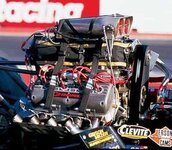
* One Top Fuel dragster outfitted with a 500 cubic-inch replica Dodge (actually Keith Black, etc)
Hemi engine makes more horsepower (8,000 HP) than the first 4 rows of cars at NASCAR's Daytona 500.

* Under full throttle, a dragster engine will consume 11.2 gallons of nitro methane per second;
a fully loaded Boeing 747 consumes jet fuel at the same rate but with 25% less energy being produced.

* A stock Dodge Hemi V8 engine cannot produce enough power to merely drive the dragster's supercharger.

* With 3000 CFM of air being rammed in by the supercharger on overdrive, the fuel mixture is compressed
into a near-solid form before ignition. Cylinders run on the verge of hydraulic lockup at full throttle.

* At the stoichio metric 1.7:1 air/fuel mixture for nitro methane the flame front temperature measures 7050 degrees F.

* Nitro methane burns yellow. The spectacular white flame seen above the stacks at night is raw burning hydrogen,
dissociated from atmospheric water vapor by the searing exhaust gases.

* Dual magnetos supply 44 amps to each spark plug. Which is typically the output of an electric arc welder in each cylinder.

* Spark plug electrodes are totally consumed during a pass. After 1/2 way thru the run, the engine is 'dieseling'
from compression and the glow of the exhaust valves at 1400 degrees F. The engine can only be shut down by cutting the fuel flow.

* If spark momentarily fails early in the run, unburned nitro builds up in the affected cylinders and then explodes
with enough sufficient force to blow the cylinder heads off the block in pieces or split the block in half !!

* Dragsters reach over 300 MPH +... before you have completed reading this sentence.

* In order to exceed 300 MPH in 4.5 seconds, a dragster must accelerate an average of over 4 G's.
In order to reach 200 MPH well before reaching half-track, at launch the acceleration approaches 8 G's.

* Top Fuel engines turn approximately 540 revolutions from light to light!

* Including the burnout, the engine must only survive 900 revolutions under load.

* The redline is actually quite high at 9500 RPM.

* THE BOTTOM LINE: Assuming all the equipment is paid for, the pit crew is working for free,
& NOTHING BLOWS UP, each run will cost an estimated $1,000 per second.

0 to 100 MPH in .8 seconds (the first 60 feet of t he run)
0 to 200 MPH in 2.2 seconds (the first 350 feet of the run)
6 g-forces at the starting line (nothing accelerates faster on land)
6 negative g-forces upon deployment of twin 'chutes at 300 MPH


An NHRA Top Fuel Dragster accelerates quicker than any other land vehicle on earth . .
quicker than a jet fighter plane . . . quicker than the space shuttle....or snapping your fingers !!


Tony Schumacher: 'Perfect storm' led to Top Fuel speed record
Feb 23, 2018

CHANDLER, Ariz. -- Tony Schumacher had the fastest official speed in Top Fuel history Friday in the NHRA Arizona Nationals,Schumacher had a 336.57 mph run at 3.667 seconds in his second pass after opening with a 3.649 at 334.65

Let's now put this all into perspective:

Imagine this .... You are driving a new $140,000 Lingenfelter twin-turbo powered Corvette Z-06.
Over a mile up the road, a Top Fuel dragster is staged & ready to 'launch' down a quarter-mile s trip as you pass.
You have the advantage of a flying start. You run the 'Vette hard, on up through the gears and blast across the
starting line & pass the dragster at an honest 200 MPH.... The 'tree' goes green for both of you at that exact moment.

The dragster departs & starts after you. You keep your foot buried hard to the floor, and suddenly you hear an incredibly
brutally screaming whine that seares and pummels your eardrums & within a mere 3 seconds the dragster effortlessly catches & passes you. He beats you to the finish line, a quarter-mile away from where you just passed him. Think about it – from a standing start, the dragster had spotted you 200 MPH....and it not only caught, but nearly blasted you off the planet when he passed you within a mere 1320 foot long race !!!!

That, my friends.....is acceleration.

acceleration explained.jpg Acceleration #2.jpg
 
Last Edited:
This stuff has always fascinated me. 1320 feet? Is NHRA still dragging a full 1/4 mile? I know many places shortened strips to 1000 feet or even 1/8 mile (660 feet). Regardless, at any length, the forces are insane.

Drags, F1, Baja, Pikes Peak, NASCAR, even demo derbies - a lot of really good stuff eventually filters down into the way everyday Subarus and Chevies are made.
 
From what I understand there are no more 1/4 strips because of safety, and the speeds the racers were reaching (over 300MPH).

So, now at 1000 feet, they are surpassing 300 MPH.

Unbelievable!

I do love reading this info. Really puts things into perspective.
 
I read somewhere a while back that it's pretty much insanity the money spent on top fuel drag racing.
 
By comparison, an F-15 burns around 385+ gallons per min, or over 23,000 gallons per hour and can accelerate from a standing start at slightly greater then 5G, and top out at more then 1600 Miles per hour! Crazy aint it!
 
By comparison, an F-15 burns around 385+ gallons per min, or over 23,000 gallons per hour and can accelerate from a standing start at slightly greater then 5G, and top out at more then 1600 Miles per hour! Crazy aint it!
Wow! What's the fuel capacity on something like that?
 
By comparison, an F-15 burns around 385+ gallons per min, or over 23,000 gallons per hour and can accelerate from a standing start at slightly greater then 5G, and top out at more then 1600 Miles per hour! Crazy aint it!

The catapult on the Nimitz class can get an F-14 weighing up 73,000 lbs from 0 to 160mph in 310 feet. The D model using GE110 engines actually creates nearly 8,000 lb feet more thrust than the PW F100 (56k lb ft vs 49k lb ft) used on the F-15....but the aircraft weighs 10,000 more pounds, so its not quite as fast.
 
Wow! What's the fuel capacity on something like that?

13,500 lbs internal, up to 1,800 lbs external on the C model (same as you see at PDX). The E model has larger fuel tanks that are added on the sides of the air intakes. Not sure how much more fuel they hold, but the max takeoff weight for an E model is like 15k lbs more than a C model. 65k vs 80k. You'd have to take off with near empty tanks and refuel immediately to make that work.
 
Some models of the USAF F15 (not overladen with excess weaponry or cumbersome external fuel stores) sport a superior power to weight ratio. Meaning it's one of very few jet aircraft that can take off, engage afterburners, turn straight up and accelerate vertically away from the planet for a couple minutes. This only lasts so long since oxygen thins at higher altitudes, diminishing thrust (unlike rockets, jets all breathe air). But by the time it does, you're several miles up - in mere moments - and looking down upon your prey.
 
Last Edited:
F-15 Echo can hold up to 35,500 pounds total fuel capacity, basically almost its empty weight in fuel! 13,550 gallons internally and 600 gallon centerline, and a 600 gallon tank under each wing ( Normal long range combat load) which is actually 1000 gallons LESS then the F-15 Charley! Also has less total installed thrust, and lower top speed, BUT more thrust under the power curve ( basically it's really quick and really fast at low altitudes! Max take off weight is 85,000 pounds! 23,000 pound weapon load normally

The old F-111Frank, could carry more fuel and more weapons but weighed 10,000 pounds more empty, and had a longer range at max load of just a fuzz over 100,000 pounds max, and also holds the record for the quickest accelerating jet airplane ever built, and second fastest at low altitude for any distance behind the F-4 Phantom, and just ahead of the F-14! F-111F could carry up to 40,000 pounds of weapons on internal fuel only! and had a range of 2300 miles in that configuration! At max fuel load, it could still carry 33,000 weapons load and could hit 3600 miles combat radius!

F-14D had a 16,000 pound payload with 16,000 pounds of fuel internally, and could carry an additional 1700 gallons externally, for a combat radius of 1600 miles max!
 
It was stunning to me as a Navy Air Traffic Controller at sea, to monitor how much airborne fuel we kept circling overhead during all launch and recovery cycles. Heading out on mission, the simple climb to 12-20k feet would burn a lot of fuel, and planes that just launched would already need 4-6k more pounds to top off and go do their thing.

Returning from mission, they were thirsty. A sip from the "tanker" (just a regular shipboard attack or surveillance jet with external "buddy stores" of fuel to give away), was usually 2,000 pounds or more. But you cannot overfill returning jets too much lest they exceed "max trap weight" when landing. Planes trapping too heavy on a carrier will snap an arresting cable - bad scene. So, at the end of every day's flight cycles, we'd dump fuel into the ocean from the tanker, a couple thousand pounds at a time. As each plane (prospective tankee) traps ahead of it, dump 2k more. It is routine practice to dump several dozen tons of jet fuel every single day. Just plain wow when you think about it.
 
Last Edited:
What amazes me, No returning aircraft could land with Live Bombs from a combat mission, so they were to drop any extras on secondary targets or where ever they could find to safely do so, or if crossing sea, to dump them off there! Last thing you want is a damaged aircraft attempting to land with Live Ordnance and fuel on board! Witnessed many an A-10 do just that before returning to base, shot up or not! Pilots always joked that they had a 100% bombing success ratio, what ever they dropped, they hit the ground 100% of the time! LOL
 
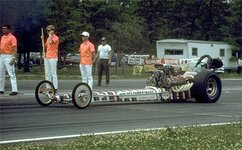
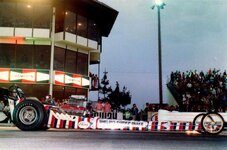
I pitted for Don Prudhomme in 1966 on this car. As a "gopher" I wiped tires at the starting line and fetched parts and supplies between runs. What more could any 18 yo ask out of life?
SuperSnake-BB.jpg SuperSnakePomona.jpg

Later on, and for the next 50 years I was involved in building, tuning, and racing these:

77.jpg

This is why I wear hearing aids now.
 

Upcoming Events

New Classified Ads

Back Top