



JavaScript is disabled
Our website requires JavaScript to function properly. For a better experience, please enable JavaScript in your browser settings before proceeding.
Messages
9,410
Reactions
19,586
Okay, I've seen this a few times now:

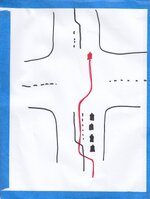
IMG_20250304_0001.jpg

This is a four way controlled intersection. There are left turn pockets on opposing sides of the roadway. The control lines are painted, not raised medians. The black cars are waiting for a red light to change. The red car pulls into the left turn pocket, then when the light changes, the driver laps the black cars and pulls in front of them, not making a left turn but pulling back into the travelling lane.. Or, another version is, the light is already green, the red car sees the turn pocket is empty, so he uses it to lap the cars in the travelling lane which are in motion.
 
Or turning left at a stop sign in front of the guy who wants to go straight because you got there first, dangit
 
I see 90mph shenanigans almost every day on my commute.
Jealous. Here, it's always people going 10 or more below the highway speed limit regardless of conditions. New roundabout at Clow Corner and 99W under construction isn't really helping things out either. But.. the other day on my way back from the coast, I wasn't aware that Highway 18 was closed to all lanes, so I took detour to ,Oregon Route 130, (Little Nestucca Highway).. someone was going 35 max on that 55mph road the entire 9 miles :s0054:
 
New roundabout at Clow Corner and 99W under construction isn't really helping things out either
More roundabouts here than ever. Definite impediments to traffic flow, but supposedly are safer. I don't see how, considering they are essentially uncontrolled. They slow traffic down but bonehead moves are made easier.
 
More roundabouts here than ever. Definite impediments to traffic flow, but supposedly are safer. I don't see how, considering they are essentially uncontrolled. They slow traffic down but bonehead moves are made easier.
The only reasons ""safer"" is no running red lights at high speed, and supposedly no left turn accidents("because all right turns from the circle" :rolleyes: )... Even though it's well documented that people have driven the wrong way in roundabouts, getting into headon crashes.
 
The only reasons ""safer"" is no running red lights at high speed, and supposedly no left turn accidents("because all right turns from the circle" :rolleyes: )... Even though it's well documented that people have driven the wrong way in roundabouts, getting into headon crashes.

I'm thinking local authorities like the low maintenance, non-electric nature of them. Meaning, there is no electric infrastructure to install and maintain, and it its absence, they save on the electric bill.

Left turns: probably the single most dangerous aspect to driving. It's not unusual for me to make three rights to avoid a left turn, when planned ahead. When I leave my place, I typically travel in a circular, clockwise route. I go out one way and return another, avoiding left turns to the extent possible.

In the last decade or more, in this area "they" opened up controlled left turns somewhat. By that I mean, they permitted turns when safe (yellow blinking light) in locations where in the past they were strictly controlled by red/green lights. But it doesn't make any difference to driving efficiency if you get someone at the head of the line who doesn't understand the meaning of a flashing yellow light.
 
More roundabouts here than ever. Definite impediments to traffic flow, but supposedly are safer. I don't see how, considering they are essentially uncontrolled. They slow traffic down but bonehead moves are made easier.
They are evidence of the insurance industry's influence in our daily lives.
 
They are evidence of the insurance industry's influence in our daily lives.
There is sound logic in assuming that roundabouts reduce the potential for head-on collisions. Not to mention red light running is eliminated. More glancing fender benders occur, though. Which result in lower pay-outs. I sometimes note weird skid marks on and around roundabouts.

In my former home town, there was one, single, solitary such traffic structure. It was called, "The Traffic Circle." It was built in 1931 as part of a route to the aquatic events venue in the 1932 Olympics. There were more traffic accidents at that "intersection" than any other in the entire city.
 
I'm thinking local authorities like the low maintenance, non-electric nature of them. Meaning, there is no electric infrastructure to install and maintain, and it its absence, they save on the electric bill.

Left turns: probably the single most dangerous aspect to driving. It's not unusual for me to make three rights to avoid a left turn, when planned ahead. When I leave my place, I typically travel in a circular, clockwise route. I go out one way and return another, avoiding left turns to the extent possible.

In the last decade or more, in this area "they" opened up controlled left turns somewhat. By that I mean, they permitted turns when safe (yellow blinking light) in locations where in the past they were strictly controlled by red/green lights. But it doesn't make any difference to driving efficiency if you get someone at the head of the line who doesn't understand the meaning of a flashing yellow light.
Clow Corner and 99W has a reputation; as does the Highway 51/22 intersection, for being among the "most deadly" Oregon intersections South of Portland.

Edit. The intersection at Clow and 99W, used to be a controlled flashing red/yellow (red from Clow Corner, yellow on 99W) location. The locals all have suggested changing it to a controlled red-green light like the other two intersections, Rickreall road/ 99W and Hoffman Road/99W. The new roundabout under construction, from my admittedly uneducated observation, is quite a bit smaller than similar roundabouts on Highway 47 between McMinnville and Forest Grove.
 
There is sound logic in assuming that roundabouts reduce the potential for head-on collisions. Not to mention red light running is eliminated. More glancing fender benders occur, though. Which result in lower pay-outs. I sometimes note weird skid marks on and around roundabouts.

In my former home town, there was one, single, solitary such traffic structure. It was called, "The Traffic Circle." It was built in 1931 as part of a route to the aquatic events venue in the 1932 Olympics. There were more traffic accidents at that "intersection" than any other in the entire city.
It's the small accidents that justify their higher rates for everyone. Being in a stupid roundabout feels like foreplay for being sideswiped.
 

Upcoming Events

New Classified Ads

Back Top