





Bronze Vendor
Gold Lifetime
- Messages
- 316
- Reactions
- 1,073
Hello NWFA!
A little while back, I took on the project of rebarreling and threading a Mini 14. I see no good resources documenting how this is done, so I figured I would post up my process on how I did it. This could very easily be a skinned cat situation.
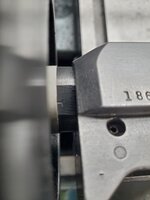
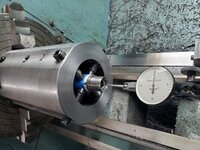
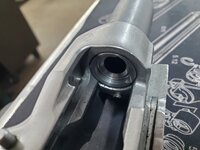
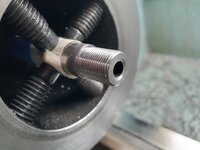
A customer brought in a 186 series Mini 14, and was wanting the current barrel exchanged for a take-off barrel that was purchased from a third party. He also wanted the muzzle threaded for a flash hider. I unthreaded the factory barrel and hand tightened the new replacement. The first picture shows the original barrel at hand tight. The flat with the "W" engraved on it clocks at 5 o'clock. Once torqued, the flat will be at 6 o'clock. The second picture shows how far off from clocking the new barrel is (sorry for the bad angle, the barrel was mounted in my lathe for this pic). It was clocking closer to 4 o'clock.
I have seen some confusion about this online. It would appear that unlike the M1 Garand/M14 series, Ruger does not control the timing of their threads to ensure proper barrel installation. They must use other methods. If I were to guess, it has to do with the numbers/letters engraved on the aforementioned flat.


A little while back, I took on the project of rebarreling and threading a Mini 14. I see no good resources documenting how this is done, so I figured I would post up my process on how I did it. This could very easily be a skinned cat situation.
A customer brought in a 186 series Mini 14, and was wanting the current barrel exchanged for a take-off barrel that was purchased from a third party. He also wanted the muzzle threaded for a flash hider. I unthreaded the factory barrel and hand tightened the new replacement. The first picture shows the original barrel at hand tight. The flat with the "W" engraved on it clocks at 5 o'clock. Once torqued, the flat will be at 6 o'clock. The second picture shows how far off from clocking the new barrel is (sorry for the bad angle, the barrel was mounted in my lathe for this pic). It was clocking closer to 4 o'clock.
I have seen some confusion about this online. It would appear that unlike the M1 Garand/M14 series, Ruger does not control the timing of their threads to ensure proper barrel installation. They must use other methods. If I were to guess, it has to do with the numbers/letters engraved on the aforementioned flat.