



JavaScript is disabled
Our website requires JavaScript to function properly. For a better experience, please enable JavaScript in your browser settings before proceeding.
Messages
1,567
Reactions
3,313
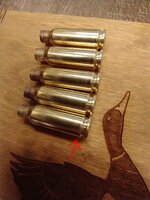
Photo below is once fired Starline 6.5 Grendel brass, fired by me and after sizing. I am ruling out case head separation because the line was not there pre sizing, plus it is well below the top of the web. There was a very slight burr present prior to tumbling. The case head fired to .4420 (in spec for chamber) and sized to .438-.439 (SAAMI spec is .4410). My thought is that the RCBS Small Base Die is too much for the brass and I should switch to a Full Length. Any concurrences?

IMG_20251223_090735224~2.jpg
 
Somewhere I have a photo of some of my fired and resized 6.5 Grendel Starline brass I set aside for what appears to be the same exact marking.
Im still not sure what causes it, and its random.
Im using a Hornady full length sizing die.
 
Go full length and see what happens. Most semi autos
don't like small base dies.
That generalization ignores what a case fired in a guns chamber and how it cycles tells you.
I don't care for SB dies because how they work brass fired in a non SB chamber. I have a lot of ARs and semi-autos in 9 different cartridges. Easily half prefer SB dies for trouble-free feeding.
 
I was taught that small base dies should be used for semi-auto's, pumps, and lever guns.
I don't know about "should be" but manufacturers specifically make small base dies for this purpose. As a remedy against tight chambers in some such designs, and as a feature of prevention to eliminate possibilities of malfunction. If it isn't necessary for the function of your rifle, I wouldn't use them.

The marks shown in the pictures are a lot like those found on some brass sized in pistol calibers. Where a carbide sizing die was used. It's unsightly but doesn't seem to detract from the function of the finished product.

I have SB die sets in 5.56mm and .308 Win., most of those are fired in semi-autos. They've never left marks such as those shown in the OP pictures. I had a set in .30-06 for the M1 Rifles, but based on my experience, they weren't necessary so I sold them.

There is the issue of the brass used. Has any other brand been reloaded with these dies that shows the same marks? If not, I'd suggest trying it to see if it makes a difference.

Comment on nomenclature. FL = Full length, as opposed to Neck Sizing. Small Base (SB) are at the same time full length. I think of the distinction as Standard and Small Base.
 
I don't know about "should be" but manufacturers specifically make small base dies for this purpose. As a remedy against tight chambers in some such designs, and as a feature of prevention to eliminate possibilities of malfunction. If it isn't necessary for the function of your rifle, I wouldn't use them.

The marks shown in the pictures are a lot like those found on some brass sized in pistol calibers. Where a carbide sizing die was used. It's unsightly but doesn't seem to detract from the function of the finished product.

I have SB die sets in 5.56mm and .308 Win., most of those are fired in semi-autos. They've never left marks such as those shown in the OP pictures. I had a set in .30-06 for the M1 Rifles, but based on my experience, they weren't necessary so I sold them.

There is the issue of the brass used. Has any other brand been reloaded with these dies that shows the same marks? If not, I'd suggest trying it to see if it makes a difference.

Comment on nomenclature. FL = Full length, as opposed to Neck Sizing. Small Base (SB) are at the same time full length. I think of the distinction as Standard and Small Base.
I should have added that the SBD's should be used in those firearms that may be experiencing extraction issues. I have two AR's that both prefer to feed on the slimmer SBD sized brass.
 
I have ARs that require SB die to avoid occasional failure from a tight feed/fail to chamber or a brutal extraction. Factory ammo works fine. Once I went to a SB die those problems went away. I started doing a standard FL sizing of 5.56 and .300 BLK and followed with the SB die to theoretically ease the squeeze on the brass.

I wonder if that is a wrinkle from the SB die squeezing the base more than it can allow, or maybe too much in one pass. Maybe a std FL die followed by the SB will not produce that?
 
There is the issue of the brass used. Has any other brand been reloaded with these dies that shows the same marks? If not, I'd suggest trying it to see if it makes a difference.
The first ammo run through the gun was factory Hornady. When I resized a few of those I did not get any marks. The Hornady did measure .441 after firing, which is .001 less that the Starline.

From what I had read, Starline is "softer" than the hornady, and SB dies put up to .002 more squeeze on the base of the case.

Looking ahead, I just settled on a load for more testing so I put up 20 of the sized Starline and 20 of the "new" Starline and we'll give'um a sling. Oh, I'll do some of the Hornady too. I'll alsosend a note to RCBS to see if they need to put a little more buff on the mouth of the die. I'll also put a FL Die on my Amazon Wish List just in case.
 
I have ARs that require SB die to avoid occasional failure from a tight feed/fail to chamber or a brutal extraction. Factory ammo works fine. Once I went to a SB die those problems went away. I started doing a standard FL sizing of 5.56 and .300 BLK and followed with the SB die to theoretically ease the squeeze on the brass.
It's pretty easy to see that standard ("FL") dies typically do not restore fired brass back to its original, factory state. Just look at the web of a case re-sized with standard dies; you usually will see a slight bulge. If you want cases that get close to original specs, you will usually need a SB sizing die.

The reason for this is because reloading sizing dies are made within the range of SAAMI specs. Which is rather like "close enough." Factory ammo is made to tighter tolerances to cover all the bases, including tight chambers.
 
Looks like an artifact from a carbide die to me. Were you paying attention to what operation the marks happened on? From the OP it seems like it happened on the sizing step but it is unclear to me for sure.

If it did happen on the sizing step I would check the die for a small burr or lip right at the die mouth. It is probably totally fine, but such burrs can case feed issues in sensitive guns. I have mostly seen this kind of thing on pistol reloads, and it was always cause by the sizing die itself.
 
A radiused chamfer to the bottom inside edge of your die will likely eliminate the brass burr. I think you have a sharp edge in there, and new brass is not yet work hardened. Use imperial sizing wax… nothing better. Leave the lanolin to Palmolive.
 
I have a set of CH dies in 5.7MMJ that did the same thing. The radius on the case mouth was to small. I chucked the die up in the lathe and took a die grinder with a craytex bullet and polished the dies mouth, putting a slightly larger radius on the mouth. Problem solved. And I discussed the matter with CH and he agreed with my solution and assured me that my solution was exactly what he would have done. He also said that all future dies would be inspected for that deficiency in the future.
 
UPDATE:

I will be sending the die back to RCBS along with some unsized fire formed brass and they will rework the die to match my chamber. Problem solved.
 
UPDATE #2:

Just received this from RCBS, This'll do it.: :)

Here are the notes from our die technician:
replaced S.B. sizer with F.L. sizer with a rock chucker press turning sizer down 1/4 turn more after touching shell holder and press cams over before sizing base .442 shoulder .432 headspace 1.194 after base .441 shoulder .429 headspace 1.186.
 

Upcoming Events

New Classified Ads

Back Top