


JavaScript is disabled
Our website requires JavaScript to function properly. For a better experience, please enable JavaScript in your browser settings before proceeding.
Messages
27
Reactions
25
hello, i'm doing research into the differences between monolithic copper bullets, monolithic lead bullets, and jacketed bullets, and i'm trying to understand the difference in these things in terms of RANGE

and so what i'm understanding, is that monolithic copper bullets have greater velocity because they weigh less, but this also means that they lose velocity faster then jacketed bullets,

so does this mean that monolithic copper bullets have less range then a jacketed bullet or a monolithic lead bullet?
 
monolithic copper bullets have greater velocity because they weigh less
No. The only reason one would weigh less than the other is if it were a different grain weight, 180 gr vs 180 gr is a wash.

so does this mean that monolithic copper bullets have less range then a jacketed bullet or a monolithic lead bullet?
Only because the copper has a minimum FPS requirement to effectively open up.

The difference between the two is that copper weighs less than lead and when you compare the two the copper bullet is longer than the jacketed to make up for it. This makes a big difference to the reloader leading them to use a copper bullet of a lessor grain weight to closer match the size of the jacketed with the hopes of matching the performance of the jacketed bullet and keeping control of the pressure. This lower grain weight is where the higher velocities come from. As you continue your research you will find that copper monolithics have a minimum FPS requirement (mentioned above) to effectively open which also leads users to wanting a lower grain bullet. There is still lots to learn Grasshopper.

My experience: I started loading copper (E-Tip) years back when the CA law was looming over our heads and had a very good load worked up using the 168 gr and my old rifle. After moving to Oregon I bought a new rifle and gladly switched back to the Accubond. Now that I am back in CA I am convinced this new rifle cannot tolerate the E-Tips having thrown tons of resources at it and have had to settle on 1.25 MOA for the moment. I say settle because the Accubonds shot sub .50 MOA. I might continue that journey next Spring.
 
Because monometal bullets are typically longer than their lead core comparable bullets, they benefit from a higher twist rate. Some firearms don't like them very much as a result. Bullet styles also have individual optimal performance envelopes, so you have to try to keep within those as well.

Generally, lead core bullets perform best down to 1800 feet per second (FPS), while monometal might need 2000. There are, of course, bullets designed for lower velocity performance like extreme long range models, but those then suffer at shorter ranges and are prone to disintegrating on impact at high velocity.

Many bullet manufacturers will provide a minimum or optimal FPS for their bullet.
 
hello, i'm doing research into the differences between monolithic copper bullets, monolithic lead bullets, and jacketed bullets, and i'm trying to understand the difference in these things in terms of RANGE

and so what i'm understanding, is that monolithic copper bullets have greater velocity because they weigh less, but this also means that they lose velocity faster then jacketed bullets,

so does this mean that monolithic copper bullets have less range then a jacketed bullet or a monolithic lead bullet?
The super short answer is no.

No, monos do not have any different range than any other bullet. Ive recently switched my hunting bullets to copper monos and can share my take on my study of them.
If your asking about precision: A bullets range is dependent on its ballistic coefficient, then its gyroscopic stability ("SG"). When selecting a bullet for hunting or long range always check its SG at the altitude you plan to use it, or... to be safe, at sea level (it never hurts ballistics to increase altitude). Lastly, regardless of bullet type you need the proper twist rate to handle that bullet. This is regarding accuracy or precision.

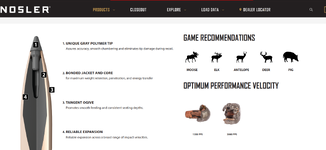
If your asking about terminal performance, again monos do not have any different range than any other bullet, terminal performance depends on the bullet design and its impact velocity regardless of construction. The Ron Spomer video Titsontiz shared above is a great video on that subject worth watching. Regardless of bullet, generally the longer the range the softer the bullet needs to be to expand properly because it will have a lower impact velocity. Most bullet manufacturers list their minimum impact velocity (see screenshot below). (Note: I refer to that as the bullets "terminal velocity" but I dont think there is a standard name for that, anyways...) If you select a bullet, run some muzzle velocity estimates you expect to achieve in a ballistic calculator and it will estimate your bullets impact velocity at the ranges your interested in, then you will know -that- bullets "range". But then dont forget to consider its stability in your rifles twist rate when selecting any bullet, will save you a lot of frustration in group sizes at longer ranges. Also, there is one thing worth noting here comparing monos to cup and cores, as long as you stay at or above the monos "terminal velocity" it will open the same where lead core bullets open differently at different velocities. Most monos also retain virtually all their weight even when they mushroom, some monos like Hammer bullets are designed to fracture the mushroom petals off creating a larger wound channel as low as 1800fps impact velocity, all Hammers are rated to fully open as low as 1800fps. To me, those are advantages worth considering and none of these mono options are limited to longer ranges. For example, both my 280ai with a 140gn Hammer and my 25-06ai with a 127gn Hammer are both still over 2100fps at 600yds.

The biggest difference comparing monos to cup and cores (cnc) is their weight difference, the trade off is if you like to shoot heavier bullets monos will be longer in the same weight class as their cnc bullet equivelent, so they will need a faster twist rate. If your rifle is older or uses a more traditional twist rate for caliber then longer (heavier) monos probably wont stabilize and you will need to select a lighter mono and drive it faster to maintain the terminal performance (and they will). Or just not use them in slower twist rifles if you want to stay with heavier bullets. If your rifle is newer or your shopping you can find more rifles now with faster twist rates to handle the trend in longer higher BC bullets (both cnc or monos). Note: there isnt a downside to faster twist rates anymore, only benifits of higher BC bullet options.

Example of the different levels of expansion and impact velocities with a traditional lead core bullet, Nosler Accubonds long range: it will still open at long range impacts but not the same at closer ranges, it will kill but "might" see a delayed response in the animal compared to closer range shots with that bullet.
1729183058041.png
 
Didn't read any other answers.
If you have the same weight bullet, copper jacketed vs copper solid, the solid will have better ballistic coefficient, improved sectional density, and because of it's improved BC, will fly farther than its jacketed counterpoint.
I have found with copper solids, you load for them as if they are a heavier bullet because of the bearing surface, but do not reduce the powder charge. For example, I will use a slower powder and load to near 100% (no compressed kernels). This would be bad juju with a bullet that is truly heavier, but with the coppers, you get a much higher velocity (e.g. 100-250fps) more than the jacketed equivalent. While I have had heavy bolt lift, flattened or blown primers with jacketed, I have yet to encounter such pressure signs with copper solids. The thing I don't care for about copper is they are 80¢ - $1.10 or more, 50¢ apiece if you can find them on clearance. If I could find copper solids at 35¢ or less, I'd shoot them all the time.
Edit to add : because copper bullets are longer than their same grain weight copper jacketed bullet, as you get into the heavier bullet weights, you need to check the stability of the copper bullet in your rifle, especially older ones. For example, I have a 1:11 twist 7mm rifle, that with 149gr copper solids, is calculated as marginally stable according to Berger's stability calculator. They have proven themselves to be extremely consistent and accurate, so I don't worry about the stability any more. YMMV
 
Last Edited:

Upcoming Events

New Classified Ads

Back Top