


JavaScript is disabled
Our website requires JavaScript to function properly. For a better experience, please enable JavaScript in your browser settings before proceeding.
Messages
2,533
Reactions
3,360
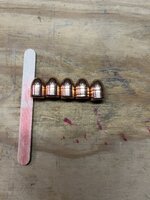
Trying to perfect the crimp on plated bullets. After reloading tons of plated bullets I decided to read what everyone else was doing for a crimp. Of course, opinions differ, but nearly everyone thinks the least crimp you can get by with is the best and most accurate. You can see here by this photograph, I hope, my progression downwards on using a Lee factory crimp die on 45 ACP, 230 grain plated bullets. Mostly by Xtream/Berrys, I have kind of settled on second from left in the photograph. All of these were done with the LFC die on an RCBS Junior. Thank you for experienced and educated comments/criticisms.

IMG_1860.jpeg
 
You want them crimped just enough that they don't break the plating or get seated deeper when feeding and they don't back out under recoil. Other than that...
 
I did dummy up a round and it did shorten by 4 thousandths after 4 cycles through the mag/gun. I did the same thing to a Federal factory round and it did the same thing. I can't shorten it by the "bullet pushed on the bench" technique, so maybe I'm good.
 
I did dummy up a round and it did shorten by 4 thousandths after 4 cycles through the mag/gun. I did the same thing to a Federal factory round and it did the same thing. I can't shorten it by the "bullet pushed on the bench" technique, so maybe I'm good.
I had previously posted about how I discovered my new RIA 1911 9mm was causing a 'set back' with with Xtreme plated bullets.

I discovered I was not crimping heavily enough. I 'found' a factory round and measured the crimp at the mouth and it was .375. My loads were running about .379 - .380.

Something I did however is I have a bunch of mixed old dies and had an extra 9mm seating die so I removed the bullet seating 'stem' and adjusted the die to perform the crimp AFTER I had seated the bullet with a separate seating die but NOT to crimp it.

Never done this before with 9mm (or an SA rounds) but I SEEM to be getting a better crimp.

You MIGHT want to consider doing the same, and maybe consider A Lee factory crimp die.
 
2nd from left looks reasonable for plated bullet. I've found some plated bullets have thicker/more durable plating than others, so that can be a factor on how positive a crimp will work. Too much and it can cut through the plating (roll crimp) or swage down the projectile (taper crimp) which can cause issues. Too little and you risk the seated projectile OAL moving around.
 
Once you are satisfied that you are not getting set back then you might try capturing a fired round with jugs of water. If the plating is unbroken then you are all set.
 
Isn't that a "Taper" crimp you're dealing with? The crimp part of the seater/crimp die only squeezes the bell out of the case up tight to the bullet. Different headstamp brass has different malleability (for lack of another word). And also different lengths which affect how much crimp/squeeze you get at the bottom of the stroke. That is, unless you trim pistol brass for uniform length.? I don't, except .38sp/.357 mag. And have a Lee factory collet roll-crimp die
 
The crimp part of the seater/crimp die only squeezes the bell out of the case up tight to the bullet.
This. ☝️

Since straight wall cartridges in a semi auto headspace on the mouth of the brass, you really do not want to do anything other than remove the bell to insure that the case doesn't seat deeper into the throat of the chamber potentially creating other "failure to" issues.

OP, if you are only experiencing a .004" set back after beating it up a few times, you're good IMHO.
 
You want them crimped just enough that they don't break the plating or get seated deeper when feeding and they don't back out under recoil.
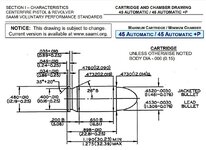
If you are getting enough bullet tension to prevent set-back in .45, you don't need any "positive" crimp. Just enough to make sure the mouth of the case is flush with the bullet shank. See below.

Different headstamp brass has different malleability (for lack of another word). And also different lengths which affect how much crimp/squeeze you get at the bottom of the stroke.
If your brass won't hold the bullet properly against set-back, then you have to consider giving it a little taper crimp to help hold it in place.

Re. case length variations, this is why it's advised to sort by headstamp/brand. Even then, there can be deviations from lot to lot or era to era.

Consider the difference in press design and what action takes place at the bottom of the stroke. The RCBS press that I used for many years had a camming over action at the bottom of the stroke. When the Lee Classic Cast press came out, I wanted one of those because they could handle a .30-06 without tilting it into the press like with the RCBS. Right away, I noticed that the Lee Classic doesn't have this camming action. Which is an advantage when you are loading pistol cartridges where case length deviations occur. You can feel a long case right away, so you can back off and prevent over crimping. If you are doing this as part of the bullet seating process (as I usually do), the minute difference in bullet seating depth will never be noticed on a pistol cartridge. This distinction is practically imperceptible with the RCBS camming action; you won't feel it until it cams and by that time, it will be too late, it will go ahead and crimp as much as it's mechanically allowed to.
 
Since straight wall cartridges in a semi auto headspace on the mouth of the brass, you really do not want to do anything other than remove the bell to insure that the case doesn't seat deeper into the throat of the chamber potentially creating other "failure to" issues.
Completely agree. But one thing I was thinking about adding to my post #13 above was as follows. Reloaders live in a less than perfect world because so often they are reusing components. Therefore they often wind up with cases that are less than willing to grasp bullets properly or uniformly. I can't remember ever buying brand new, unfired .45 ACP cases. Heaven forbid.
 
If your brass won't hold the bullet properly against set-back, then you have to consider giving it a little taper crimp to help hold it in place.
All handgun brass that doesn't require roll crimp gets a taper crimp. Just enough to remove any "bell" in the case. I don't believe I have to worry, with the amount of taper-crimp, about cutting into plated bullets. It's just by feel for me. Sometimes longer brass will cause a case to bulge if you go all the way down. In that case (no pun) I'll give a slight turn down on the seater to make sure OAL stays close to where it's supposed to be and not go to the bottom. 9mm is/can be a little funky because it's a slightly tapered case. It's more likely to bulge the case if you push the case all the way into the taper of the die.

The only NEW brass I've used was a 500 bag of Star Line .45 colt. I felt I needed to size it all. And I use the Lee Collet roll-crimp die on the .45 Colt.
 
The only NEW brass I've used was a 500 bag of Star Line .45 colt. I felt I needed to size it all.
I think Starline intentionally makes those oversize. For people who want to use the older .454 bullet size, vice .451/.452. The last batch I bought needed initial sizing before I could load .451 jacketed bullets.
 
I think Starline intentionally makes those oversize. For people who want to use the older .454 bullet size, vice .451/.452. The last batch I bought needed initial sizing before I could load .451 jacketed bullets.
I'd heard about those larger bullets, but had never given them a thought. Nor do I recall trying one of the T&B 200gr coated slugs I've been using. BEFORE I ran them through a sizer. I must have though.
 

Upcoming Events

New Classified Ads

Back Top