


JavaScript is disabled
Our website requires JavaScript to function properly. For a better experience, please enable JavaScript in your browser settings before proceeding.
Messages
1,021
Reactions
1,429
I'm working on a Mosin Nagant SBR and I want to put a knife-style bayonet on it because it makes me laugh. I'm doing this with mostly pre-bubba'd and reproduction parts, so don't worry about losing any high-quality historical examples.

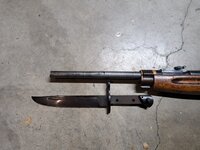
So I picked up a Finnish M39 nose cap and a reproduction bayonet. I've inlet the stock for the nose cap and the bayonet will sit about here:

PXL_20240826_170834535.MP_000.jpg

The problem is that moist nuggets have a tapered barrel and the bayonet is designed to sit about a foot further away from the receiver, where the barrel would be more narrow. In this location, the bayonet ring's opening is about 2mm too small:

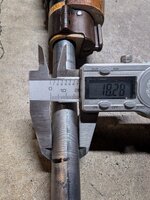
PXL_20240826_171158851.jpg PXL_20240826_171236604.MP_000.jpg

...and the ring only has about 3mm of thickness to work with:
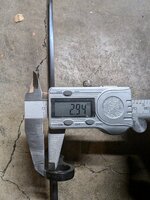
PXL_20240826_171312163.jpg

If we make the very unlikely assumption that my stock inletting will put the bayonet's ring perfectly centered on the barrel, then just grinding away enough material to make it fit will leave the ring only about 1mm thick. I have no idea if that's thick enough to hold up to 7.62x54R rattling it around.

I could pretty easily slap together some alternative ring and cut the existing one off, but none of my ideas would look all that great.

Any suggestions?
 
Any suggestions for supporting the ring while I'm driving the pin through it? Or would just alternating the direction I'm driving the pin be good enough?
Alternating directions, but... 2mm expansion on a piece that size... unless you have a furnace to completely and evenly anneal the entire material area... it's likely going to crack. That's why I mentioned cutting a relief to reduce the stress. Allowing you to freely reshape the ring size (then add material to the gap)... vs... trying to thin the material through expansion.

It depends on your skill set, but pounding it out 2mm is pretty high risk.
 
Alternating directions, but... 2mm expansion on a piece that size... unless you have a furnace to completely and evenly anneal the entire material area... it's likely going to crack. That's why I mentioned cutting a relief to reduce the stress. Allowing you to freely reshape the ring size (then add material to the gap)... vs... trying to thin the material through expansion.

It depends on your skill set, but pounding it out 2mm is pretty high risk.
Oh, that makes sense. A high risk of cracks changes things.

Unfortunately I have no welding skills or tools. Sounds like my best option might be to do the split and fitting, then let it just hang on there with a small gap until I can find someone who can close it up for me.

Or fit a small piece in and see if JB Weld does the job. Worse case scenario, my metal wedge might go flying off under recoil and then I'm no worse off than before.
 
Probably something made out of steel as it is unlikely to burn or melt.
I definitely planned on steel support.

I meant more the shape of the structure, so I can avoid stressing the connection between the ring and the rest of the bayonet. Honestly, I was hoping someone would know of an obscure tool that would be good for it. It seems like every time I rig up a contraption some old machinist takes a look and says, "Why didn't you just use a flibber-flabber instead? They don't make 'em anymore, but they're cheap on eBay."

I might just get a couple of thick and wide steel washers (insert your own hard and thick joke here) of varying opening sizes. They could sit under the ring on some open vice jaws with the blade down and handle up, then I can swap to a larger opening washer as the ring opens up.
 
I definitely planned on steel support.

I meant more the shape of the structure, so I can avoid stressing the connection between the ring and the rest of the bayonet. Honestly, I was hoping someone would know of an obscure tool that would be good for it. It seems like every time I rig up a contraption some old machinist takes a look and says, "Why didn't you just use a flibber-flabber instead? They don't make 'em anymore, but they're cheap on eBay."

I might just get a couple of thick and wide steel washers (insert your own hard and thick joke here) of varying opening sizes. They could sit under the ring on some open vice jaws with the blade down and handle up, then I can swap to a larger opening washer as the ring opens up.
An anvil with a hardy hole is often used in conjunction with a tapered drift. I don't know how jewelers size rings but they do use tapered drifts to do it.
 
An anvil with a hardy hole is often used in conjunction with a tapered drift. I don't know how jewelers size rings but they do use tapered drifts to do it.
They do, but jewelers cut and then add or remove material during resizing. Drifts used only for measurement and shaping.
 
Unfortunately I have no welding skills or tools. Sounds like my best option might be to do the split and fitting, then let it just hang on there with a small gap until I can find someone who can close it up for me.
Cut cleanly and evenly it wouldn't look horrible and the hold during normal firing shouldn't be an issue. I mean, if you were applying heavy torque force with your bayonet stuck in a moving meat sack it would need more support, but... me thinks that shouldn't be an issue(?):D

At least in the short term, but another option might just be hitting up a local machine shop to do the fill. If you do the final grinding yourself I can't imagine it would cost much just to gap fill it.. dirty like.

If you have a local high school or community college with machinist/welding courses, you might also solicit them for a student to do the work. I've done that in the past on non critical projects.
 
Not for small amounts.. that would be silly since metal is generally malleable.
Typically, the stretching method will only be done up to a max of 1/2 a ring size (~1.3mm max). Any larger and it's cut and filled. Downsizing is always removing material and reshaping to size.

It also depends on the malleability of the material. Highly malleable they can do up 1.3mm but less malleable are always cut and filled.
 
Typically, the stretching method will only be done up to a max of 1/2 a ring size (~1.3mm max). Any larger and it's cut and filled. Downsizing is always removing material and reshaping to size.

It also depends on the malleability of the material. Highly malleable they can do up 1.3mm but less malleable are always cut and filled.
Originally the (or any) piece was formed from one piece so some arbitrary 1.3mm limit sounds ridiculous.
 
Originally the (or any) piece was formed from one piece so some arbitrary 1.3mm limit sounds ridiculous.
I don't make the physical properties rules... just relating what the industry does and doesn't do... since the questions about how a jeweler does it was brought up, Applying a bit of thought to it makes it easy to consider some of the "why's" though.

A solid band of a single material that is evenly malleable, has a relatively low melting point and of uniform shape and size throughout... no patterns or mountings would likely be easier to go beyond that limit. However, rings are not always like that. Many have thicker portions, attachments, mountings of some type or portions of the ring are tapered to different widths or contain design patterns.

The thinnest part of a ring will expand the most. Without full and complete annealing of the material (which is pretty near impossible with a torch) then stress fractures will occur. During the stretching, thinning process, mountings are also likely to be loosened or deformed. Patterns may be disfigured.. among other considerations.

I guess a guy could always ask a jeweler and then educate him on how ridiculous he's being if he won't enlarge a ring beyond half a size without cutting it. :D

On the OP's bayonet, the side with the most material leading into the tang will not heat evenly with the outer portion. Not with a torch, anyway. All stretching would occur within a limited section of the ring and the area with more connected material will be resistant to any stretching. That creates a stress point that is at high risk of cracking.

If he has a furnace, able to evenly heat the whole tang/mount and the skill set to do it, he might could get away with it. Lowest risk for stress fracturing though is still to cut, expand and then add material to fill. A planned cut is much easier to fill than welding cracked pieces back together.

Just sayin...

ETA: Milling out the inner circumference is another option. I highly doubt it would weaken it enough that recoil would do anything to it, but if you want to be able to use it as intended... the structural integrity will have been impacted. Might be fine, might not(?)
 
Last Edited:
I don't make the physical properties rules... just relating what the industry does and doesn't do... since the questions about how a jeweler does it was brought up, Applying a bit of thought to it makes it easy to consider some of the "why's" though.

A solid band of a single material that is evenly malleable, has a relatively low melting point and of uniform shape and size throughout... no patterns or mountings would likely be easier to go beyond that limit. However, rings are not always like that. Many have thicker portions, attachments, mountings of some type or portions of the ring are tapered to different widths or contain design patterns.

The thinnest part of a ring will expand the most. Without full and complete annealing of the material (which is pretty near impossible with a torch) then stress fractures will occur. During the stretching, thinning process, mountings are also likely to be loosened or deformed. Patterns may be disfigured.. among other considerations.

I guess a guy could always ask a jeweler and then educate him on how ridiculous he's being if he won't enlarge a ring beyond half a size without cutting it. :D

On the OP's bayonet, the side with the most material leading into the tang will not heat evenly with the outer portion. Not with a torch, anyway. All stretching would occur within a limited section of the ring and the area with more connected material will be resistant to any stretching. That creates a stress point that is at high risk of cracking.

If he has a furnace, able to evenly heat the whole tang/mount and the skill set to do it, he might could get away with it. Lowest risk for stress fracturing though is still to cut, expand and then add material to fill. A planned cut is much easier to fill than welding cracked pieces back together.

Just sayin...
Worst case scenario he'd be out $.75 if he threw it in the creek.
 

Upcoming Events

New Classified Ads

Back Top