





- Messages
- 24
- Reactions
- 99
As I have said before I like Wildcats and Oddball cartridges. Not only do I have rifles I have pistols chambered these cartridges. This time I did not build it, I brought it.
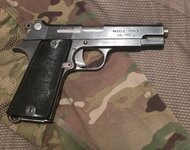
The subject for today is the first of the French Military Standard Semiautomatic Service Pistols. The 1935 A and 1935 S both chambered for the 7.65 Longue cartridge.
I have often wondered what they were thinking when thought this one up? What made them think it was a good idea? A 7.65 x 20 mm cartridge that used a .308 diameter, 85-87 grain FMJ bullet was somehow better than what your most likely enemy is using?
It is basically a French twist on the 30 Pedersen round that was designed for the Pedersen Device. A device that converted the 1903 Springfield bolt action rifles into a large submachine gun. It didn't turn out to be much because WW1 ended before it was used.
In 1934-35 the French Military decided they needed a new Service Pistol. So, they tested different models from around Europe, including the FN (Browning High Power) P-35 in 9mm Parabellum. Yet this little Oddball won out.
By 1935 the United States had been using the 45 ACP since 1911, and the Germans; the 9mm since 1904. It appears the French didn't learn much from WW1.
Let's compare the 7.65 Longue to the 45 ACP, 9mm Parabellum and the other cartridges the French used during the Great War.
Cartridge Bullet Velocity (fps) Muzzle Energy (Ft. #'s)
7.65 Longue 85/87 grain FMJ 1,100 234
45 ACP 230 grain FMJ 870 387
9mm 125 grain FMJ 1,180 355
*32 Auto (ACP) 71 grain FMJ 881 122
*8mm French Ord. 120 grain FMJ 740 145
* Stick with me. I'll get to them
In 1892 the French Military adopted the French Ordnance Revolver Model 1892, and it was chambered for the 8mm French Ord cartridge. It was the Standard Service Pistol during WW1.
When WW1 started the French Military found themselves short of side-arms. Like all countries at war, they scurried around looking for "Substitute Pistols" from non-traditional sources. France bought train loads of side-arms from Spain and most of them were chambered for the 32 Auto (ACP).
The Model 1894 remained the Standard Service Pistol until it was replaced by the 1935 A and 1935 S.
I think the choice of the 7.65 Longue was in their Institutional DNA, Military Conservatism and raw Nationalism.
I still remember the first time I saw a1935 S. It belonged to a friend. I liked the size of it (7 1/2" long, 4 3/4" high, 1 1/8 thick) and it looked cool. Then my friend explained to me what the biggest problem with it was, the ammo. There wasn't any and all that ever was had Berdan primers. He did have 50 cases that were made from 32 Long brass. After he explain that process, I knew it wasn't for me.
Now 45 years on, Starline is making brass for it. Who would have thought?
A while back I came across a 1935 S in great shape and at a fair price. So, I brought it and three magazines. I purchased 200 Starling cases. Bought a set of Lee Dies and even found Hornady .309 diameter 90 grain bullets. I was good to go. My want from years ago was about to be scratched.
Reloading:
My goals were simple: Not to exceed 1100 fps.
Must cycle the action every shot
Last shot must always lock the slide to the rear
Most accurate loads
Remember: These loads are safe in my pistol. Do not start with these loads. Reduce your load at least by 1 grain and work up. Do not exceed 1100 fps. Be safe and keep your fingers and things.
Load #1
90 gr. Hornady XTP Hollow Point 3.5 grs. Bullseye
Small Pistol Winchester Primer 1092 fps. / 238 ft#'s
COAL: 1.14" 3" groups @ 12 yards
same as above 3.8 grs Unique
1012 fps / 205 ft#'s
5" groups @ 12 yards
same as above 3.3 Clays
1100 fps / 245 ft#'s
2" groups @ 12 yards
same as above 3.5 grs 700X
1067 fps / 227 ft#'s
1 3/4 -2 1/4 " groups @ 12 yards
90 gr. Hornady XTP Hollow Point
Smal Pistol Federal Mag Primer
COAL: 1.10" 3.5 grs 700X
1084 fps / 235 ft#'s
1 1/2 - 2" groups @ 12 yards
Last Remarks:
It is a fun gun to shoot. Very light recoil. Still don't understand why the French ever adopted it. Figue out something to catch your brass. The brass is small and hard to find, in the store and on the ground.
400 Whelen

The subject for today is the first of the French Military Standard Semiautomatic Service Pistols. The 1935 A and 1935 S both chambered for the 7.65 Longue cartridge.
I have often wondered what they were thinking when thought this one up? What made them think it was a good idea? A 7.65 x 20 mm cartridge that used a .308 diameter, 85-87 grain FMJ bullet was somehow better than what your most likely enemy is using?
It is basically a French twist on the 30 Pedersen round that was designed for the Pedersen Device. A device that converted the 1903 Springfield bolt action rifles into a large submachine gun. It didn't turn out to be much because WW1 ended before it was used.
In 1934-35 the French Military decided they needed a new Service Pistol. So, they tested different models from around Europe, including the FN (Browning High Power) P-35 in 9mm Parabellum. Yet this little Oddball won out.
By 1935 the United States had been using the 45 ACP since 1911, and the Germans; the 9mm since 1904. It appears the French didn't learn much from WW1.
Let's compare the 7.65 Longue to the 45 ACP, 9mm Parabellum and the other cartridges the French used during the Great War.
Cartridge Bullet Velocity (fps) Muzzle Energy (Ft. #'s)
7.65 Longue 85/87 grain FMJ 1,100 234
45 ACP 230 grain FMJ 870 387
9mm 125 grain FMJ 1,180 355
*32 Auto (ACP) 71 grain FMJ 881 122
*8mm French Ord. 120 grain FMJ 740 145
* Stick with me. I'll get to them
In 1892 the French Military adopted the French Ordnance Revolver Model 1892, and it was chambered for the 8mm French Ord cartridge. It was the Standard Service Pistol during WW1.
When WW1 started the French Military found themselves short of side-arms. Like all countries at war, they scurried around looking for "Substitute Pistols" from non-traditional sources. France bought train loads of side-arms from Spain and most of them were chambered for the 32 Auto (ACP).
The Model 1894 remained the Standard Service Pistol until it was replaced by the 1935 A and 1935 S.
I think the choice of the 7.65 Longue was in their Institutional DNA, Military Conservatism and raw Nationalism.
I still remember the first time I saw a1935 S. It belonged to a friend. I liked the size of it (7 1/2" long, 4 3/4" high, 1 1/8 thick) and it looked cool. Then my friend explained to me what the biggest problem with it was, the ammo. There wasn't any and all that ever was had Berdan primers. He did have 50 cases that were made from 32 Long brass. After he explain that process, I knew it wasn't for me.
Now 45 years on, Starline is making brass for it. Who would have thought?
A while back I came across a 1935 S in great shape and at a fair price. So, I brought it and three magazines. I purchased 200 Starling cases. Bought a set of Lee Dies and even found Hornady .309 diameter 90 grain bullets. I was good to go. My want from years ago was about to be scratched.
Reloading:
My goals were simple: Not to exceed 1100 fps.
Must cycle the action every shot
Last shot must always lock the slide to the rear
Most accurate loads
Remember: These loads are safe in my pistol. Do not start with these loads. Reduce your load at least by 1 grain and work up. Do not exceed 1100 fps. Be safe and keep your fingers and things.
Load #1
90 gr. Hornady XTP Hollow Point 3.5 grs. Bullseye
Small Pistol Winchester Primer 1092 fps. / 238 ft#'s
COAL: 1.14" 3" groups @ 12 yards
same as above 3.8 grs Unique
1012 fps / 205 ft#'s
5" groups @ 12 yards
same as above 3.3 Clays
1100 fps / 245 ft#'s
2" groups @ 12 yards
same as above 3.5 grs 700X
1067 fps / 227 ft#'s
1 3/4 -2 1/4 " groups @ 12 yards
90 gr. Hornady XTP Hollow Point
Smal Pistol Federal Mag Primer
COAL: 1.10" 3.5 grs 700X
1084 fps / 235 ft#'s
1 1/2 - 2" groups @ 12 yards
Last Remarks:
It is a fun gun to shoot. Very light recoil. Still don't understand why the French ever adopted it. Figue out something to catch your brass. The brass is small and hard to find, in the store and on the ground.
400 Whelen