


JavaScript is disabled
Our website requires JavaScript to function properly. For a better experience, please enable JavaScript in your browser settings before proceeding.
I just bought an iCom hand held from the classifieds here for a great deal. The seller was nice enough to program several local channels for me. I know nothing about Ham Radio but have been a little interested in having one for emergencies.

I've been watching beginner videos and reading threads on forums the last couple days, but I still don't "get" the hobby side of it. I'm don't think I'll be geeking out on the technology site of things and wanting to build systems. I'm not interested in meeting people across the world. If I was, I'd do it on technology that's 100 years newer (internet).

I've been listening to the local channels, but I'm often wondering why the hell I'm listening to it. I heard old guys talking about a raffle today. Yesterday it was old guys talking about anti-virus programs. The day before it was old guys talking about fishing (at least that was somewhat interesting. Is this what you guys are listening to? Thought i might at least hear cops and firefighters but nothing. I keep thinking I must be missing something. I'm fine throwing this thing into the glove box until I see zombies, but I figured I'd ask here.
I suspect that when the EMP wars start you will see what you were missing.
 
My friend thats into Hamm tells me they can send emails, not sure about texts. I think you have to learn some kind of voice to text coding though... I cant really say.
It's called winlink, and can send emails into the internet system, or radio to radio when the radios are hooked up to a computer. The 'puter does not need to be online, it's just used as the vessel to receive and send using the keyboard and downloaded software.
 
but I still don't "get" the hobby side of it.
My impression, it's an obsolete pass-time, kinda like stamp collecting. Once popular, now way past decline. HAM guys used to send each other post cards to confirm radio contacts. Which in itself is emblematic of the decline. Who sends postcards now? Rotten things cost 56 cents now.
 
I can see how prior to the internet and cell phones, Hamms would be more 'entertaining' to chat with someone so far away and for "free".
Now we just chat on internet forums virtually.
 
Some people don't get the hobby side of guns, or horses, or model trains etc., as for all hobbies, there's a hobby out there for everyone.

When a disaster strikes, often the cell phone system is one of the first systems to go down from not only the disaster itself, but also from overuse jamming the system. Ham radio operators are called upon in many cases during disasters to help facilitate comms.

I've been able to communicate with people in both Ukraine and around Israel to get front line updates. There are programs out there that will track your signal so you can see where it's being received.

Some like to contact satellites and comm with the space station, some like to build their own radios, amplifiers and related gear. It's kinda like the model train hobby...you can settle for the train that just goes around the circle, or you do all the fancy scenery etc.
 
My impression, it's an obsolete pass-time, kinda like stamp collecting. Once popular, now way past decline. HAM guys used to send each other post cards to confirm radio contacts. Which in itself is emblematic of the decline. Who sends postcards now? Rotten things cost 56 cents now.
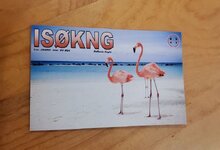
Yes, some of us still do the post card thingy...

sardinia.jpg

From a little island called Sardinia...
 
Got me thinking. We used to be able to do TTYs , convert telephone signals to text; still seems to exist though practically no one uses landlines... but in theory, shouldn't it be largely the same technique/technology to convert radio signals into text on a small display within a handheld? Or a digital/analog radio version of TTYs?
 
I just bought an iCom hand held from the classifieds here for a great deal. The seller was nice enough to program several local channels for me. I know nothing about Ham Radio but have been a little interested in having one for emergencies.

I've been watching beginner videos and reading threads on forums the last couple days, but I still don't "get" the hobby side of it. I'm don't think I'll be geeking out on the technology site of things and wanting to build systems. I'm not interested in meeting people across the world. If I was, I'd do it on technology that's 100 years newer (internet).

I've been listening to the local channels, but I'm often wondering why the hell I'm listening to it. I heard old guys talking about a raffle today. Yesterday it was old guys talking about anti-virus programs. The day before it was old guys talking about fishing (at least that was somewhat interesting. Is this what you guys are listening to? Thought i might at least hear cops and firefighters but nothing. I keep thinking I must be missing something. I'm fine throwing this thing into the glove box until I see zombies, but I figured I'd ask here.
"I heard old guys talking about a raffle today. Yesterday it was old guys talking about anti-virus programs. The day before it was old guys talking about fishing (at least that was somewhat interesting."


When you get a chance can you hop on that HAM Radio and find out whether prunes or Metamucil works best.
 
Got me thinking. We used to be able to do TTYs , convert telephone signals to text; still seems to exist though practically no one uses landlines... but in theory, shouldn't it be largely the same technique/technology to convert radio signals into text on a small display within a handheld? Or a digital/analog radio version of TTYs?
Yep, still being used...although somewhat sparsely these days.
 
Ok, sounds like I'm not missing anything. Thought i might at least hear cops and firefighters but nothing.
I'll keep this short and basic in hopes of helping you to understand it better.

To begin with cops, firefighters and other first responders typically operate on 'commercial' frequencies outside of typical HAM frequencies.

Depending on where you are you might be able to hear them but a lot of government agencies have gone to digitized frequencies and other formats and cannot be received on standard radios

I my area I can receive Forest service, interagency and air to ground fire communications on one of my radios, but most municipal LE and fire departments are now digital.

Traditional HAM frequencies are outlined on a 'band plan' based on antenna 'wavelength' but that's not important now.

HAM frequencies begin nearly as low as AM broadcast radio up to very high UHF frequencies.

The 2 meter HAM band (144 - 148 Mhz) is probably the most commonly used and is very popular. It can be used on 'simplex' which is basically radio to radio however it is more commonly used with repeaters which greatly increase its range.

Repeaters are devices that are installed on mountains, towers and other high locations and basically receive on one frequency and re-transmit it out on another. There are a LOT of 2 meter repeaters nationwide (many in Oregon) and a lot of them are 'linked' allowing for even greater range.

2 meter is Kinda sorta the 'modern' version of 'citizen's band'. It is widely used by truckdrivers, local HAM organizations and a lot of entry level HAM operators as it only requires a basic, 'technician' license and can be utilized with fairly inexpensive handheld radios. It is also often to used to assist local organizations with events requiring communication assistance.

Another common use of 2 meter is with what is called 'SOTA' or 'Summits on the air' whereby people will hike up to (or drive) up to mountains, set up simple, mobile equipment and transmit out on common 'simplex' frequencies seeing how many 'contacts' they can make. I hear many on weekends (when I am monitoring) and will respond when I do.

73's
KJ7ZNH
 
Correct me if wrong, but isnt the main idea of operating a HAM radio the building, customizing, tinkering with custom built high power radios?

I totally agree with the licensing requirement, considering their potential to interfere with offical use radio waves.

One thing I wish they would do, allow, is sell a simple 2way HAM handheld radio, and require a "user" license only. Is that available?

Not the gmrs license or radios but like that but full HAM power.
 
One thing I wish they would do, allow, is sell a simple 2way HAM handheld radio, and require a "user" license only. Is that available?
Well with traditional HAM the only thing closest to a 'user' license is the basic 'technician' license which can be obtained with a week of online studying. It's only 35 questions.

A LOT of HAM users never venture past the Technician license as they only use the 2 meter band.
Correct me if wrong, but isnt the main idea of operating a HAM radio the building, customizing, tinkering with custom built high power radios?
This is part of it, no doubt but its roughly the same as reloading is to the shooting sports.

Not everyone gets into setting up a 'Ham shack' messing with radios and other equipment. Many just get what they will use mostly and within their budget.

It's amazing how many never get past a $20 Baofeng on the 2 meter band.
 
Last Edited:
Correct me if wrong, but isnt the main idea of operating a HAM radio the building, customizing, tinkering with custom built high power radios?

I totally agree with the licensing requirement, considering their potential to interfere with offical use radio waves.

One thing I wish they would do, allow, is sell a simple 2way HAM handheld radio, and require a "user" license only. Is that available?

Not the gmrs license or radios but like that but full HAM power.
I think that's what I just bought. An icom f52D. They aren't cheap though. I got mine used for less than half price of new so that helped a lot.

And I just learned this yesterday from my Google searches. Ham isn't capitalized since it's not an acronym for anything. I see it capitalized here in this thread so I thought I'd mention it. It seems it bothers some people online. lol
 
Amateur ("ham") radio started out as text only - also known as Morse code (or "CW" in ham talk). Still used extensively by many as it requires the least amount of complexity at both ends of the communications. There are even tiny low power long distance (high frequency / "HF" / 1.8 to 30MHz) transceivers out that can connect to a full keyboard to send Morse and show the responses on a built-in display.

Not good enough? Newer text schemes such as QSK, FT8, and more allow text messaging around the world with less than one watt of power(!). Packet radio (AX.25) allows rapid text and binary exchange through the handheld you already have.

As mentioned earlier, winlink and similar tools make for powerful hybrids of ham and internet capabilities.

So who wants to waste their time listening to (us) old pharts gassing on endlessly? Check out your local ham club that likely has folks actively engaged in ongoing emergency communications. The many local wildfires have made good use of that.

Your wish for a handheld that's made just for texting is terrific. So far, though, the limiting factor of required licensing drastically reduces the potential market which, so far, seems to prefer voice. No doubt someone will eventually realize such a product would fill a real void.

Yes, cell phone texting is easier and available from more vendors. It's also far easier to buy fish from the market than to go fishing. But many enjoy the challenge of the less convenient but still rewarding alternatives.

None of which is meant in any way to denigrate you or anyone here. Welcome aboard the ham community - and do feel free to ask any time you have questions. There's a lot of us here!

Jim Horn, WB9SYN/7, White Salmon, WA Licensed since '75
 

Upcoming Events

New Classified Ads

Back Top