Join the #1 community for gun owners of the Northwest
We believe the 2nd Amendment is best defended through grass-roots organization, education, and advocacy centered around individual gun owners. It is our mission to encourage, organize, and support these efforts throughout Oregon, Washington, Idaho, Montana, and Wyoming.
Any of these will do:
Varget, AA2520, IMR-4064, IMR4895, Big Game, Win748, BL-C(2), TAC, H335, H4895, H380, N133, N135, N530, Reloader 15, Reloader 15.5, Reloader 16
Finding one is the tougher challenge. I'd bet IMR 4064, Win748 and AA2520 will be your most common. I saw a can of Varget and BL-C(2) on the shelf in Pendleton yesterday.
I'm about to try some Power Pro 200 MR and Reloader 15 with that bullet and purpose. I'll post what I find - it may be a few before I get to the range. I loaded some 150 soft point non-BT with the Power Pro and ti shot pretty well in my bride's gun. BL-C(2) seems to be the go to for many, just never tried it. Alliant powders are beginning to appear again.
I typically use IMR-4064 in my bolt gun with 168 gr bullets for target work. In my AR-308, I like Ramshot TAC and Speer 125 gr TNT hollow points. Hoping to find a coyote or two this winter
I load 150 gr Hornady FMJ with H4895 and CCI #34 primers in Lake City once fired brass (after I address the primer pockets). Also do the same load using 150 gr Hornady SST bullets.
Varget and Reloader 15 have been good to me with 150-168gr bullets. Be careful with brass brand if you are loading at or above max. I've found that Federal brass, specifically from Gold Metal match, cannot handle hot loads without over pressure signs as they have less internal capacity. Lapua, Winchester, and Hornady brass all have internal capacities on the higher end.
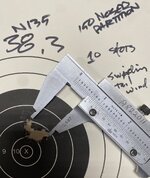
For what you want to do, N135 is a good choice. Finnish powders are hard to beat and no longer the most expensive. IMR 4895 also good but hard to find and very expensive. If your barrel is 1:10, don't drive them too hard as they will be over stabilized and that diminishes accuracy potential. Also, at those ranges, flat base bullets are generally preferred by competitors. This target is a light load for the reason mentioned. Have fun
The U.S. armed services primarily use the 7.62×51mm NATO cartridge (ballistically very similar to commercial .308 Winchester) rather than civilian .308 loads. The propellant (gunpowder) varies by specific ammunition type and era, as military specs prioritize reliability, temperature stability, and performance in weapons like the M14, M240, and sniper systems.Standard Ball Ammunition (e.g., M80)
This is the most common general-purpose 7.62×51mm round (147-150 grain FMJ bullet).
It typically uses spherical (ball) powder, often variants like WC846 or similar double-base ball propellants produced at facilities such as Lake City Army Ammunition Plant.
Ball powders are favored for consistent metering in high-volume military production.
Precision/Sniper Ammunition (e.g., M118, M118LR, MK 316 MOD 0)
These use heavier bullets (168-175 grain, often Sierra MatchKing).
Propellants have evolved for better long-range accuracy and reduced temperature sensitivity:
Early M118/M118LR: IMR 4895 (extruded) or WC750/WC846 (ball powder).
Later M118LR: Often Reloder 15 (extruded, from Alliant).
Military ammunition does not use a single universal powder across all 7.62×51mm loads—contracts and performance needs lead to variations over time. Current production (as of recent years) leans toward extruded powders like Reloder 15 or IMR 4064 for match-grade rounds, while standard ball remains ball powder-based.Note: Commercial .308 Winchester reloads often use civilian equivalents (e.g., Hodgdon Varget, IMR 4064, or BL-C(2), which is similar to military ball powder), but U.S. military service ammo follows stricter mil-spec formulations.
Personally, I have had excellent results with the aforementioned BL-C(2) and have used it for two decades.
I push 168's in my 308.
If our Supporting Vendors don't have what you're looking for, use these links before making a purchase and we will receive a small percentage of the sale