Join the #1 community for gun owners of the Northwest
We believe the 2nd Amendment is best defended through grass-roots organization, education, and advocacy centered around individual gun owners. It is our mission to encourage, organize, and support these efforts throughout Oregon, Washington, Idaho, Montana, and Wyoming.
Having lived in the P-hoe-nix area, they would close roads with 6" of nearly still water.
I'd be there with my 4" lifted Jeep, idling by an unattened 'road closed sign' with the option of driving through 100 yards of water that would barely touch the bottom of my wheels or driving 5 miles around the impassable marine intrusion.
For fear of an unknown statute of limitations, I shall not admit publicly which option I chose.
Having lived in the P-hoe-nix area, they would close roads with 6" of nearly still water.
I'd be there with my 4" lifted Jeep, idling by an unattened 'road closed sign' with the option of driving through 100 yards of water that would barely touch the bottom of my wheels or driving 5 miles around the impassable marine intrusion.
For fear of an unknown statute of limitations, I shall not admit publicly which option I chose.
You wouldn't have been around to be rescued
Some of those roads looked like they had 6" of water but the road had washed out and it was 6" except for where it was 2 feet
You wouldn't have been around to be rescued
Some of those roads looked like they had 6" of water but the road had washed out and it was 6" except for where it was 2 feet
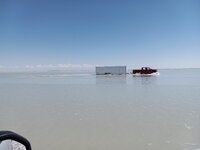
BFD!! Try four or five MILES of this. Or forty or fifty miles if you're the guys picking up the timing equipment and cones. Saltier than the ocean or the Great Salt Lake by far. And when you're done, wash it REALLY good!! Not that washing will save it, but you feel better about it until it won't roll one day because the wheels are all froze up. I wish I had pictures of us dragging our 53' trailer through this with the F450, but I was busy driving.
I think in a lot of these cases, we aren't talking about people driving a jeep that has four feet of clearance. We are more likely talking about knotheads (one word or two?) in typical passenger vehicles who drive into multiple feet of water. I suppose in their defense, they can't tell just how deep it is. So instead of using common sense and caution, they plough ahead then find themselves in the drink. Mark it up to human frailty in decision making.
Personally, I'm not going to drive any vehicle in standing water high enough that it touches the bottom of the vehicle or even close. Once water gets up that high, you get into the area of potential damage to the vehicle even though it maintains momentum. Even if the water is barely touching, or even quite close but not quite touching, there is splash factor and unseen variations in road surface. Forward motion may be maintained, but there is potential for water to get in around door weather stripping and under carpets. It might get into wiring. The catalytic converter can get damaged from thermal shock. Differential and transmission housings often have air vents, water can get in these and contaminated fluids. Etc., etc.. Often water damage doesn't show up right away, corrosion can take time to degrade components.
However, having said the foregoing, vehicle damage may not be the only consideration. In case of an emergency, sometimes chances need to be taken. If you were taking your wife in labor to the hospital, mushrooms growing out of the carpet three months hence probably wouldn't be foremost in your mind. But driving a vehicle in high water for no good reason, not recommended.
In the 1950's, my mother drove a 1940 Ford. With a flathead V-8 engine. The radiator sat rather low in the engine compartment, consequently the fan sat low on engine. In 1957, there was flooding in my home town. We were driving to my grandmother's house across town. My mother drove through some high water and the fan doused the engine and killed it. The distributor on that engine was mounted on the front, it got splashed pretty good. We didn't get to grandma's house. It was the first (but not the last) time I heard my mother say, "Damnit."
In 97/98 when we have the two back to back 500 year floods that made me doubt the accuracy of the weather man I was driving my new Ford Ranger in Portland where water was shooting up 3 feet out of the manholes and the road was covered in 9" of water. No problem I thought. Turns out Ford had put the air intake 7" over the ground. Died right in the street. Had to have my brother pull me off the road and we had to pull the plugs out of the engine to blow the water out of the cylinders that were hydraulically locked.
Must be in Britain. Those health and safety motherbubblegumers have to justify their jobs. If D's have their way here America woudl be the same. The poor unfortunates have to be protected with massive amounts of Nanny's watching over everything. Britain is totally bubbleguming out of control with their health and safety bullbubblegum. You need permission to wipe your bubblegum there.
In the 1950's, my mother drove a 1940 Ford. With a flathead V-8 engine. The radiator sat rather low in the engine compartment, consequently the fan sat low on engine. In 1957, there was flooding in my home town. We were driving to my grandmother's house across town. My mother drove through some high water and the fan doused the engine and killed it. The distributor on that engine was mounted on the front, it got splashed pretty good. We didn't get to grandma's house. It was the first (but not the last) time I heard my mother say, "Damnit."View attachment 2210798
What he is talking about was there were roads that crossed dry washes. Most of the year they were dry. Summer rains would come and often those were raging rivers. Country would put of barricades. Sometimes that water was several feet deep and moving pretty good. Every year a few morons would move the barricades and try to drive through only to get washed away. Then search and rescue would have to come get them. This is what they got tired of and started giving heavy fines to the idiots. The best part was the people who did this were always locals who should have known better. The tourists would see the road closed sign and turn around. When someone decided it was "not that deep and they could make it", it was always locals.
Back in the Willamette floods of '96, I watched f'tards try to drive their minivan or sedan through streets with a foot or more of water, and the wheels would leave the ground. You see it on the coast now and then, cars, dead, in the middle of a swollen road puddle.
Hunting in Heppner last month, in my way in late at night, I came upon a small puddle in the two tracker. Started to cross it, and slammed down on my front cross-beam. It alerted me to how the local mud behaved with water. Put it in 4L and rocked it outta there.
Back in the Willamette floods of '96, I watched f'tards try to drive their minivan or sedan through streets with a foot or more of water, and the wheels would leave the ground. You see it on the coast now and then, cars, dead, in the middle of a swollen road puddle.
Hunting in Heppner last month, in my way in late at night, I came upon a small puddle in the two tracker. Started to cross it, and slammed down on my front cross-beam. It alerted me to how the local mud behaved with water. Put it in 4L and rocked it outta there.
And this is why when I'm out in the mountains, if I see a puddle larger than my van's width, I don't try to drive through it. Never know how deep those things can get especially in the mountains gravel roads.
Back in the Willamette floods of '96, I watched f'tards try to drive their minivan or sedan through streets with a foot or more of water, and the wheels would leave the ground. You see it on the coast now and then, cars, dead, in the middle of a swollen road puddle.
Hunting in Heppner last month, in my way in late at night, I came upon a small puddle in the two tracker. Started to cross it, and slammed down on my front cross-beam. It alerted me to how the local mud behaved with water. Put it in 4L and rocked it outta there.
Yes, it's a skill that requires practice. I'm not suggesting that everyone does it, just that I have had plenty of experience with it and 6" of still water on roads I was very familiar with wasn't going to stop me.
If our Supporting Vendors don't have what you're looking for, use these links before making a purchase and we will receive a small percentage of the sale