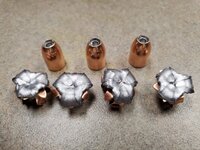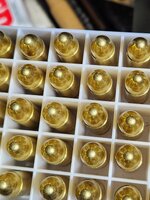





Now that I find myself with numerous .380 pistols, I decided to try some of them out. I have some boxes of factory ammo, but of course being a reloader, I couldn't resist the challenge. Lately I've been prowling around on ebay seeing if there were any deals on dies. Yes, I could just buy the Lee starter set for under $40. These days, I'm taking an interest in steel pistol dies, kind of a reversion of practice. Because using steel dies results in the truest resizing of the case. Carbide or nitride dies have the advantage of eliminating lubing cases but they don't give the best finished product due to the taper that most cartridge cases have.


Anyway, I finally settled on a 3 die set of vintage Texan dies. Which I've never owned before. This set had the older configuration where die #1 sizes (only); die #2 decaps and flares the case mouth; and die #3 of course seats the bullet. Old school. I've had a set of CH dies in .32-20 that were that system. I've had some older RCBS sets that were like this as well. The dies came in the mail. They looked like new. I had a few clean .380 cases for setting up the dies. It didn't work out. No matter what adjustment I made, the flaring plug (stem mounted) would bottom out before it flared. That part of the plug that does an expansion of the case to accept the bullet was over expanding. I finally decided that the plug was wrong. I think this die set had a flaring plug for a .38 Special die set. Not .380 ACP. That would explain both issues.
Another issue cropped up as well. The die bodies were too short to work well in my Lee Classic Cast press, which has a tall "O". Great for having enough room for doing .30-06, and contemporary dies of all calibers have bodies long enough to not be an issue. I guess in years gone by, the die bodies were typically shorter. Or at least the threated part that screws into the press.
Now the dies are packed up and waiting for the mailman to pick them up for return to the seller. I think I'll just go ahead and send for a cheap set of Lee carbide dies, good enough for my purposes. I've ordered and received a 500 count bag of .380 95 gr. FMJ bullets from Rocky Mountain Reloading. Then I sent for a 500 count bag of pulled bullet primed aluminum cases, also from RMR. I think those were $60. I figured at today's prices, the primers alone would cost $40 plus.

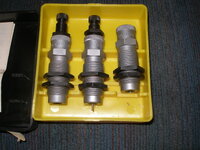
Anyway, I finally settled on a 3 die set of vintage Texan dies. Which I've never owned before. This set had the older configuration where die #1 sizes (only); die #2 decaps and flares the case mouth; and die #3 of course seats the bullet. Old school. I've had a set of CH dies in .32-20 that were that system. I've had some older RCBS sets that were like this as well. The dies came in the mail. They looked like new. I had a few clean .380 cases for setting up the dies. It didn't work out. No matter what adjustment I made, the flaring plug (stem mounted) would bottom out before it flared. That part of the plug that does an expansion of the case to accept the bullet was over expanding. I finally decided that the plug was wrong. I think this die set had a flaring plug for a .38 Special die set. Not .380 ACP. That would explain both issues.
Another issue cropped up as well. The die bodies were too short to work well in my Lee Classic Cast press, which has a tall "O". Great for having enough room for doing .30-06, and contemporary dies of all calibers have bodies long enough to not be an issue. I guess in years gone by, the die bodies were typically shorter. Or at least the threated part that screws into the press.
Now the dies are packed up and waiting for the mailman to pick them up for return to the seller. I think I'll just go ahead and send for a cheap set of Lee carbide dies, good enough for my purposes. I've ordered and received a 500 count bag of .380 95 gr. FMJ bullets from Rocky Mountain Reloading. Then I sent for a 500 count bag of pulled bullet primed aluminum cases, also from RMR. I think those were $60. I figured at today's prices, the primers alone would cost $40 plus.