


JavaScript is disabled
Our website requires JavaScript to function properly. For a better experience, please enable JavaScript in your browser settings before proceeding.
Messages
9,404
Reactions
19,572
Now that I find myself with numerous .380 pistols, I decided to try some of them out. I have some boxes of factory ammo, but of course being a reloader, I couldn't resist the challenge. Lately I've been prowling around on ebay seeing if there were any deals on dies. Yes, I could just buy the Lee starter set for under $40. These days, I'm taking an interest in steel pistol dies, kind of a reversion of practice. Because using steel dies results in the truest resizing of the case. Carbide or nitride dies have the advantage of eliminating lubing cases but they don't give the best finished product due to the taper that most cartridge cases have.

P3192821.JPG P3192822.JPG

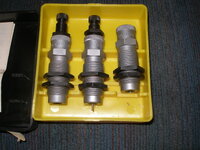
Anyway, I finally settled on a 3 die set of vintage Texan dies. Which I've never owned before. This set had the older configuration where die #1 sizes (only); die #2 decaps and flares the case mouth; and die #3 of course seats the bullet. Old school. I've had a set of CH dies in .32-20 that were that system. I've had some older RCBS sets that were like this as well. The dies came in the mail. They looked like new. I had a few clean .380 cases for setting up the dies. It didn't work out. No matter what adjustment I made, the flaring plug (stem mounted) would bottom out before it flared. That part of the plug that does an expansion of the case to accept the bullet was over expanding. I finally decided that the plug was wrong. I think this die set had a flaring plug for a .38 Special die set. Not .380 ACP. That would explain both issues.

Another issue cropped up as well. The die bodies were too short to work well in my Lee Classic Cast press, which has a tall "O". Great for having enough room for doing .30-06, and contemporary dies of all calibers have bodies long enough to not be an issue. I guess in years gone by, the die bodies were typically shorter. Or at least the threated part that screws into the press.

Now the dies are packed up and waiting for the mailman to pick them up for return to the seller. I think I'll just go ahead and send for a cheap set of Lee carbide dies, good enough for my purposes. I've ordered and received a 500 count bag of .380 95 gr. FMJ bullets from Rocky Mountain Reloading. Then I sent for a 500 count bag of pulled bullet primed aluminum cases, also from RMR. I think those were $60. I figured at today's prices, the primers alone would cost $40 plus.
 
Congratulations on the latest addition to your reloading habit hobby! I've reloaded .380 for a bit using 115 grain bullets that I have on hand for 9mm purposes versus buying a separate bullet for it. I would recommend getting the Lee Deluxe pistol die set as it will include the Factory Crimp die. Many of my reloads will have a slight bulge in the case from the bullet and wouldn't go into a size checker until I ran it through the Factory Crimp die. The bulges seem to cause no issue once sized with the Factory Crimp die. I'm using 3.5 grains of True Blue (slightly under max listed at Hodgdon Reloading website of 3.8). I haven't chronographed the load so can't provide any info on that aspect but they seem to shoot fine enough for that caliber.

Not sure what is going on with your previous dies as usually you can adjust out the issues by threading the dies in/out along with the decapping/inside neck expander threaded rod.
 
Too bad its all boxed. I'd be curious to see dims on the expander mandrel. If memory serves me right, most flaring mandrels do so within 3/8" of the bottom of the mandrel.

Not saying you're silly or don't know, I'd be interested to have seen what you were up against. I have a classic cast and I can use any of my dies in it, the bodies are the same length for the most part since some calibers require you to bottom out the die at the top of the up-stroke.

Really bizarre.

:-(
 
Not saying you're silly or don't know, I'd be interested to have seen what you were up against. I have a classic cast and I can use any of my dies in it, the bodies are the same length for the most part since some calibers require you to bottom out the die at the top of the up-stroke.
My Classic Cast press works no problem with contemporary dies of any make. All of which have threads far enough up the die body to lower it deep enough to work. The Texan die body threads didn't have enough depth for this adjustment.

I'd be curious to see dims on the expander mandrel. If memory serves me right, most flaring mandrels do so within 3/8" of the bottom of the mandrel.
The #2 die in this set had a decapping pin on the end of the flaring mandrel. Which was mounted on a threaded rod. I removed the decapping pin for die set-up. But the nose of the mandrel was the same length with the pin removed. The nose of the mandrel would bottom out in the bottom of the case before it would flare the mouth.

The design of the mandrel was such that it would size the inside of the case to a set diameter prior to the flare. The result of this showed s distinct oversizing of the inside of the case. Since .38 Special is typically about .002 larger than .380 ACP, these two problems caused me to think the mandrel was for .38 Special, not .380.

I've reloaded .380 for a bit using 115 grain bullets that I have on hand for 9mm purposes versus buying a separate bullet for it.
My thinking is the reverse. That is, I can shoot the 95 grain bullets in 9mm Luger pistols if need be.

I would recommend getting the Lee Deluxe pistol die set as it will include the Factory Crimp die. Many of my reloads will have a slight bulge in the case from the bullet and wouldn't go into a size checker until I ran it through the Factory Crimp die.
This is probably good advice. Which I will likely follow. I've already decided to buy a Lee set; the extra $ for the fourth die may be well spent.

I've already gotten the idea over the years that .380 ACP is one of those loadings whose cases can vary a lot by manufacturer. That was a real headache years ago when I fooled around reloading .32 ACP. Rims varied and case wall thickness was all over the place. I guess the smaller the case, the amount of variation is amplified.

My pal Dave left me a bunch of ammo, including 9mm Luger stuff. There was one box of 50 Winchester, dated to 1970's. I've used some of those to test fire guns. After resizing, the cases won't hold a bullet they are so thin.
 
It sounds like you're saying the Texan die was decapping and flaring at the same time? Very odd? I think most of the pistol dies that I'm aware of size and decap on first die and then flare on second die (the Lee's I have all allow for powder add on the flaring of case neck step through the die). All my Hornady pistol dies have a second die for flaring but don't allow that same powder addition through the die. My Dillon Square B for pistol cartridges only (uses proprietary dies) also flares and adds powder on the same die. I don't have any RCBS (or other manufacturers dies) for pistol but I gather they all behave the same as the Hornady version.


My thinking is the reverse. That is, I can shoot the 95 grain bullets in 9mm Luger pistols if need be.
Five on one hand, ten on the other...I shoot way more 9mm than .380 so it makes more sense for me the other way. Plus I'm recently going the other direction for my 9mm reloading. I used to use 115 grain bullets but now stepping to 124's for a couple of reasons.

1. I got a great deal on bulk RMR 124 grain Nukes from @misterarman and
2. The general internet consensus indicates 124 grain is the best choice (it's on the internet...it must be true) for balance of recoil and power.

RMR 124 grain Nukes:

1742725644041.jpeg
 
It sounds like you're saying the Texan die was decapping and flaring at the same time? Very odd? I think most of the pistol dies that I'm aware of size and decap on first die and then flare on second die (the Lee's I have all allow for powder add on the flaring of case neck step through the die). All my Hornady pistol dies have a second die for flaring but don't allow that same powder addition through the die. My Dillon Square B for pistol cartridges only (uses proprietary dies) also flares and adds powder on the same die. I don't have any RCBS (or other manufacturers dies) for pistol but I gather they all behave the same as the Hornady version.


Five on one hand, ten on the other...I shoot way more 9mm than .380 so it makes more sense for me the other way. Plus I'm recently going the other direction for my 9mm reloading. I used to use 115 grain bullets but now stepping to 124's for a couple of reasons.

1. I got a great deal on bulk RMR 124 grain Nukes from @misterarman and
2. The general internet consensus indicates 124 grain is the best choice (it's on the internet...it must be true) for balance of recoil and power.

RMR 124 grain Nukes:

View attachment 2061105
Old dog, new tricks.
I just learned like last year that the earlier RCBS pistol dies flared and Sized with the same die.
 
Many of my reloads will have a slight bulge in the case from the bullet and wouldn't go into a size checker until I ran it through the Factory Crimp die. The bulges seem to cause no issue once sized with the Factory Crimp die.
I wonder if the brass you're having an issue with has a taper on the inside, where the brass gets thicker as it gets closer to the base. Have you tried seating the 115's at maximum cartridge length, so they're not so deep in the case?
 
I wonder if the brass you're having an issue with has a taper on the inside, where the brass gets thicker as it gets closer to the base. Have you tried seating the 115's at maximum cartridge length, so they're not so deep in the case?
There's definitely no visible taper but it could be that reason as not all brass has this bulge. I'm at the listed COAL for 115 grain bullets. Once it's ran through the Factory Crimp die and it chambers and seems to cause zero issue with shooting and reloading the case, I lost interest in finding the cause. I know I've found range 9mm brass cases that you can see a ridge internally where the brass gets thinner closer to the neck, usually about 1/4" down, and I don't reload those for reasons found on the interwebs along with certain brands of brass (I think these might be for subsonic rounds but not positive).
 
It sounds like you're saying the Texan die was decapping and flaring at the same time? Very odd?
This was not uncommon on older dies sets as I mentioned in my original post.

The flaring dies with the powder through feature didn't come along until progressive machines came into vogue.

I wonder if the brass you're having an issue with has a taper on the inside, where the brass gets thicker as it gets closer to the base. Have you tried seating the 115's at maximum cartridge length, so they're not so deep in the case?
Thicker interior wall of the case is usual on modern brass but it's in the area closer to the head where support tends to be less. The thickening should never be in the mouth end where some expanders size to a given measurement.

Some flaring die designs do not try to expand the case to some nominal size. Lee is an example. Those just open up the case mouth with a flare, the interior sizing is what it is. Others have a sizing surface on the end of a mandrel that pre-sizes the bullet contact area and flares, like a Lyman M die. Material thickness of the case has everything to do with whether you get a bulge or not. This is why I separate cases by brand, even 9mm. Because brass thickness affects bullet tension. Which in turn affects pressure. It's my view that cartridges that go off with relatively uniform pressure may tend to be more accurate. Not that it probably matters all the much with 9mm.

Re. the Lee Factory Crimp Die for pistol. Finished cartridges that won't fit the chamber due to bulge, the FCD is simply crushing them down to fit. I'm guessing rounds so finished will have a bit higher pressures than those that weren't. But again I say, it probably doesn't matter with .380 ACP. I don't think the Lee FCD for pistols can crush them down enough to present safety issues.

9mm Luger has in my experience been a cartridge that can present bulge from bullet seating more often than most others. For one thing, the bullet must be concentrically aligned as it goes into the case mouth. A seating stem that does the best alignment job is recommended. The other thing is, pre-sizing of the case mouth to accept the bullet is important because of the taper of the 9mm case. Even if the bullet is properly aligned to enter the case, if the case interior isn't pre-sized, the bullet often wants to go on an eccentric angle. Long ago I quit using the powder-through 9mm Lee flaring die for this reason. I use a Lyman M die for this work which usually eliminates bullet seating bulge.
 
Finished cartridges that won't fit the chamber due to bulge, the FCD is simply crushing them down to fit. I'm guessing rounds so finished will have a bit higher pressures than those that weren't.
The Lee FCD doesn't seat the bullet or change its length so not sure why the pressure will change.

From the interwebs:
  • Crimp Type:
    • Auto Pistols: The CFCD applies a taper crimp, which compresses a longer section of the case mouth around the bullet.

    • Revolvers: For revolver cartridges, the CFCD applies a roll crimp, rolling the case mouth into the bullet.
  • Post-Sizing:
    The CFCD features a carbide sizing ring that sizes the finished cartridge as it is withdrawn from the die. This ensures that the cartridge will chamber correctly, even if there are minor case bulges or irregularities.

  • Benefits:
    • Consistent Crimp: The CFCD provides a consistent and reliable crimp, ensuring that the bullet is held firmly in place.

    • Improved Chambering: The post-sizing feature ensures that the cartridge will chamber properly.

    • Reduced Feed Problems: The crimp helps prevent the bullet from coming loose during feeding, cycling, and firing.
  • Adjustability:
    The degree of crimp can be adjusted by turning the knob on the top of the die.

  • Not a bullet seating die
    The CFCD does not seat the bullet, it is used after the bullet has been seated.
 
The Lee FCD doesn't seat the bullet or change its length so not sure why the pressure will change.
Greater friction from increased sidewall pressure on the bullet. It takes more pressure to expel a bullet that is held more firmly in place.

For the above reason, Lee's claim of "consistent" crimp isn't necessarily true. Because if you use mixed brass, they are bound to vary.
 
I reload a lot of 380 (and a lot of 40 and 45). Thought I would share my most significant take-away from reloading 380 ACP.

All three cartridges are known for getting bulges at the case head, especially if shot from a barrel with a chamber that doesn't provide full support of the case (like Glock pistols - and I shoot a lot of Glocks). But bulging happens consistently with 380 ACP, even is shot from a barrel with a well supported chamber.

If this bulge isn't taken out of the case, it won't feed completely into the chamber. Or, if it feeds, it won't extract after the shot because the bulge that was there to begin with has expanded even more during the ignition and thus, gets stuck in the chamber and won't extract.

@bpyycpyy provided an excellent explanation on how the Lee Factory Crimp Die (LFCD) works for both pistol rounds and revolver rounds.

I have to run all of my 45, 40 and 380 through the LFCD to make sure they will pass my gauge test (I gauge 100% of my reloaded rounds).

I load so much of these three calibers that I bought the Lee Bulge Buster Kit so I can quickly de-bulge a large quantity of cases before or after they're clean. This kit uses the LFCD (but the LFCD does not come with the kit - you have to buy the specific caliber LCFD separately). With this method, I don't have to have a station for the LFCD during the progressive reloading process.

Downside to the Bulge Buster Kit is that it adds another step in brass preparation. For me - it's worth it, because I've experienced so many problems when I haven't bulge-busted brass for these three calibers (or used the LFCD as the last station in my progressive press).

Anyway, my main point here is that 380 ACP case head bulges are normal if not dealt with during the reloading process, will result in your rounds not feeding, chambering and/or extracting with reliability.

My 2 cents.

TWYLALTR

Cheers.
 
I have been eliminating the Lee FCD.
Threw the .357sig awsy after I blew 2 guns up.
Second was catastrophic.
Switched to Dillon seating and crimping and have never made such beautiful ammo.

Started having trouble with a back up 9mm toolhead with the Lee FCD and switched to an RCBS seating die with no stem in it so just using it to crimp and I'm making beautiful ammo again that case gauges beautifully as I case gauge everything as well.
Not a fan of Lee.
Don't know what the problem was with them but eliminated them and also eliminated the problem.
I have also been known to shoot a Glock like every week and I have never had an issue with "Glock bulge".
Don't know if it's because of brand of brass or because I don't shoot the same brass forever.
 
I have been eliminating the Lee FCD.
Threw the .357sig awsy after I blew 2 guns up.
Second was catastrophic.
Switched to Dillon seating and crimping and have never made such beautiful ammo.

Started having trouble with a back up 9mm toolhead with the Lee FCD and switched to an RCBS seating die with no stem in it so just using it to crimp and I'm making beautiful ammo again that case gauges beautifully as I case gauge everything as well.
Not a fan of Lee.
Don't know what the problem was with them but eliminated them and also eliminated the problem.
I have also been known to shoot a Glock like every week and I have never had an issue with "Glock bulge".
Don't know if it's because of brand of brass or because I don't shoot the same brass forever.

1000018640.jpg 1000018641.jpg
 
@bpyycpyy provided an excellent explanation on how the Lee Factory Crimp Die (LFCD) works for both pistol rounds and revolver rounds.
My impression from his post was that he was referring to the bulge experienced in the forward end of the case from bullet seating. Not the bulge near the head from unsupported cases. But he may be talking about the base bulge problem as well.


I have also been known to shoot a Glock like every week and I have never had an issue with "Glock bulge".
I don't shoot every week but my experience with a Glock is the same, never seen a case bulge from shooting it.

I reload a lot of 380 (and a lot of 40 and 45). Thought I would share my most significant take-away from reloading 380 ACP.

All three cartridges are known for getting bulges at the case head, especially if shot from a barrel with a chamber that doesn't provide full support of the case (like Glock pistols - and I shoot a lot of Glocks). But bulging happens consistently with 380 ACP, even is shot from a barrel with a well supported chamber.
I've loaded .45 ACP for years, never had the issue. I've loaded .380 in the past and it was never a problem for me. Long before the Bulge Buster was invented. I had a couple of .40's, a Ruger and a Glock 23, I never noticed any bulged cases. But then again, I don't load at or near the top end. It stands to reason that pressure has something to do with this issue. The .380 is a rather small cartridge; trying to wring too much performance out of it might lead to bulged fired cases.

I will observe what happens when I commence loading .380 again. Which will be at moderate levels. Which is all I expect of a .380, actually. I don't expect high performance out of it.

As I said previously, I may buy the Lee .380 four die set just to have the FCD. In the event of some seated bullet deformities. But this is a situation separate from bulged bases. I've got a couple of Lee FCD pistol dies in other calibers. My experience was that whenever I ran a group of cartridges through them, it was unnecessary. So I guess I was doing everything right before it got to that stage. Not to sound smug, that's just my experience with the FCS tools. Because I've had my share aplenty of doing things wrong and doing them over.
 
It sounds like you're saying the Texan die was decapping and flaring at the same time? Very odd?

I think most of the pistol dies that I'm aware of size and decap on first die and then flare on second die (the Lee's I have all allow for powder add on the flaring of case neck step through the die). All my Hornady pistol dies have a second die for flaring but don't allow that same powder addition through the die. My Dillon Square B for pistol cartridges only (uses proprietary dies) also flares and adds powder on the same die. I don't have any RCBS (or other manufacturers dies) for pistol but I gather they all behave the same as the Hornady version.
The older RCBS pistol dies the resizer die did not deprime, there was no depriming stem in the resizer die.

The decapping pin was in the flare die.
I have a couple of these older RCBS die sets.


I have an older set of C&H dies that will not work in my Hornady Lock & Load single-stage presd, not enough threads to screw it down far enough to work.

I'm not a big Lee follower, i do like a few of their products but could care less about most of their low quality items.
 
I'm not a big Lee follower, i do like a few of their products but could care less about most of their low quality items.

I agree with that most of their stuff is cheaply made.
I tend to have Lee dies for cartridges that I don't load or shoot that often. I like Hornady well enough, actually prefer RCBS. The latter two of which have gotten pricey.

I don't always use all three brand original dies in a set. I might mix them up during process, depending on what I prefer. I have been known to have multiple sets of dies in the same caliber in different brands to deal with case variations.

I don't like the flaring die on Hornady pistol sets. Lyman dies mostly suck but I like the M dies. Redding, a bit expensive and every set I've owned had some little nuanced difference about it. I have a few CH dies (before they sold and became CH/4D) and I like those. Dillon dies, very nice but pricey.

I would say I'm surprised the Chinese haven't gotten into the game, but if I'm not mistaken some RCBS production comes from there now.

I really like my Lee Classic Cast press. It's at least as good as the RCBS that I used previously, and has a larger "O" opening.

I've always preferred the Lee Auto Prime tools. At present, I use the Auto Bench Prime which is perfect for the problems I have with my hands. I've had the RCBS hand-held tool, it was awkward for me and time-consuming to change shell holders. I have an old RCBS one-at-a-time bench priming tool, it works well but is slow. The on-press priming arms supplied with the Lee Classic Cast press work well enough but of course are slow. I use those for onesies and twosies.

Other Lee stuff I don't use. Their powder thrower is cheap looking but I can't say I've used one so it may work okay. Their beam scales always looked bad compared to the RCBS I used before I went digital. Again, maybe it's okay but... The aluminum presses aren't for me.

The Lee Load All press for shot shells was mostly a waste of money.

When I was still casting bullets, I had a Lee bottom pour lead casting pot. It wasn't very expensive and it worked well enough for my limited use. I wasn't casting lots of bullets at a time, maybe 100 or so in a run. It's hard to compare Lee molds to steel molds. I've owned and used both with success.

I've tried and ditched a lot of gear. The Lyman turret press was whippy and no good. I bought one of those Forster coaxial presses that are supposed to be the Bee's Knees. I didn't like the process. I had a Dillon 550 press which I ran for a year or two. It was fiddly and boring. I wanted to enjoy what I was doing, not get into an industrial operation so I got rid of it. I like their dies, though. So I went back to single stage completely which I find more enjoyable.
 

Upcoming Events

Back Top