


JavaScript is disabled
Our website requires JavaScript to function properly. For a better experience, please enable JavaScript in your browser settings before proceeding.
Messages
19,599
Reactions
35,707
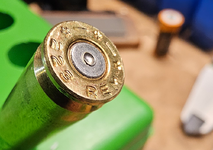
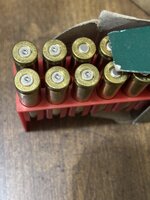
I need to revisit some thoughts on pressure signs, specifically primer cratering. I'm revisiting a handload I never got decent accuracy from; for a 223 using a 60gn Hammer Hunter bullet but now using different brass. Accuracy looks promising with a 5 round group under 1moa... but, there is a little cratering around the firing pin mark on the primer. No other pressure signs.

Would primer cratering alone be a concern?

(click pic to enlarge)
1740964314686.png
Edit: Starline brass, CCI400 primer, A2520, 60gn Hammer Hunter.
 
Last Edited:
Rifle? I have a Remington 700 SPS Varmint that cratered primers on factory loads out of the box. Decades later, it still does. Best guess is a sloppy fit of the firing pin to the bolt. Apparently can be fixed by bushing the bolt with a proper sized aperture, but I never bothered. It does it more noticeably with CCI-400 and Federal 205 primers than with CCI-450, No. 41's or RP 7 1/2's.
 
Those are known softer primers and show pressure signs earlier than others.
I feel like thats whats going on here but want to be sure. No other pressure signs. I dont mind backing down but also dont feel like this is overcharged.
"feel"... :/

Here's another pic, tried to find the worst example... some others arent even noticeable so maybe the inconsistency is suggesting its just a soft primer issue?

1740968376288.png
 
You could always try CCI 41's, they have a harder cup and I believe are the same priming charge as the 400's
I have about 2500 CCI400s on hand so not likely finding the motivation to switch primers. I don't mind backing down if needed but so far thinking Im ok.
 
Go to a military or magnum primer or back down about a grain and a half. That primer looks a little flat too.

Cratering is not the tell all but it's not something to ignore either.

What's the chronograph say your speed is?
 
Go to a military or magnum primer or back down about a grain and a half. That primer looks a little flat too.

Cratering is not the tell all but it's not something to ignore either.

What's the chronograph say your speed is?
Gotta be honest I'm not seeing any flatness that bothers me if at all. No edge rolling or gas marks escaping on the primer sides (Ive already decapped these). I examine all case head and primers for pressure signs using a jewlers loupe. I'll see if I can get a picture from the side thru the loupe but thats a balancing act with my cell phone... :p
I'm not ignoring it but just have not experienced -only- cratering when Ive hit pressure, especially without really flat primers. I don't mind backing down but found an accuracy node in my OCW test.

Average velocity is 3130fps. Note Hammer bullets tent to get more velocity due to their drive band design.
 
What I might do is another OCW test backed down at least a full grain charge weight, see if I find an accuracy node and compare velocities. I'll redo the node I found this weekend to see if its consistent.

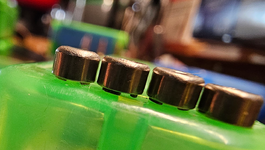
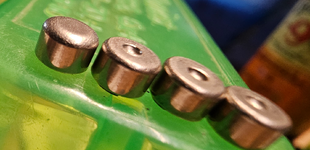
zoom pics from side. The one on the left is unfired. The two on the far right have no cratering... its the inconsistency that suggests its just soft primers, probably approaching max perhaps.
1740972003052.png


1740972127957.png
 
You didn't say what your load is or if your load is shown in any loading manuals.
Me? I get a little concerned when I see a pronounced "ring" around the firing pin indentation.
That shows that the metal is extruding into the firing pin aperture in the bolt.
The #41 primers were designed to prevent slam fires with heavy steel firing pins in full-auto fire, not to cover-up high pressures.
Nothing is gained trying for that last 50>100fps.
 
You didn't say what your load is or if your load is shown in any loading manuals.
Me? I get a little concerned when I see a pronounced "ring" around the firing pin indentation.
That shows that the metal is extruding into the firing pin aperture in the bolt.
The #41 primers were designed to prevent slam fires with heavy steel firing pins in full-auto fire, not to cover-up high pressures.
Nothing is gained trying for that last 50>100fps.
I did in my first post, 60gn Hammer Hunter with A2520. This was an OCW test so I tested the following charge weights, 5rds each: 27gn, 27.2, 27.4, 27.6. all had some with cratering, others were fine. 27.4 was sub moa, 27.6 was close.
There is no published load data for this powder with this bullet. Though there is similar powders from Hammers website data and I'm definitely pushing the velocity so that was a good reminder, thank you. I'll back down a bit and rerun the OCW test and see if I can find another accuracy node.
 
Here are a couple photos of my primers that were under maximum load data from my Remington 700. As I said before, it has been doing this since new, still doing it after thousands of rounds. Still shoots pretty good groups, although velocity has tailed off a bit….

IMG_0249.jpeg IMG_0248.jpeg
 
I need to revisit some thoughts on pressure signs, specifically primer cratering. I'm revisiting a handload I never got decent accuracy from; for a 223 using a 60gn Hammer Hunter bullet but now using different brass. Accuracy looks promising with a 5 round group under 1moa... but, there is a little cratering around the firing pin mark on the primer. No other pressure signs.

Would primer cratering alone be a concern?

(click pic to enlarge)
View attachment 2047341
Edit: Starline brass, CCI400 primer, A2520, 60gn Hammer Hunter.
I've seen way worse cratering with primers completely unflattened due to firing pin being too small and or the hole giggity being too large.
 

Upcoming Events

New Classified Ads

Back Top