


JavaScript is disabled
Our website requires JavaScript to function properly. For a better experience, please enable JavaScript in your browser settings before proceeding.
Messages
27
Reactions
25
hello, i'm doing some research into jacketed, vs monolithic ammo, and i would like to know what types of bullets have the greatest expansion when hitting a target.

to my understanding monolithic copper bullets do not really deform or expand when hitting a target, and that obviously jacketed hollow points are fantastic for expanding and transferring energy to a target.

so if those are true, my question is, what about monolithic lead bullets? do they expand very good? how do you guys feel about that?

between jacketed, copper, and lead bullets, how do they all behave when it comes to expanding when the bullet hit's a target?

thank you
 
The questions you are asking lead to more questions in return.

What kind of target...?

Some bullets perform better from certain barrel lengths and rifling twist rates...

Distance from the target may play a role here....

As will barriers between you and the target...

How many layers of clothing or fur / hide / etc.....are there...?

And....no matter what kind of bullet...bullets at times will do weird things when they hit flesh.

It may be better to narrow down your questions over
What type of target...
And specific types of bullets* and firearms.
Andy

* As in just what type of hollow point or solid / what type of jacketed bullet / what brand / etc...

Edit to add....
All of my pure lead round balls have been "pass throughs" at various game animals.
Some of the round balls I have recovered...and they did expand.
Distances vary between 30 ish...and 150ish yards.
 
Last Edited:
hello, i'm doing some research into jacketed, vs monolithic ammo, and i would like to know what types of bullets have the greatest expansion when hitting a target.

to my understanding monolithic copper bullets do not really deform or expand when hitting a target, and that obviously jacketed hollow points are fantastic for expanding and transferring energy to a target.

so if those are true, my question is, what about monolithic lead bullets? do they expand very good? how do you guys feel about that?

between jacketed, copper, and lead bullets, how do they all behave when it comes to expanding when the bullet hit's a target?

thank you
All this has been explored ad naseum on YouTube. Gel tests, metal/glass/other barrier tests, human torso and head facsimile tests, barrier plus gel tests (also oddball tests such as concrete, drywall, or wood) . YouTube is your friend for this.
 
Monolithic lead? Cast boolits?
Clip On Wheel Weight (COWW) alloy versus STICK on Wheel Weight (SOWW) alloy?
At pistol velocity COWW tends to shatter on steel targets, while SOWW tend to bounce.

Joe
 
To my understanding jacketed are great for expansion and transferring energy while monolithic don't expand as much but are awesome for deep penetration which makes them ideal for hunting big game. Leads being softer do expand pretty well but they're not as controlled as jacketed ones, so they work better at lower speeds or with older firearms. It really depends on what you're using them for.
 
Some will change their EDC gear for different seasons; heavier calibers for winter when heavy clothing is worn and lighter calibers during summer. Or change from harder lead for deeper penetration.

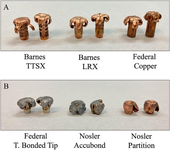
Not all non-leaded projectile retain its shape. There are full copper projectiles which expand (i.e Barnes TSX & Tac-TX, Hornady CX, etc.) When using cast lead bullets, it depends upon the hardness of the lead and the shape of the projectile.

Too many varibales; use, caliber, weather, etc.
 
You're asking about bullet behavior on target, which is good. But you seem to be making an assumption that the behavior is a simple function of the material in the bullet. Focus instead on the design of the bullet. For example, jacketed lead core bullets can be designed to expand barely at all, expand in a slower controlled manner (penetrating deeper), or expand rapidly (penetrating less though with more explosive effect). All-copper monolithic bullets can also be designed in different ways for different effects. Bullets tend to be designed for a particular function - maybe good deer bullet within a particular range vs. good elk bullet, or whatever. It's unclear from your question what you're really looking for, making it difficult to respond directly.
 
All-copper monolithic bullets can also be designed in different ways for different effects.
Yes, there are many fancy solid copper bullets that are designed to expand in evil ways.

I haven't fired any into human tissue yet, but Hornady makes some bulk swaged lead bullets that are .358 hollow point semi wad cutters. I imagine that they expand well at less than +P .38 Special velocities but I don't have any science to prove it.
 
All-copper monolithic bullets can also be designed in different ways for different effects.
so wait, it is true that copper as a metal material is much much MUCH harder then virtually all possible forms of lead?

is it true that the weakest alloy of copper is dramatically harder then the strongest alloy of lead? or is that not correct?
 
is it true that the weakest alloy of copper is dramatically harder then the strongest alloy of lead? or is that not correc
That's a question that has been obviated by bullet design.
Do your research - there is a large amount of published data on the lethality of mono bullets on game. Start at Hammer Bullets for Links.
The same goes for jacketed, frangible bullets on humans in warfare - you can find the military studies if you dig deep enough.
 
That's a question that has been obviated by bullet design.
Do your research - there is a large amount of published data on the lethality of mono bullets on game. Start at Hammer Bullets for Links.
The same goes for jacketed, frangible bullets on humans in warfare - you can find the military studies if you dig deep enough.
Agree with P7M13, do your research. Select some videos that do comparable gel and other media testing for the round you are interested in and you will learn a ton in a very short time. Or do as suggested and read studies, etc. TONS of info is out there.

It's much better to start from a solid base of knowledge then to ask general, super basic questions that will take everyone tons of time to answer each Q individually.
 
This might be a god read for you: https://www.sciencedirect.com/science/article/pii/S0048969723049136

1732115208121.png
 
hello, i'm doing some research into jacketed, vs monolithic ammo, and i would like to know what types of bullets have the greatest expansion when hitting a target.

to my understanding monolithic copper bullets do not really deform or expand when hitting a target, and that obviously jacketed hollow points are fantastic for expanding and transferring energy to a target.

so if those are true, my question is, what about monolithic lead bullets? do they expand very good? how do you guys feel about that?

between jacketed, copper, and lead bullets, how do they all behave when it comes to expanding when the bullet hit's a target?

thank you
What do you intend to hunt and in what kind of country/terrain?
 
so wait, it is true that copper as a metal material is much much MUCH harder then virtually all possible forms of lead?

is it true that the weakest alloy of copper is dramatically harder then the strongest alloy of lead? or is that not correct?
In terms of ammunition, the Brinell scale is used. the higher the value, the harder the material. A copper jacket has a hardness 80+ BHN. The hardest lead composition considered in this field is 'Keith Elmer' hardness which is about 18 BHN. The lead composition for cast is usually made of lead, tin and antimony. Adding more antimony usually makes the BHN higher but making it too hard it becomes brittle.

A person who casts their own bullets will know more about this.

Monolithic bullets is either flutted exterior or hollow point. Flutted bullets do damage due to its shape. Underwood defender/penetrator, Lehigh defense, G9 defense are examples. Hollow points open up with the expanding petals to do damage. Hornady CX and Barnes T/TSX are examples. Shape, design, weight (mass), etc. plays critial roles in monolithic bullets considering its usually lighter and harder than lead composite.
 

Upcoming Events

New Classified Ads

Back Top